Every day, we find the historical story hiding inside the headlines. Riveting narratives
that connect the past to the present, and make you wonder what happens next.
Choose your topics
You'll receive one email per topic, per day. Pick as many as you like.
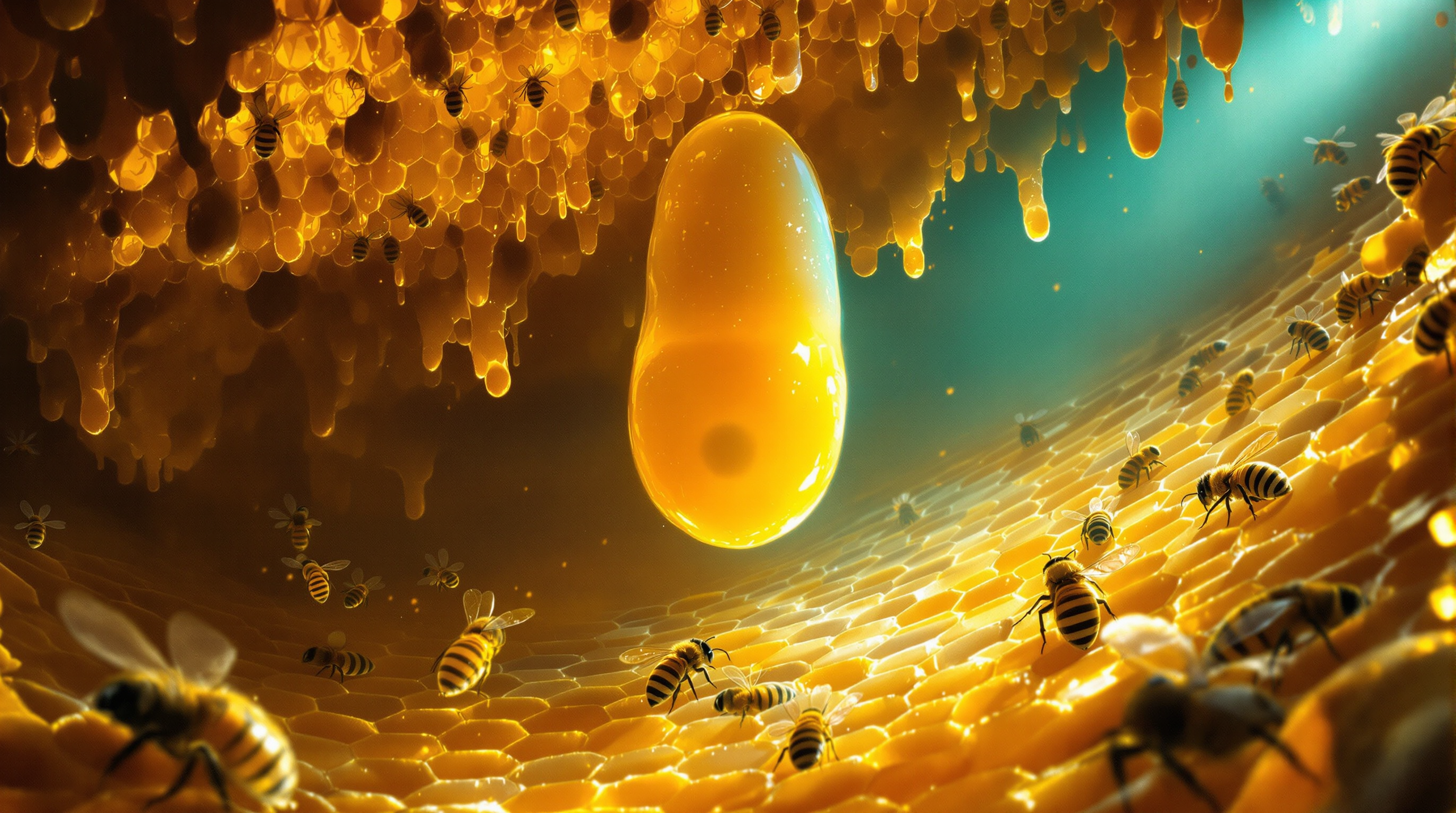
Queen and worker bees hatch from identical eggs, yet one lives for years and lays a million eggs while the others live for weeks and never breed. For a century the textbook answer was a single food: royal jelly. In 2026 a team at UC Riverside showed the real answer is grander. Specialised worker bees build the queen a palace: a peanut-shaped 'royal crib' of custom wax with its own chemistry, and they cluster to keep it warm. Raise a would-be queen in ordinary wax instead and she develops poorly and often dies. The jelly feeds her; the crib crowns her. We love a story with one secret ingredient. Nature almost never works that way.
•3 min readIn 2026 a team at the University of California, Riverside (its Center for Integrative Bee Research) showed that royal jelly alone does not make a queen: the environment does much of the work. A specialised caste of young worker bees acts as royal builders, constructing the large peanut-shaped 'royal crib' from a custom wax that is softer, melts at a higher temperature, and carries a distinct chemical signature of fatty acids and signals, and they alter their own physiology to raise the temperature around the cell, like underfloor heating. Crucially, when would-be queens were raised in ordinary worker-cell wax instead of the royal crib, the larvae developed poorly and many died: they needed the 'smell and feel' of the royal wax to transform at all. So queen determination is a whole system, diet plus architecture, temperature and wax chemistry plus the labour of many bees, not a single ingredient. It is a recurring lesson in biology: we love single-cause stories (one gene, one molecule, one food), but nature's marvels are usually built from many small causes acting together. A queen is built, not dosed.
Pasadena, 29 March 1974: a 42-year-old Caltech geologist named Bruce Murray watches the first close-up photograph of Mercury appear frame-by-frame on the Mariner 10 imaging-team console at JPL. Mercury turns out to be a thoroughly cratered airless rock. Fifty-two years later, a Harvard-Smithsonian and Max Planck team using JWST mid-infrared spectroscopy looks at LHS 3844 b, a super-Earth 48 light-years away, and finds the same thing.
•5 min readOn 4 May 2026 a multi-institution team led by Sebastian Zieba (Harvard-Smithsonian Center for Astrophysics) and Laura Kreidberg (Max Planck Institute for Astronomy, Heidelberg) published in Nature Astronomy 'The dark and featureless surface of rocky exoplanet LHS 3844 b from JWST mid-infrared spectroscopy.' Using more than 100 hours of JWST MIRI thermal-emission spectroscopy at multiple orbital phases of the tidally-locked super-Earth, the team ruled out any thick atmosphere on LHS 3844 b (with 5-sigma upper limits of 100 mbar bulk gas and 3-sigma upper limits of 10 microbars on spectroscopically active species like SO2) and identified the surface as a dark, space-weathered basalt similar in spectral character to Mercury and the lunar maria. It is the first JWST result to directly characterise the surface of a rocky exoplanet rather than its atmosphere. Mariner 10's airless cratered Mercury, 52 years later, has become the first identifiable category of object in the small-rocky-exoplanet population.
1890 to 1921, Viborg in central Jutland Denmark and the spread of bird ringing through northern Europe
Viborg, Denmark, the breeding season of 1899: a Danish classics master named Hans Christian Cornelius Mortensen fits 165 starlings with home-made aluminium leg rings, stamped with his school address and an individual number. It is the first scientific bird ringing. 127 years later a Royal Society Open Science paper reads the same principle off the natural fluke pigmentation of two humpback whales that crossed 14,000 km of ocean between Australia and Brazil.
•4 min readOn 1 May 2026, in Royal Society Open Science (vol 13 issue 5 article 260251), a multi-institution team led by Cristina Castro Ayala of the Instituto Aqualie in Brazil and Ted Cheeseman of the citizen-science platform Happy Whale published 'First evidence of bidirectional exchange between distant humpback whale breeding populations in eastern Australia and Brazil.' Working from a 19,283-photograph database of humpback whale tail-flukes collected between 1984 and 2025 and cross-matched by an automated image-recognition algorithm with manual confirmation, the team confirmed two individual humpback whales had each crossed approximately 14,200 km and 15,100 km of open ocean between sightings in the Australian and Brazilian breeding grounds. The crossings represent approximately 0.01 percent of identified individuals and are the first documented bidirectional exchange between those two populations. The underlying principle, that an individual animal's permanent unique mark (an aluminium ring in 1899, a natural fluke pigmentation pattern in 2026) can be used to track its movements at scale, is the principle Mortensen invented at his kitchen table.
1665 to 1672, Woolsthorpe Manor in Lincolnshire and Trinity College Cambridge during and after the plague-year closure
Summer 1666, Woolsthorpe Manor in Lincolnshire: Cambridge is closed by plague and the 23-year-old Isaac Newton drills a hole in his bedroom shutter, puts a prism in the beam of sunlight, and concludes that white light contains all the colours. Three hundred and sixty years later, a Xiamen laboratory feeds the same sunlight through a different crystal and shows it also contains Bell-violating quantum entanglement.
•5 min readOn 24 April 2026 a team led by Wuhong Zhang and Lixiang Chen at the College of Physical Science and Technology at Xiamen University published in Advanced Photonics 'Sunlight-excited spontaneous parametric down-conversion for ghost imaging.' They used a sun-tracking heliostat and a 20-metre multimode optical fibre to feed ordinary incoherent sunlight into a periodically poled potassium titanyl phosphate (PPKTP) nonlinear crystal that split individual sunlight photons into entangled pairs. An independent team at the Max Planck Institute for the Science of Light and the University of Ottawa (including Robert W. Boyd) reported on arXiv that the sunlight-generated pairs violate Bell's inequality with S=2.54, comfortably above the classical bound. The sunlight Newton dispersed through a prism in 1666 turns out to also contain measurable Bell-violating quantum entanglement, free of charge, and has been arriving at Earth's surface for as long as the sun has been shining.
1848 to 1862, the Bates and Wallace Amazon expedition and the Linnean Society of London
London, 21 November 1861: Henry Walter Bates reads a paper before the Linnean Society describing the strangest thing he saw in eleven years on the Amazon, unrelated butterflies converging on the same warning colours. He calls it mimicry. The mechanism takes 164 years to find: in May 2026 a Wellcome Sanger team identifies two genes, ivory and optix, that Lepidoptera have been re-using for the same job for 120 million years.
•5 min readOn 2 May 2026 an international team led by the Wellcome Sanger Institute and the University of York published in PLOS Biology 'Genetic parallelism underpins convergent mimicry coloration in Lepidoptera across 120 million years of evolution.' Working from whole-genome sequencing of seven species of Heliconius and Ithomiini butterflies and a day-flying Chetone moth, the team showed that across 120 million years of independent evolution Lepidoptera have re-used the same two genes, ivory and optix, to produce convergent warning-colour patterns. The protein-coding sequences are conserved; the evolution sits in the regulatory switches. One moth species deploys the genes via a chromosomal inversion identical in orientation to one independently evolved by a butterfly lineage millions of years earlier. The space of viable genomic solutions to the Batesian-mimicry problem is small, and lineages 120 million years apart reach for the same tools.
1987 to 2012, Bourakebougou village in southwestern Mali
Bourakebougou, Mali, 1987: a drilling crew sinks a water well, hits a gas they cannot identify, and accidentally lights it with a cigarette. The well is capped and forgotten for twenty-four years. Today it produces 98 percent pure hydrogen and powers a Malian village. Last week a Toronto team measured the same chemistry 2.4 kilometres beneath northern Ontario, suggesting a planet-scale clean-energy resource.
•4 min readOn 19 May 2026 a team led by Barbara Sherwood Lollar of the University of Toronto, with collaborators at the University of Ottawa, published in PNAS the first sustained, long-duration direct measurement of natural hydrogen discharging from billion-year-old Canadian Shield rocks. The monitoring instrument was parked 2.4 kilometres beneath the surface at the Kidd Creek copper-zinc mine in northern Ontario. The data show continuous geological hydrogen generation at depth, captured in fracture water and released at a stable rate over months. This re-classifies natural ('white' or 'gold') hydrogen from a Mali curiosity into a continuous planetary process operating wherever the geology is right, roughly 15 percent of Earth's continental crust. Active exploration leases are now pegged across Australia, France, Spain, Albania, the US Mid-Continent rift, the Canadian Shield, and parts of West Africa.
1866 to 1892, from Carl Culmann's Zurich engineering school to Julius Wolff's orthopaedic clinic in Berlin
Berlin, 1892: the Prussian surgeon Julius Wolff publishes a law claiming bones actively remodel themselves in response to mechanical load. The proposition was treated as a pretty analogy for nearly a century. Last month a laboratory in Trieste found the same principle, in a different organ, is the reason the heart almost never gets cancer.
•5 min readOn 24 April 2026 a team led by Giulio Ciucci at the International Centre for Genetic Engineering and Biotechnology in Trieste published in Science 'Mechanical load inhibits cancer growth in mouse and human hearts.' Using a heterotopic-heart-transplant model that separated blood supply from mechanical pumping, the team showed that cancer cells proliferate aggressively in non-beating hearts but replace only about 20 percent of the tissue in beating ones. The mechanism: Nesprin-2, a component of the LINC complex in the outer nuclear membrane, senses the pressure pulse of each heartbeat, transmits the signal to the nucleus, reduces histone methylation and chromatin compaction at proliferation-related genetic loci, and brakes cancer-cell division. The proposition that you might one day prescribe a heartbeat to a tumour is no longer absurd.
1974 to 1978, Hadar and the Afar Triangle of northeastern Ethiopia
Hadar, Ethiopia, 24 November 1974: a 31-year-old American paleoanthropologist named Donald Johanson spotted a small arm-bone fragment in a dry watercourse in the Afar badlands and pulled forty per cent of Lucy out of the dust. For fifty years the textbook picture was a line from her species to ours. The new Ledi-Geraru and Mille-Logya fossils have turned the line into a small grove of cousins.
•5 min readIn August 2025 a team led by Brian Villmoare reported in Nature 13 hominin teeth from the Ledi-Geraru site in the Afar showing early Homo at 2.78 and 2.59 Mya and a previously unknown Australopithecus species at 2.63 Mya. In January 2026 a team led by Zeresenay Alemseged at the University of Chicago reported in Nature the first Paranthropus jaw ever recovered from the Afar (MLP-3000), 1,000 km north of the genus' previous northernmost occurrence. Up to four hominin lineages coexisted in eastern Africa between 3.0 and 2.5 million years ago. The line is now a tree.
1900 to 1930, the Institute of Pathological Anatomy in Vienna, Mount Sinai Hospital in New York, and the Karolinska Institutet in Stockholm
Vienna, 1900: a thirty-two-year-old physician named Karl Landsteiner pricked the fingers of his lab colleagues, mixed every serum with every set of red blood cells, and discovered that the chemistry the immune system was reading was sugar chemistry on the surfaces of cells. He had found the ABO blood groups. This month, the Max Planck Institute for the Science of Light has published the first nanometre-scale atlas of the entire sugar code on every kind of human cell.
•5 min readA May 2026 Nature Nanotechnology paper by Möckl and colleagues at the Max Planck Institute for the Science of Light in Erlangen introduces Glycan Atlasing, a technique that combines DNA-tagged lectins, metabolic oligosaccharide engineering and super-resolution microscopy to map every glycan on the surface of a cell at nanometre resolution; the technique distinguishes cancerous from healthy tissue and tracks immune-cell activation by the spatial pattern of sugars alone.
1781 to 1822, Bath, Datchet, and Slough in late-Georgian England
Bath, 13 March 1781: a German-born church organist named William Herschel accidentally discovered Uranus through a home-made seven-foot telescope in his back garden. Four years later he and his sister Caroline read a paper to the Royal Society arguing that the Milky Way was a disc-shaped system of stars, the first attempt in human history to map cosmic structure. In May 2026 the James Webb Space Telescope just published the clearest map of the cosmic web ever made.
•5 min readOn 6 May 2026 the JWST COSMOS-Web collaboration published in The Astrophysical Journal the largest and highest-resolution map ever made of the cosmic web of dark-matter filaments, based on a quarter of a million galaxies in a 0.54-square-degree patch of sky reaching back to less than a billion years after the Big Bang; the same week, the European Southern Observatory's VLT released the first sharp direct image ever taken of a single cosmic filament (a 3-million-light-year strand of intergalactic gas connecting two quasars).
1815 to 1816, Sumbawa Island, Lake Geneva, and the northern hemisphere
In April 1815, the volcano of Tambora in Indonesia produced the largest eruption in recorded human history; the summer that followed killed harvests across two hemispheres and produced Frankenstein at Lake Geneva. In May 2026, atmospheric chemists at Copenhagen and the Acacia lab have shown that the 2022 Hunga Tonga eruption scrubbed 900 tonnes of methane a day from the upper atmosphere by a chemistry no model had predicted. The atmosphere is still surprising the chemists.
•6 min readA May 2026 Nature Communications paper by van Herpen, Johnson et al. (Acacia Impact Innovation Lab + University of Copenhagen) shows that the 2022 Hunga Tonga-Hunga Ha'apai underwater eruption injected seawater into the stratosphere that combined with volcanic ash and ultraviolet light to generate reactive chlorine, oxidising atmospheric methane at 900 ± 220 tonnes per day. The atmosphere did something none of the contemporary models had predicted: a complex-system surprise on the opposite side of the ledger from Tambora.