Every day, we find the historical story hiding inside the headlines. Riveting narratives
that connect the past to the present, and make you wonder what happens next.
Choose your topics
You'll receive one email per topic, per day. Pick as many as you like.
Today's Echo · History & Current Events
1922 to 1928, the British Empire and the United States
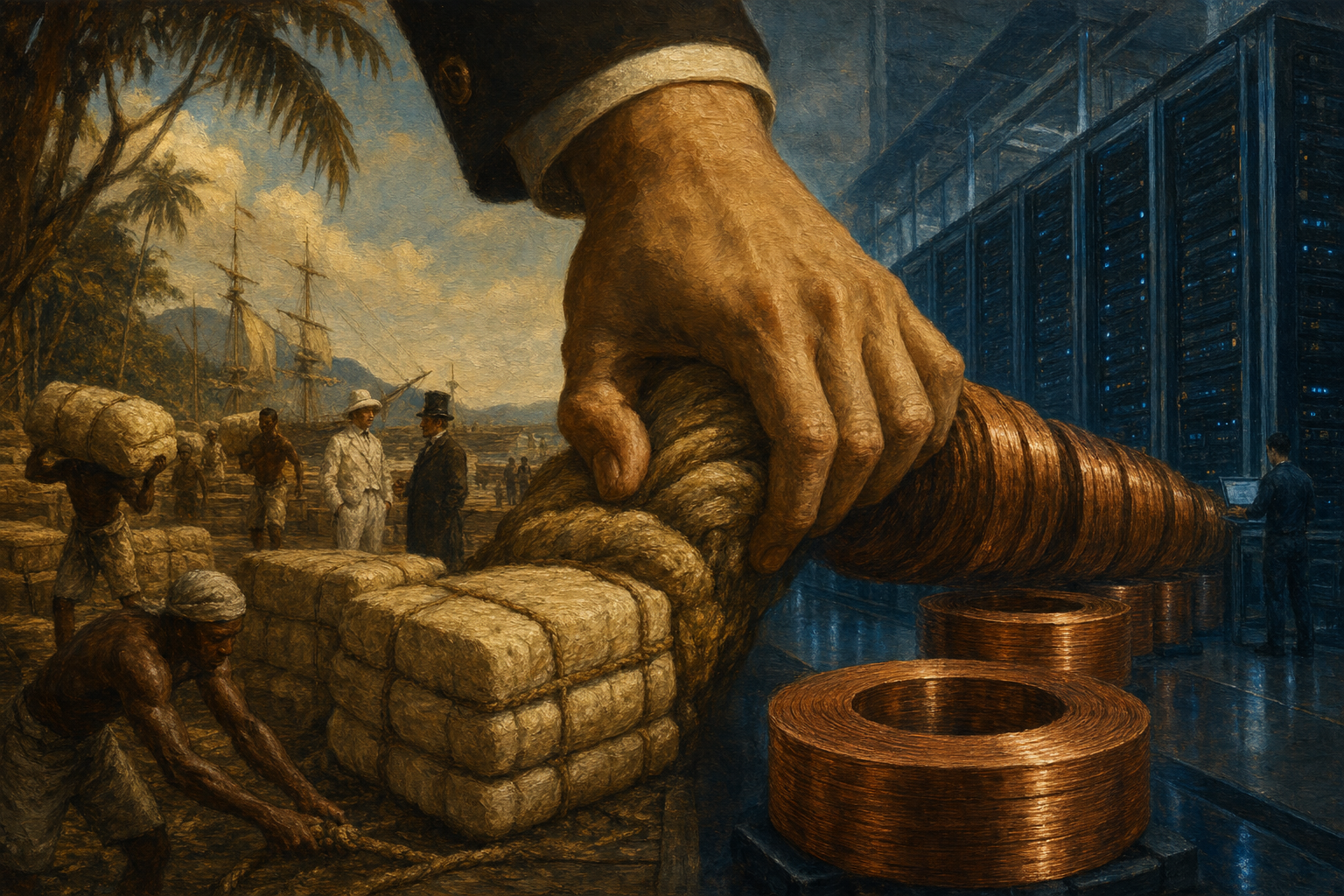
In 1925 the most valuable thing in America was a milky sap from trees on the far side of the world. Rubber ran every car, factory and phone line, Britain's colonies grew about three quarters of it, and Britain had just choked the supply: the Stevenson Plan restricted exports to drive the price from around thirteen cents a pound past a dollar. America, which bought most of the world's rubber, did not just pay. Commerce Secretary Herbert Hoover funded a global hunt for new supply, Harvey Firestone planted a million acres of Liberia, chemists chased synthetic rubber, and the cartel collapsed when the Dutch refused to join and flooded the market. Squeeze a customer hard enough and you do not make him pay; you teach him to never need you again. A century later it is copper for AI data centres and China's grip on rare earths, and the same scramble has begun.
•3 min readA century later the same dynamic has returned with metal instead of sap. The lifeblood of the AI age is copper (a single large AI-ready data centre can require up to about 50,000 tonnes) and rare earth elements used in magnets, motors and weapons. Analysts forecast a structural refined-copper deficit (J.P. Morgan projecting roughly 330,000 tonnes for 2026), with new mines averaging about 17.9 years from discovery to production. The choke point is as lopsided as rubber was in 1925: China processes around 90 percent of the world's rare earths and has used that control as leverage, prohibiting exports of gallium and germanium to the US from December 2024 and adding medium and heavy rare earths and magnets to its export-control list through 2025. Washington's response could have been written by Hoover: in February 2026 it launched a Strategic Critical Minerals Reserve (Project Vault), backed by a $10 billion EXIM loan, and pressed a global search for friendly supply, recycling and substitutes. The lesson of the rubber war is not that a choke point is permanent but the opposite: squeeze a customer hard enough and you teach him, and everyone watching, how to make sure he never needs you again.
On 19 February 1881 the New York Times explained, deadpan, how the telegraph would seduce the earth's currents, shift the poles, tip the planet off its axis, and throw the solar system into catastrophe. It was mocking a prophecy made in earnest. For two thousand four hundred years, from Socrates on writing to a bandmaster on the phonograph, every new machine has arrived to the same announcement of the end of the world. Now it is artificial intelligence's turn, and some of the men who built it are the ones predicting extinction.
•6 min readThe 2025-2026 argument over artificial-intelligence 'doom' repeats the same apocalyptic register at maximum stakes. In October 2025 more than 2,000 people, including AI 'godfathers' Geoffrey Hinton and Yoshua Bengio and Apple co-founder Steve Wozniak, signed a public statement calling for a prohibition on developing superintelligence until it can be proven safe, citing the risk of human extinction. Hinton now puts the chance that AI causes human extinction within thirty years at 10 to 20 percent; Bengio warns the race for AI dominance could create machines with self-preservation goals of their own. The structural rhyme is exact: a new information technology met with the prediction that it will not merely disrupt us but end us. The historical record suggests the genre of total catastrophe is almost always wrong, while the quieter prediction that the technology will change us in unforeseen ways is almost always right.
In 421 BC, exhausted Athens and Sparta signed a peace meant to last fifty years. It lasted six, and the six years of peace destroyed Athens more thoroughly than the ten years of war that came before. In June 2026, the United States and Iran announced a sixty-day ceasefire to negotiate a final agreement. The Peace of Nicias is the warning about what a truce really is.
•5 min readOn 11 June 2026, after months of open war between the United States and Iran, President Trump announced a 60-day ceasefire intended to give the two sides time to negotiate the contentious issues toward a final agreement. The negotiations centre on the same kind of fault lines that doomed the Peace of Nicias: control of a vital chokepoint, the Strait of Hormuz (through which much of the world's oil passes), and the role of regional proxies, with Iran tying any broader agreement to a halt in Israeli operations in Lebanon. It is a truce between exhausted enemies who do not trust each other, whose allies and proxies are not bound by it, and who can use the quiet to rearm: structurally, the shape of the Peace of Nicias rather than the shape of a peace.
In February 1948, Czechoslovakia, the last working democracy in Eastern Europe, was swallowed by the Soviet bloc in three weeks, without a single tank crossing the border. Two weeks later its foreign minister was found dead beneath a window. The lesson was brutal: a small state in a great power's orbit does not get to choose. On 7 June 2026, Armenia tried to vote the other way, steering out of Russia's orbit toward Europe despite a covert Russian campaign to stop it. The two stories run in opposite directions, which is exactly why they rhyme.
•4 min readOn 7 June 2026 Armenia, for a generation Russia's closest ally in the South Caucasus (hosting a Russian base and belonging to Moscow's security alliance), held a parliamentary election that became a referendum on its attempt to climb out of Russia's orbit toward the European Union, a pivot Prime Minister Nikol Pashinyan had accelerated after Moscow stood aside during Armenia's 2023 loss of Nagorno-Karabakh. Western intelligence officials and international observers described a broad Russian covert interference campaign, disinformation, money and support for pro-Russian candidates, and Putin had pressured Pashinyan in April 2026 to allow a jailed pro-Russian tycoon to run. This time the pressure did not fully work: Pashinyan's Civil Contract won about 49.8 percent and a majority of roughly 64 of 105 seats, but fell short of the two-thirds needed for the constitutional referendum tied to a lasting peace with Azerbaijan, leaving Armenia still caught in the same vice that crushed Czechoslovakia, a small democracy hemmed in by a larger neighbour that does not accept its right to choose its own friends.
On 23 August 1958, Communist China opened fire on two specks of rock two miles off its coast, Quemoy and Matsu, and for a few weeks the world's first serious nuclear crisis turned on whether America would fight for them. Eisenhower found a way to answer without ending the world. Sixty-eight years later, China's largest war games yet sent the coast guard circling the very same islands, now spelled Kinmen and Matsu, rehearsing a blockade. History did not just rhyme. It chose the exact same two islands.
•4 min readAt the end of December 2025 China conducted its largest exercises yet around Taiwan (Justice Mission 2025), with the China Coast Guard patrolling and encircling the same outer islands of Kinmen (Quemoy) and Matsu, closing to within about 1.3 to 1.6 nautical miles, while all 84 scheduled flights between Taiwan and the islands were suspended, affecting roughly 6,000 travelers. Analysts assessed the drills as a rehearsal for a blockade meant to choke off Taiwan's shipping and energy and prevent outside aid, escalating the Fourth Taiwan Strait Crisis. The pressure is being applied first at the very islands Mao shelled in 1958, and the deliberate ambiguity that held the line for a generation is wearing thin.
In 1847 a freshman congressman named Abraham Lincoln demanded that President Polk point to the exact spot where, as Polk claimed, Mexico had shed American blood on American soil to justify a war. The blood, Lincoln argued, was spilled on disputed ground the President had marched troops into on purpose. The gesture was ignored, it was mocked as Spotty Lincoln, and it helped end his career. In June 2026, the House voted 215 to 208 to limit the President's power to wage the undeclared war on Iran. He called it meaningless. So was the spot.
•5 min readOn 3 June 2026 the US House of Representatives voted 215 to 208 to pass a war powers resolution directing President Trump to end American hostilities with Iran, the first time such a measure cleared a chamber on a final vote since the war began in late February following US strikes on Iran's nuclear sites. Four Republicans (Thomas Massie, Brian Fitzpatrick, Tom Barrett and Warren Davidson) crossed the aisle. The vote is largely symbolic: the Senate has not passed its own version, a veto is expected, and the administration argues the 1973 War Powers Resolution is itself unconstitutional. Trump called the vote 'meaningless.' The episode revives a 178-year-old constitutional question about whether a president can take the country to war on his own judgment, and whether the legislature can stop him.
In 1881 revolutionaries killed Tsar Alexander II, the reformer who had freed the serfs and who had signed Russia's first proto-constitution that very morning, certain his death would open the door to freedom. Instead it brought his harder son, the secret police, and decades of reaction. In 2026, a regime-change war has killed Iran's supreme leader, and the Revolutionary Guards have installed his son and tightened a harder, more militarised grip. The lesson of the canal is cold: the surest way to empower a dead man's hardest heirs is to kill him.
•4 min readThe 2026 US-Israeli regime-change war on Iran, the killing of Supreme Leader Ali Khamenei, and the Revolutionary Guards' installation of his son Mojtaba amid a shift of power to the military-security apparatus.
In 964 the warrior-emperor Nikephoros Phokas, conqueror of Crete, Cyprus and Antioch, tried to make the Byzantine Church share the burden of the empire's defence: he curbed the tax-exempt, service-exempt monasteries and asked that fallen soldiers be honoured as martyrs. The Church refused, he was murdered, and his law was undone. A thousand years later, Israel is fighting almost exactly the same battle over the ultra-Orthodox draft exemption, and history offers a sobering note: the exemption tends to outlive the reformer.
•4 min readIsrael's 2026 crisis over ending the ultra-Orthodox (Haredi) exemption from military conscription, pitting the Supreme Court and a war-weary public against the religious community and the parties that protect it.
Around the year 410, with the legions gone, the Western emperor sent word that Rome could no longer defend Britain: see to your own defence. The abandoned province improvised, hiring Saxon mercenaries who soon turned on their employers and took the island. In 2026, as the United States pulls troops from Germany and floats a NATO without America, Europe is scrambling to build a defence of its own, and the oldest lesson of abandonment is waiting on the wall.
•4 min readPresident Trump's 2026 withdrawal of US forces from Germany and his floating of a NATO without the United States, and Europe's scramble to rearm and build a fallback defence it cannot quickly fully replace.
Boston, June 1768: the Royal Navy tows a smuggling sloop called Liberty out of the harbour and lights a riot. For thirty years Britain had let the colonies smuggle in peace; the day it chose to enforce its trade laws, it began to lose them. In 2026, as Washington walls off Chinese goods and chases the trade as it reroutes through Vietnam and Mexico, the same lesson is waiting on the dock.
•4 min readThe US-China tariff war of 2026 and the rerouting of Chinese trade through third countries such as Vietnam and Mexico, with Washington escalating enforcement against transshipment.
July 1902 to December 1919, from Theodor Herzl's testimony before the British Royal Commission on Alien Immigration to the Aliens Restriction (Amendment) Act that sealed Britain's first peacetime immigration regime into permanent peacetime law
Brussels, 1 June 2026: the EU Commission, Council and Parliament conclude the trilogue on the Pact on Migration and Asylum, creating third-country return hubs and expanded deportation powers. Britain's Aliens Act 1905, the first general peacetime immigration control of the modern British state, built the same architecture for a different generation of refugees, and used it in the 1930s to refuse the children of the people it was first written to keep out.
•8 min readBrussels, 1 June 2026: EU concludes the trilogue on the Pact on Migration and Asylum (in force 12 June), creating third-country return hubs, expanded detention, biometric collection from children, a seven-state safe-country-of-origin list, and a €420M frontline fund.