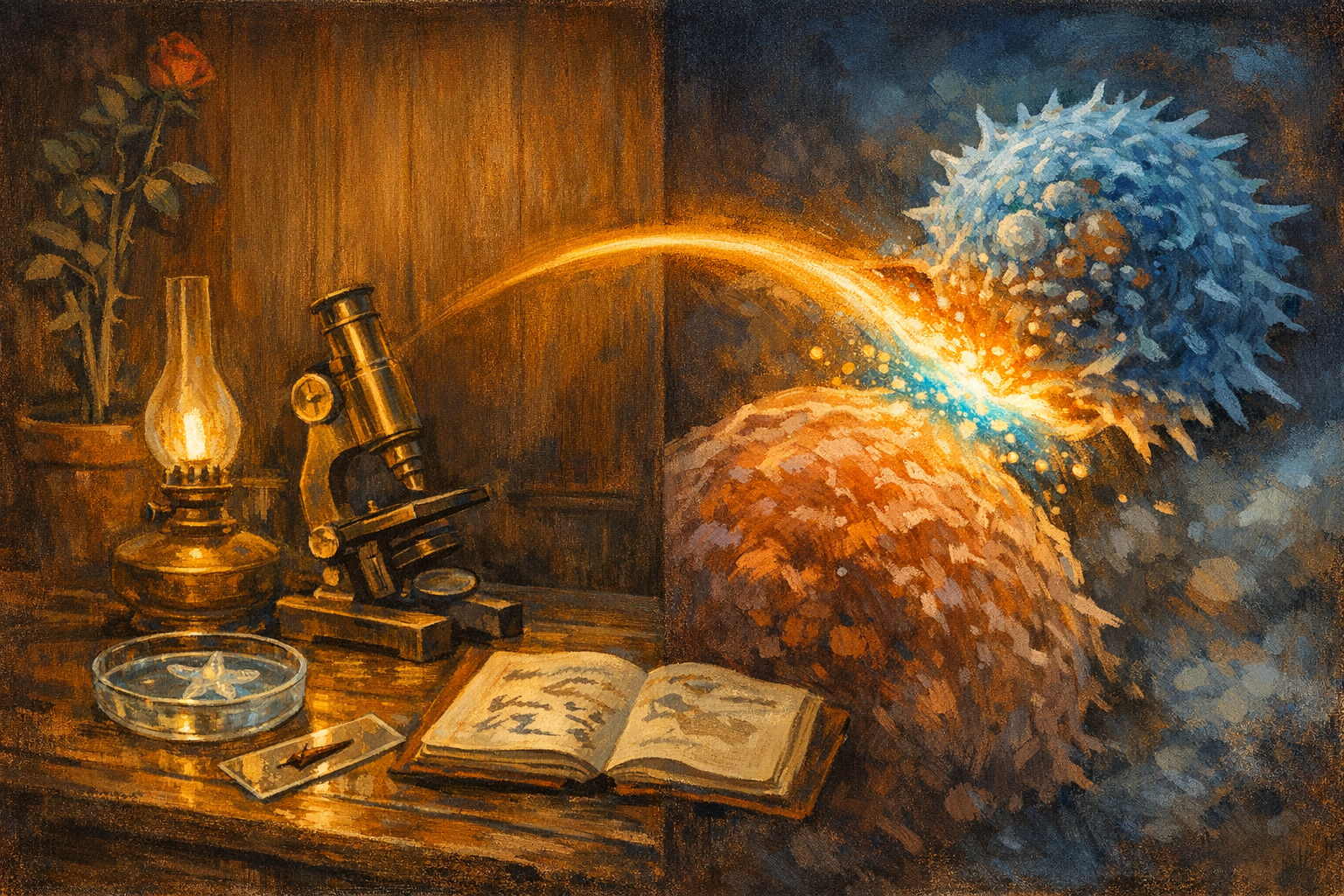
In December 1882, in his lodgings in Messina, Sicily, a 37-year-old Russian zoologist named Élie Metchnikoff was alone for the evening. His wife Olga, her two sisters, and her three brothers had gone into town to see a circus performance. Metchnikoff had stayed home with his microscope.
He had recently resigned his professorship at Odessa University. His country, after the assassination of Tsar Alexander II in 1881, had become unbearable to him. He had twice in his life tried to kill himself: once in 1873, with morphine, after his first wife died of tuberculosis, and once in 1880, by injecting himself with the spirochete of relapsing fever. He had survived both attempts. He had moved to Sicily with Olga to start over in a private laboratory funded by what little he had left.
On his microscope stage that evening was a transparent starfish larva. He had been watching the digestive cells move around inside it when an idea flickered. He went into the garden, broke a thorn off a rose bush, came back, and with his finest needle pushed the thorn through the larva's translucent skin.
By the next morning, dozens of small motile cells had gathered around the thorn and were trying to eat it.
This is Metchnikoff's own retelling, written years later, and historians of immunology have argued about exactly how the night unfolded. What is not in dispute is what came out of it. Metchnikoff had glimpsed something the medical world had not seen and would spend a decade refusing to believe. The cells in the body that ran toward an injury were not failing. They were the army.
Metchnikoff's idea was outrageous in 1882. The reigning theory of how the body resisted disease was chemical. The German school, led by Robert Koch and his pupils, was proving that specific bacteria caused specific diseases, and they were closing in on what Paul Ehrlich would later call humoral immunity: the soluble factors in blood serum, the things we now call antibodies, that bind and neutralise invaders. Immunity, in the German account, was a clever kind of chemistry suspended in fluid.
Metchnikoff was proposing something almost insulting in its biology. He claimed the body's defence was not a chemical but a behaviour. Specific cells, motile and apparently unintelligent, swam toward foreign objects and consumed them whole. He coined the word "phagocytosis," from the Greek for cell-eating. The cells themselves he called phagocytes.
He spent the next decade getting laughed at for it. The Berlin and Paris establishments, deep in the chemistry of toxins and antitoxins, viewed him as a Slavic enthusiast who had wandered into a serious field. When Louis Pasteur invited him to Paris in 1888 and gave him a laboratory at the new Pasteur Institute, the move was widely read as charity from one outsider to another. Metchnikoff worked at the institute for the next twenty-eight years of his life.
Vindication, when it came, was awkward. By the early 1900s, evidence had piled up that both kinds of immunity were real. The body did make soluble antibodies. The body also sent cells to engulf invaders. The two systems worked together: antibodies tagged the enemy, phagocytes ate the tagged enemy. In 1908, Metchnikoff and his old rival Paul Ehrlich shared the Nobel Prize in Physiology or Medicine for their opposed theories, both of which had turned out to be correct.
What Metchnikoff never got to see was the act itself. He had inferred the kill from the gathering of cells around a rose thorn. He could watch phagocytes arrive and the thorn disappear. He could not watch a phagocyte do the actual eating, because he could not see at the scale where it happens. His microscope was a piece of polished glass with delusions of grandeur. The cells were specks. The molecules were unimaginable. Metchnikoff died in July 1916, almost certainly without ever seeing, in any direct sense, the act his thorn had pointed him at.
The Echo
Yesterday, on 29 April 2026, a team led by Florent Lemaître at the University of Geneva and Benita Wolf at Lausanne University Hospital published a paper in Cell Reports showing, in three dimensions, what cytotoxic T cells do to cancer cells at the moment of contact.
The technique is called cryo-expansion microscopy. The team takes immune cells caught in the act of killing a tumour cell and freezes them in milliseconds, fast enough that the water inside the cells does not have time to crystallise. The frozen tissue is then chemically swelled, like a sponge, until distances inside the cell that used to be too small for any optical microscope become visible. What appears, at near-nanometre resolution, is the immunological synapse: the patch of membrane where the killer cell docks against its target, builds a small contact dome, and discharges a packet of poison directly into the other cell's interior. The poison is not delivered through the bloodstream. It is delivered face to face, through a kind of kiss.
This is the act Metchnikoff inferred from a thorn. The cells he saw running toward the wound in a starfish larva were doing exactly what the Geneva paper now shows: making contact, recognising the target, killing it from inside the contact zone. The image he could not get is now a colour photograph.
The paper is being read most carefully by oncologists. Modern cancer immunotherapy works by getting the patient's own T cells to attack their own tumour. Sometimes it works astonishingly well. Sometimes it does not, and the reasons are mostly invisible. With a direct image of the synapse, drug developers can now ask, for the first time, what a successful kiss looks like at the level of the membrane, and why some kisses fail. The answer will change how the next generation of cancer therapies gets designed.
In Messina, while his family was at the circus, the cells ran toward the thorn. In a Geneva lab one hundred and forty-four years later, at a resolution he could not have imagined, the cells are still running. We can finally see what happens when they arrive.