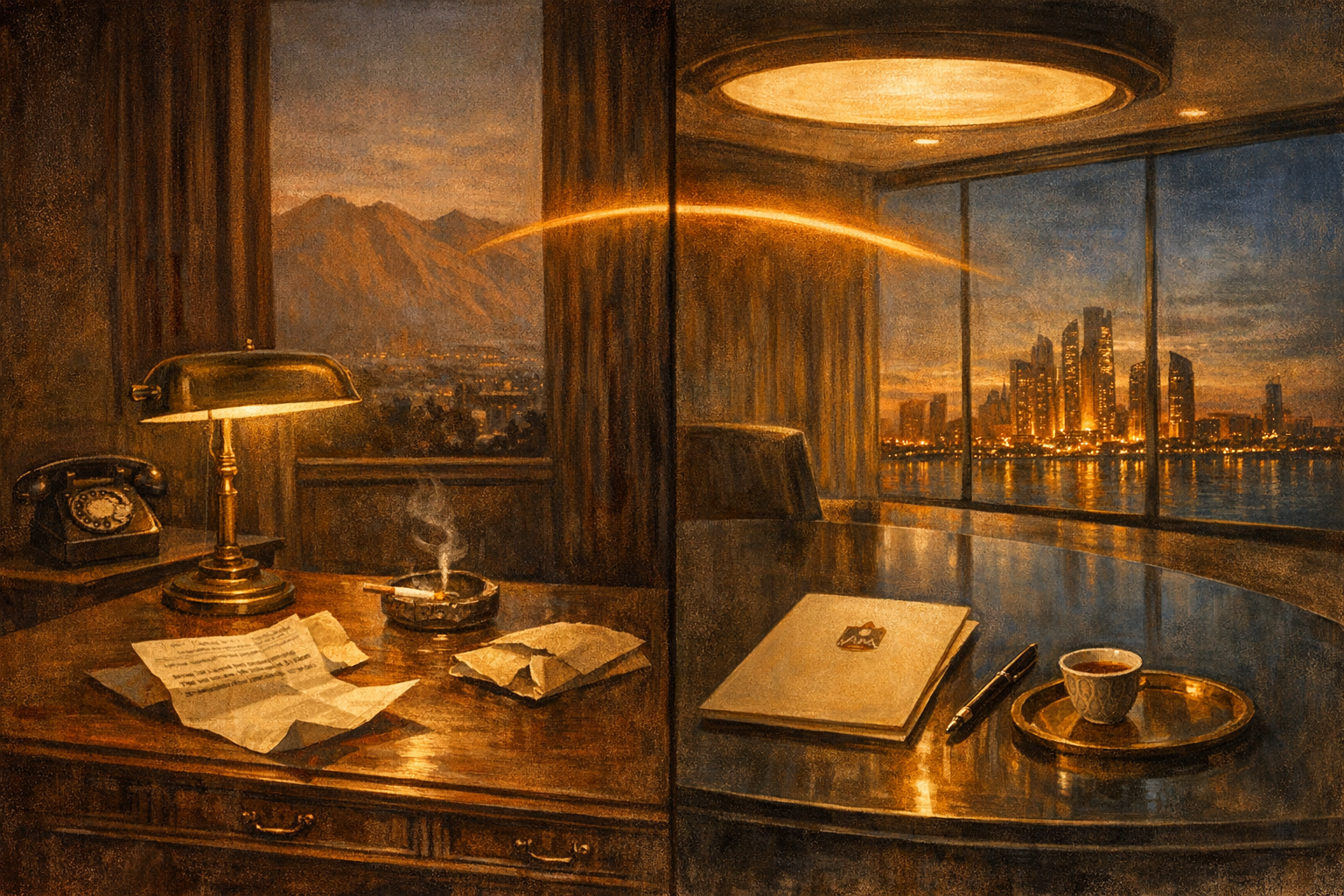
In February 1959, in his office in Caracas, Juan Pablo Pérez Alfonzo opened a cable from London. British Petroleum had cut the posted price of Venezuelan crude. By ten percent. Without consultation. Without warning.
Pérez Alfonzo had not been Venezuela's Minister of Mines and Hydrocarbons for very long. He was a Caracas-born lawyer by training, a former professor of civil law at the Universidad Central, a quiet man in rimless glasses, recently returned from a decade of political exile in the United States and Mexico. He looked, in his thinning hair and his neat double-breasted suit, like a librarian.
What he was, in fact, was a furious librarian.
For most of the twentieth century, the international oil business had been run by a cartel of seven Western multinationals: Standard Oil of New Jersey, Royal Dutch Shell, British Petroleum, Texaco, Gulf, Mobil, and Standard of California. Italian journalists had nicknamed them the Sette Sorelle, the Seven Sisters. Together they pumped more than seventy percent of the petroleum produced outside North America and the Communist bloc, owned almost all the pipelines, and controlled the bulk of the world refining capacity. They posted the prices at which they bought the oil under producing countries' deserts. They set the production quotas. They paid the royalties. The producer states, including Venezuela, were treated as junior partners at best.
The producer states had tried, in the previous decade, to break this arrangement. Iran's Mohammed Mossadegh had nationalised the Anglo-Iranian Oil Company in 1951 and was overthrown two years later by an Anglo-American coup. Mexico had nationalised in 1938 and been embargoed by the majors for a generation. The price of attempting independence in oil had been amply demonstrated.
Pérez Alfonzo had spent his exile thinking about that price, and reading. The model that fascinated him was the Texas Railroad Commission, which since the 1930s had managed Texas oil production through a strict prorationing system, allocating quotas to each well to support prices. If Texas could do it for the United States, he reasoned, why couldn't a coalition of producer states do it for the world?
He needed a partner. He chose Saudi Arabia.
In April 1959, the Arab Petroleum Congress convened in Cairo. Pérez Alfonzo went uninvited, as a Venezuelan observer. He had brought with him a brief, eloquent document outlining a possible "Oil Compact": a producer-state cartel that would set quotas, defend prices, and force the Seven Sisters to consult before posting unilateral cuts.
In Cairo, he found his partner. Sheikh Abdullah Tariki was Saudi Arabia's first oil minister, a Najdi born in Al Zulfi in 1919, the son of a camel caravan organiser and a bedouin mother. He had been educated at Cairo University and the University of Texas at Austin, where he had taken a master's in geology and married an American woman. He had then worked as a geologist for Texaco in California before returning to Saudi Arabia. The journalists called him the Red Sheikh. Like Pérez Alfonzo, he had been making the producer-cartel argument inside his own government for years and being told to be patient.
In a suburb of Cairo called Maadi, the two men signed what came to be called the Maadi Pact. It was a Gentlemen's Agreement, not a treaty. It committed each delegation to lobby their governments to form a producer organisation. Iranian, Iraqi and Kuwaiti delegates added their names.
Then on the ninth of August 1960, Exxon (still officially Standard Oil of New Jersey) announced another unilateral price cut. Up to fourteen cents per barrel, almost eight percent off the posted price.
Within hours, Pérez Alfonzo and Tariki were exchanging telegrams. The Maadi Pact would have to become a real institution, fast.
A month later, on the fourteenth of September 1960, in the Al-Shaab Hall in Baghdad, government representatives from five countries (Venezuela, Saudi Arabia, Iran, Iraq, Kuwait) signed the founding charter of the Organisation of the Petroleum Exporting Countries. OPEC was born as a producer revolt against a cartel of consumer-side intermediaries.
For the next thirteen years, the Seven Sisters laughed at it. OPEC's posted prices were ignored. Production quotas were unenforceable. The new organisation rented an office in Geneva, then moved it to Vienna, and waited.
Then came October 1973. The Yom Kippur War. The Arab oil embargo. OPEC seized the price-setting power for itself, lifted prices fourfold within a year, and rewrote the global economy. The Seven Sisters, who had owned the lion's share of producers' oil revenue in 1960, were by 1980 reduced to operating contractors. The producer states had won.
What had Pérez Alfonzo built? The most consequential cartel in modern economic history. He had transferred trillions of dollars in lifetime rents from consuming countries to producer states. He had given the small petrostates of the Persian Gulf the wealth and confidence to build cities of glass on sand and to buy aircraft carriers from countries they had never planned to fight.
He had also done one other thing.
In 1976, retired and watching his country's oil revenues vanish into mismanagement, currency overvaluation and patronage, Pérez Alfonzo gave an interview that would haunt his reputation. "Ten years from now, twenty years from now, you will see, oil will bring us ruin." Then, quoting an old saying, he called petroleum el excremento del diablo: the devil's excrement. Easy money, he said, was the surest road to failure.
He was right about Venezuela. By the 2020s, the country with the world's largest proved oil reserves had collapsed into hyperinflation, a refugee exodus of seven million citizens, and a gangster state that imported gasoline.
But that is not the punchline. The punchline is that the cartel he built has just started to come apart in exactly the way he built it.
The Echo
On the twenty-eighth of April 2026, the United Arab Emirates announced that on the first of May it would leave OPEC and OPEC+. After fifty-nine years of membership, dating back to Abu Dhabi's accession in 1967.
The UAE's reason was procedurally simple. OPEC's quotas had capped its production at three point two million barrels per day, while it had built capacity to pump close to five million. By 2027 it expects to reach five million barrels of capacity. The cartel that Pérez Alfonzo built to give producer states a say in the price of their oil had become, from the Emirati point of view, a tax on Emirati production. So the UAE did what Venezuela had done in 1960. It walked out of the cartel that constrained it.
The geopolitics matter too. Two decades of sovereign wealth investment, aviation, finance and a deepening alignment with Washington have made the UAE less dependent on oil revenue and less aligned with Saudi Arabia's preferred regional policy. The Iran war has accelerated the divergence. With Iranian drones reaching Abu Dhabi, the UAE no longer trusts that OPEC discipline serves its security as much as autonomy does. As the world begins, slowly, to use less petroleum, Abu Dhabi has chosen to sell as much of its reserves as it can while there is still a buyer.
Saudi Arabia, which built OPEC alongside Venezuela, is now in something close to the position the Seven Sisters were in 1960. Its cartel is being walked out of by a member who thinks it can do better alone. The Saudi response so far has been muted: public commitments to discipline, private signs of fury.
If history rhymes, the next phase is not a graceful divorce. The UAE, freed from quotas, will pump aggressively to fund its post-oil transition. Other constrained members (Iraq, Kazakhstan, Algeria) will do the maths and consider following. Saudi Arabia, the only remaining producer with major spare capacity, will face a choice as old as oil cartels: defend prices by cutting alone, and watch its market share shrink. Or open the taps and crash the price, as Sheikh Yamani did in 1985, and let the smaller producers blink first.
Pérez Alfonzo, who lived long enough to regret the wealth he had brought home, would have recognised the moment. The cartel he founded was always going to fracture when one of its members decided that its individual interest had outgrown the collective. That was what he had done to the Seven Sisters in 1959. That is what the UAE has done to OPEC in 2026.
He warned the world about the curse of oil. He did not warn it about the curse of cartels.
Last time, the breakup transferred trillions to producer states, and helped fuel two oil shocks, two recessions, and a continent of petrostates.
This time, the breakup is on the producer-state side.
What comes next?