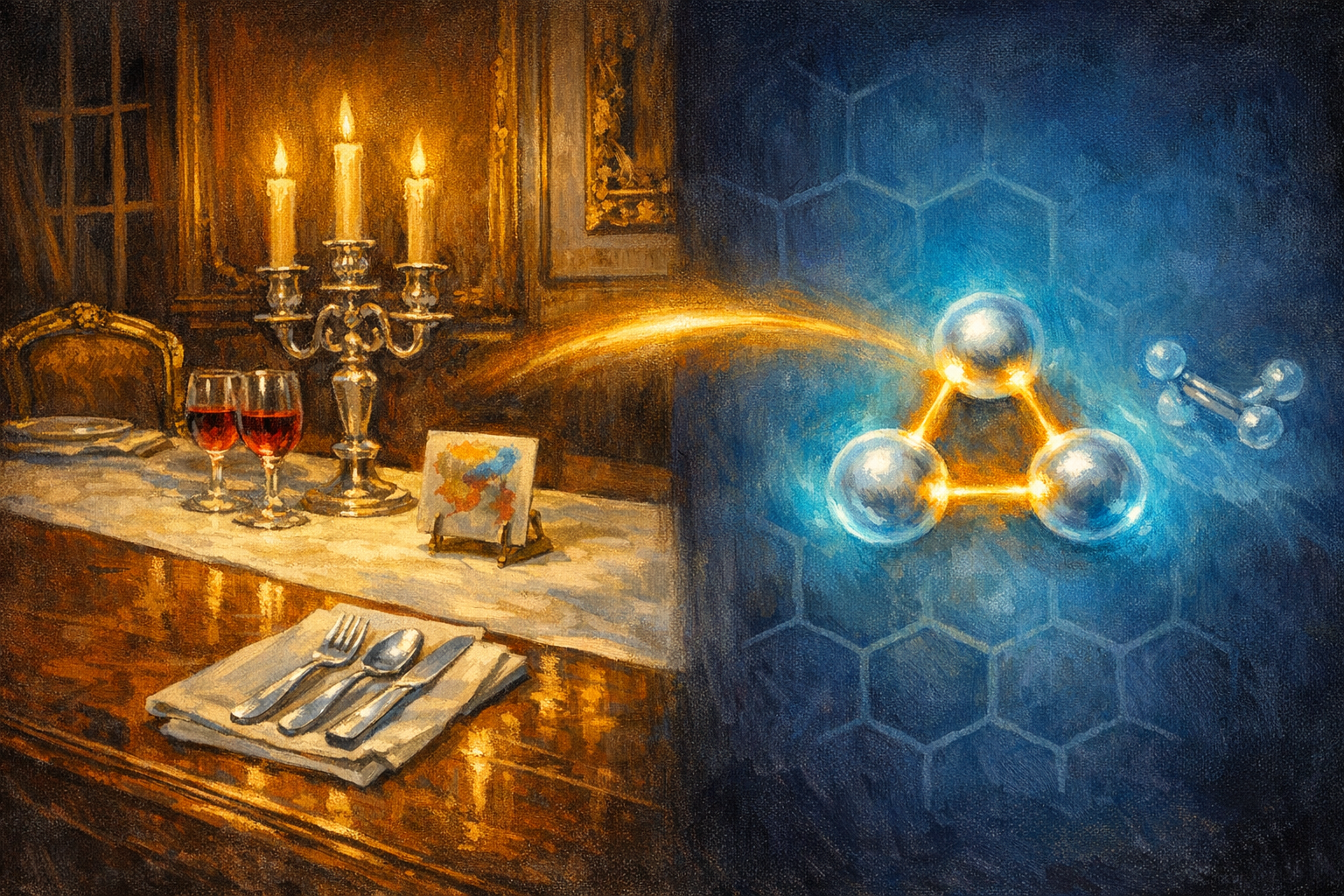
In the summer of 1855, at a state banquet in the Tuileries Palace in Paris, Emperor Napoleon III sat down to dinner with his most honoured guests. The cutlery laid in front of those few special guests, including the emperor himself, was made of a strange new silvery-white metal that had until very recently been almost impossible to extract in any quantity. Lesser guests had to settle for gold.
The metal was aluminium. It is the third most abundant element in the Earth's crust. It is what lager cans are made of, and beach chairs, and the foil over Sunday roast, and the body panels of a Tesla. In 2026 the wholesale price of refined aluminium is roughly two dollars a kilogram. In 1855, it sat in the imperial accounts alongside gold and silver, and at the Paris Exposition Universelle that same summer it was displayed inside the Crown Jewels exhibit, behind glass.
This is the story of how the most precious metal at the emperor's table became the cheapest metal worth talking about, and how, last week, it overtook platinum.
The reason aluminium had been precious in 1855 was that nobody could get it out of its ore. Aluminium does not occur in nature as a metal. It is locked into oxide minerals as Al³⁺, an ion that holds its three electrons more tightly than almost anything except fluorine. Friedrich Wöhler in Berlin had managed in 1827 to produce a small grey powder of aluminium metal by reducing aluminium chloride with metallic potassium, but the process was hideously expensive and the product looked like ash. The first practical industrial route came in 1854, when the French chemist Henri Étienne Sainte-Claire Deville announced at the French Academy of Sciences a method for reducing aluminium chloride with metallic sodium. It worked. It produced about a pound of aluminium per gigantic hot mess of a furnace.
Deville cast the first commercial bar of pure aluminium in time for the 1855 Paris Exposition. Napoleon III, who had backed Deville's research with imperial funds in the hope of one day making aluminium armour and aluminium helmets for his cavalry, was fascinated. The cutlery for state banquets followed shortly after, and the imperial child's rattle, also of aluminium, became the most photographed nursery object in Europe.
The price held for thirty years. In December 1884, when the Washington Monument was capped, the engineer William Frishmuth was commissioned to cast the small pyramid that would sit at the top of the obelisk. He chose aluminium, because it was light, did not corrode, and would not stain the marble. The 100-ounce pyramid (approximately 2.85 kilograms of metal) was set on the monument on 6 December 1884 as one of the great showpieces of nineteenth-century American engineering. The metal in it alone cost more than three months' wages for a skilled American workman of the day.
Eighteen months later, the price collapsed.
On 23 February 1886, in an attached woodshed at his family's house in Oberlin, Ohio, a twenty-two-year-old chemistry graduate named Charles Martin Hall, eight months out of Oberlin College, passed an electric current through a hot bath of aluminium oxide dissolved in molten cryolite. Small grey beads of pure aluminium settled at the bottom of the crucible. He filed his US patent on 9 July 1886.
In April 1886, in the École des Mines in Paris, a twenty-three-year-old French metallurgy student named Paul Héroult, working completely independently of Hall, did exactly the same thing. He filed his French patent on 23 April 1886, almost three months ahead of Hall. The two had never met, never corresponded, and never heard of each other before the patent fights began.
They had both been born in 1863. They both died in 1914. They had independently invented what would be called, by the historians of metallurgy who eventually had to settle the priority dispute, the Hall-Héroult process. It is still the only economic way to extract aluminium from its ore, and roughly seventy million tonnes of aluminium are made by it every year.
In 1854, when Sainte-Claire Deville had unveiled his sodium method, the wholesale price of aluminium had been around twelve hundred dollars per kilogram in the money of the day, well above the silver price and on a par with gold. By 1893, seven years after the patents, the price was less than two dollars per kilogram. By 1914, when both Hall and Héroult died, it was about 35 cents per kilogram. In thirty years, the most precious metal at the emperor's table had become a commodity. The Washington Monument's aluminium capstone, treasured in 1884, was by 1900 a curiosity that schoolchildren visited to be reminded of how strange the world had been before electricity.
Aluminium did everything cheap-and-light asks of a metal. Beverage cans. Aeroplanes. Saucepans. By the 1960s the United States alone produced more aluminium each year than gold had been mined in all of human history up to that point. The metal that had joined Napoleon's crown jewels at the Exposition was now in the rubbish.
The thing aluminium could not do, however, was act as a catalyst. The interesting industrial catalysts, the ones that build polyethylene and split hydrogen and turn one organic molecule into another, were all made of platinum, palladium, rhodium, and the other "platinum-group" metals at the bottom of the periodic table. These are some of the most expensive substances on Earth, mined in grams per tonne of ore, concentrated in a handful of South African and Russian mines. Catalyst chemistry is roughly a fifty-billion-dollar global business, and a depressing fraction of its cost is the precious metal you have to keep recycling out of the reactor.
For a long time, chemists had a story about why aluminium could not do this work. Aluminium is in the wrong column. It has three valence electrons and gives up all three immediately to become Al³⁺. The platinum metals, by contrast, can sit in half a dozen different oxidation states, hand single electrons in and out of bonds, hold a passing molecule for the thousandth of a second needed to rearrange it, and let it go. Aluminium does not do that. Aluminium is, in catalytic terms, a brick.
The Echo
Last week, in Nature Communications, a team led by Dr Clare Bakewell at King's College London reported the first stable example of a molecule called a cyclotrialumane. It is three aluminium atoms arranged in a small flat triangle, each in the unusual +1 oxidation state, holding two of their three normal electrons back. It looks simple. It is not. Nobody had ever managed to make aluminium keep this much electron density for long enough to call it a stable compound, and the team had to spend the better part of a decade refining the bulky organic groups they hung off the triangle to stop it from collapsing into ordinary Al³⁺.
The reason it matters is what the triangle does. The Bakewell team show that the cyclotrialumane, dissolved in solution, can split molecular hydrogen into two atoms, a reaction normally reserved for platinum and palladium. It can take a single ethene molecule into its triangle and add it to a carbon chain, the step-by-step insertion that turns ethene into polyethylene under the Ziegler-Natta catalysis Karl Ziegler invented in 1953 with a different family of organoaluminium compounds. It does these reactions because aluminium in the +1 state still has electrons left to give. The team have, in effect, taught aluminium to behave like a transition metal.
Aluminium is approximately twenty thousand times less expensive than platinum. The same catalyst chemistry that today consumes a multi-billion-dollar precious-metal supply chain could, if the cyclotrialumane approach scales, run on the metal that lager cans are made of. The team are clear that they have one paper and a long road from a beaker to a barrel. But the chemistry is no longer impossible. The brick has electrons after all.
The arc closes. In 1855 the Emperor of the French gave aluminium cutlery to his most honoured guests because aluminium was the most precious metal at the table. By 1900 it would have been a strange affectation, a bit like serving dinner on plates of lead. By 2026 the same metal has walked into a different room of the periodic table and started to displace the precious metals that today share Napoleon's old seat at the table.
The metal we once locked up with the crown jewels is, this week, the metal we expect to replace the ones still locked up with the crown jewels.
He would, one suspects, have approved.