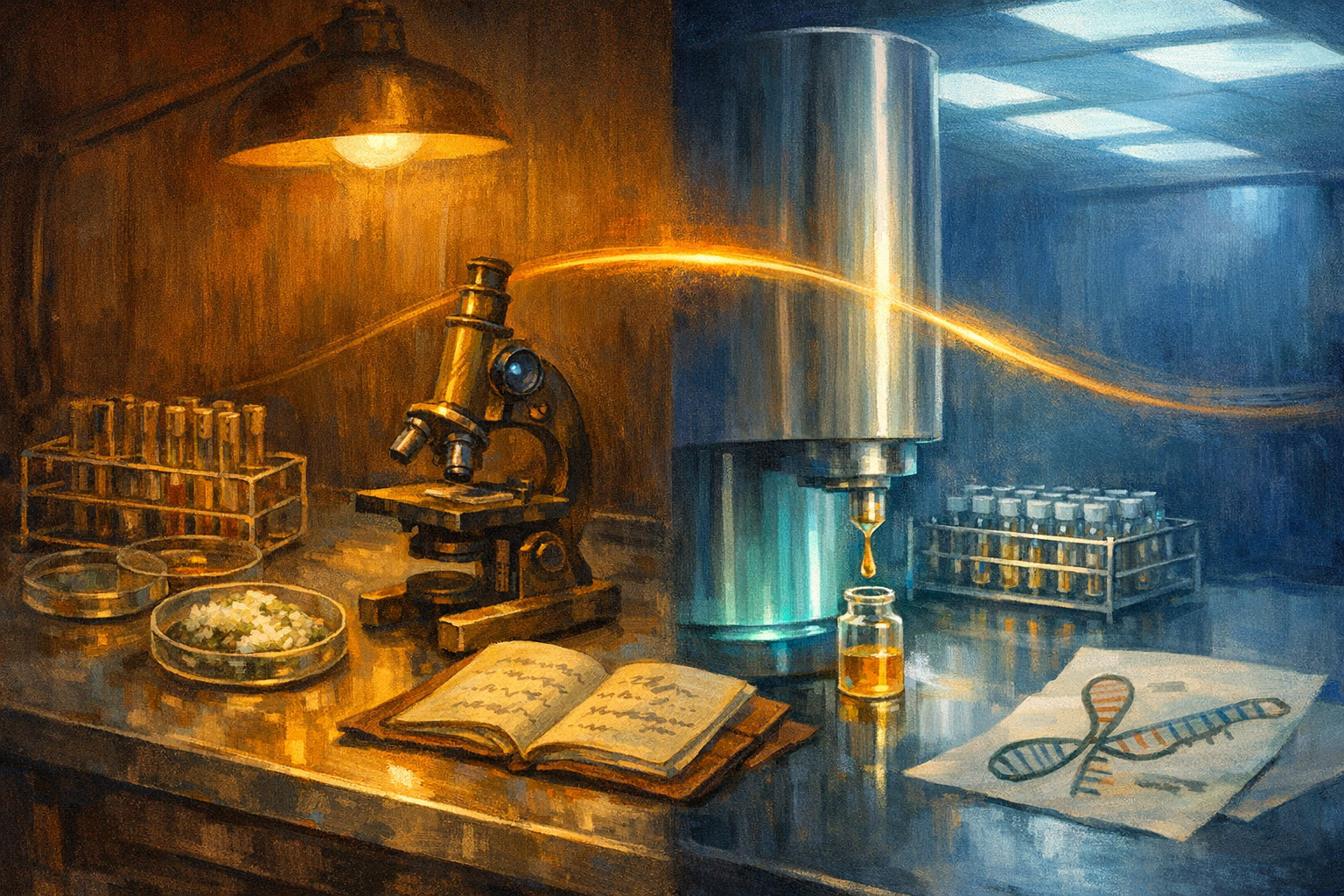
In the summer of 1972, in a fluorescent-lit basement laboratory at the Sankyo Company in Tokyo, a thirty-eight-year-old biochemist named Akira Endo cultured a sample of rice he had picked up in a small grain shop in Kyoto. The rice was lightly mouldy. He had been collecting samples like that for nearly two years, from grain shops, vegetable markets, soil, leaf litter, anywhere a Penicillium might be growing. He had cultured around six thousand of them and tested each one against a single, very specific question. Does this fungus make a molecule that blocks the human enzyme that builds cholesterol.
The Kyoto rice yielded a strain he labelled Pen-51. He took its broth, ran it through his assay, and got the third positive hit of his career. The molecule, in time, became compactin, the first statin, and the founding member of a class of drugs that now reaches more patients on Earth than almost any other.
This is the story of how a farm boy from northern Japan with a childhood interest in mushrooms found a penicillin for the heart in a grain shop, and how the molecule he found is now being replaced by something stranger.
Endo had been chasing fungi since childhood. He grew up on a farm in Akita prefecture, in the cold north of Honshu. His grandfather, an autodidact with an interest in folk medicine, told him as a small boy about a local mushroom that paralysed flies without harming people. Endo paid attention. By the age of eight he had decided to be a scientist. As a teenager he read a Japanese-language biography of Alexander Fleming, who had found penicillin in 1928 by paying attention to a contaminated Petri dish, and the lesson stuck. The interesting molecules of the world, Endo decided, were not in the catalogue. Something small and overlooked was already making them.
He took a degree in agricultural chemistry at Tohoku University in Sendai in 1957 and joined Sankyo the same year as a junior biochemist. He spent two years between 1966 and 1968 at the Albert Einstein College of Medicine in the Bronx, in the laboratory of Bernard Horecker, where for the first time he was given American-scale resources and learned how American biochemistry asked its questions. He came home to Tokyo in 1968, and Sankyo did something unusual. They told him to pick a topic that did not have to make money any time soon, and work on it.
He picked cholesterol.
The reason was simple. The Framingham Heart Study, running in Massachusetts since 1948, had by the late 1960s established beyond reasonable doubt that high blood cholesterol causes heart attacks. The biochemists had worked out the long enzymatic pathway by which cells synthesise cholesterol from acetate, and they had identified the rate-limiting step. The slowest enzyme in the chain was 3-hydroxy-3-methylglutaryl-coenzyme A reductase, abbreviated HMG-CoA reductase. Block that enzyme, the textbook said, and you block the synthesis of cholesterol. Nothing did.
Endo's hypothesis was the Fleming hypothesis applied to lipids. Fungi compete for soil and grain. They evolve molecules that disable the metabolism of their competitors, including, sometimes, the metabolism of any mammal that happens to encounter them. Penicillin had been one such molecule, accidentally encountered. Therefore, Endo reasoned, somewhere in the world's fungi, there had to be a natural inhibitor of HMG-CoA reductase. He just had to find it.
He set up a screen. For each fungus, he grew it, extracted its broth, and applied the broth to a cell culture making radioactive cholesterol from radioactive acetate. If the fungus produced an HMG-CoA reductase inhibitor, the radioactivity in cholesterol would fall. He started in 1971. By the end of 1972 he had tested somewhere between three thousand eight hundred and six thousand cultures, depending on whether you count individual species or total broths. He had two earlier hits, both abandoned. The Kyoto grain-shop rice, fed into the screen in the summer of 1972, was Pen-51.
In July of 1973 he isolated three active metabolites from Pen-51 and labelled them ML-236A, ML-236B, and ML-236C. ML-236B turned out to be a structural mimic of the natural substrate of HMG-CoA reductase, fitting into the active site of the enzyme like a forged key into a lock. He published the work in The Journal of Antibiotics in 1976. By the time the paper appeared, a British group at Beecham had independently isolated the same molecule from a different mould and called it compactin. The two names eventually merged.
Sankyo took compactin into clinical trials in Japan in the late 1970s. The early human results were spectacular. Then, in 1980, the company quietly cancelled the programme. The official explanation, which has hardened over forty years, is that long-term high-dose dog studies showed possible carcinogenicity at doses well above any human would receive, and Sankyo lost its nerve. Endo was reassigned. He left Sankyo for academic life at Tokyo University of Agriculture and Technology in 1979.
Merck, watching the science, had quietly begun developing a near-identical molecule from a different mould. They called it lovastatin. The US Food and Drug Administration approved it in September 1987. It became the first member of the modern statin family to reach the market. Within a decade, Pfizer's atorvastatin had become the bestselling pharmaceutical in human history. Statins now reach more than a hundred million patients a year worldwide. The Scandinavian Simvastatin Survival Study, published in 1994, showed thirty percent fewer deaths in patients taking the drug. By any measure, Akira Endo's mould had become a public-health intervention on the scale of vaccination. He died in 2024, aged ninety, with a Lasker Award, a Japan Prize, and an Albany Medical Center Prize, but no Nobel.
The trouble with statins, then and now, is that they only get you so far. About a third of patients cannot tolerate them, or do not respond enough, or carry inherited mutations that defeat them. So in the early 2000s the search began for the next step. Two French geneticists, Marianne Abifadel and Catherine Boileau, working with families afflicted with severe early heart disease, identified in 2003 a gene whose gain-of-function mutations caused autosomal-dominant familial hypercholesterolaemia. The gene encoded a protein called PCSK9. PCSK9 had one job. It sat at the surface of liver cells and chewed up the LDL receptors that statins relied on. More PCSK9 meant fewer receptors, which meant more cholesterol in the blood. In 2005, Helen Hobbs and Jonathan Cohen at UT Southwestern, working with the Dallas Heart Study, found the mirror-image story. People with broken PCSK9 had unusually low cholesterol and almost never had heart attacks.
PCSK9 was, in other words, a knob you wanted to turn down. By 2015, the FDA had approved two PCSK9-blocking antibody drugs. They worked beautifully and cost roughly fourteen thousand dollars per patient per year.
The Echo
This week, in Biochemical Pharmacology, a team led by Carles Ciudad and Verònica Noé at the University of Barcelona, with Nathalie Pamir at Oregon Health and Science University, reported a new approach to the same target. They have designed a small synthetic DNA molecule called a polypurine reverse Hoogsteen hairpin. The molecule is a piece of single-stranded DNA folded back on itself in a hairpin loop, engineered to bind a specific stretch of the PCSK9 gene's regulatory region. When the hairpin binds, the cell's machinery cannot transcribe the gene. PCSK9 is not blocked. PCSK9 is not made.
In human liver cells in culture, their best hairpin, HpE12, dropped PCSK9 messenger RNA by seventy-four percent and PCSK9 protein by eighty-seven percent. In transgenic mice, a single injection dropped circulating PCSK9 by half and circulating cholesterol by forty-seven percent within three days. The molecule is small, easy to manufacture on a DNA synthesiser, and structurally unlike anything an antibody company has on the market.
The result is mouse-only. It will be a long road to human use. But the design pattern is the future of this field. Akira Endo went looking for a molecule that some fungus, somewhere, was already making, and found it in a grain shop in Kyoto. The Barcelona-Oregon team did not need a fungus. They wrote the molecule.
What links the two milestones is the enzyme cascade Endo identified in 1971. Block cholesterol synthesis at HMG-CoA reductase, and the liver pulls LDL out of blood via its receptors. Inhibit PCSK9, and the receptors live longer and do more. Either way, the body wants to do the right thing. You only have to remove the thing stopping it.
Endo's argument throughout his career was that the truly important medicines tended to come from paying attention to the small. A mould in a Petri dish. A grain shop in Kyoto. A French family with terrible numbers. The future of medicine, he thought, was hidden in places that looked unremarkable more often than in molecules designed from scratch.
The Barcelona team have just designed a molecule from scratch.
He would have laughed.