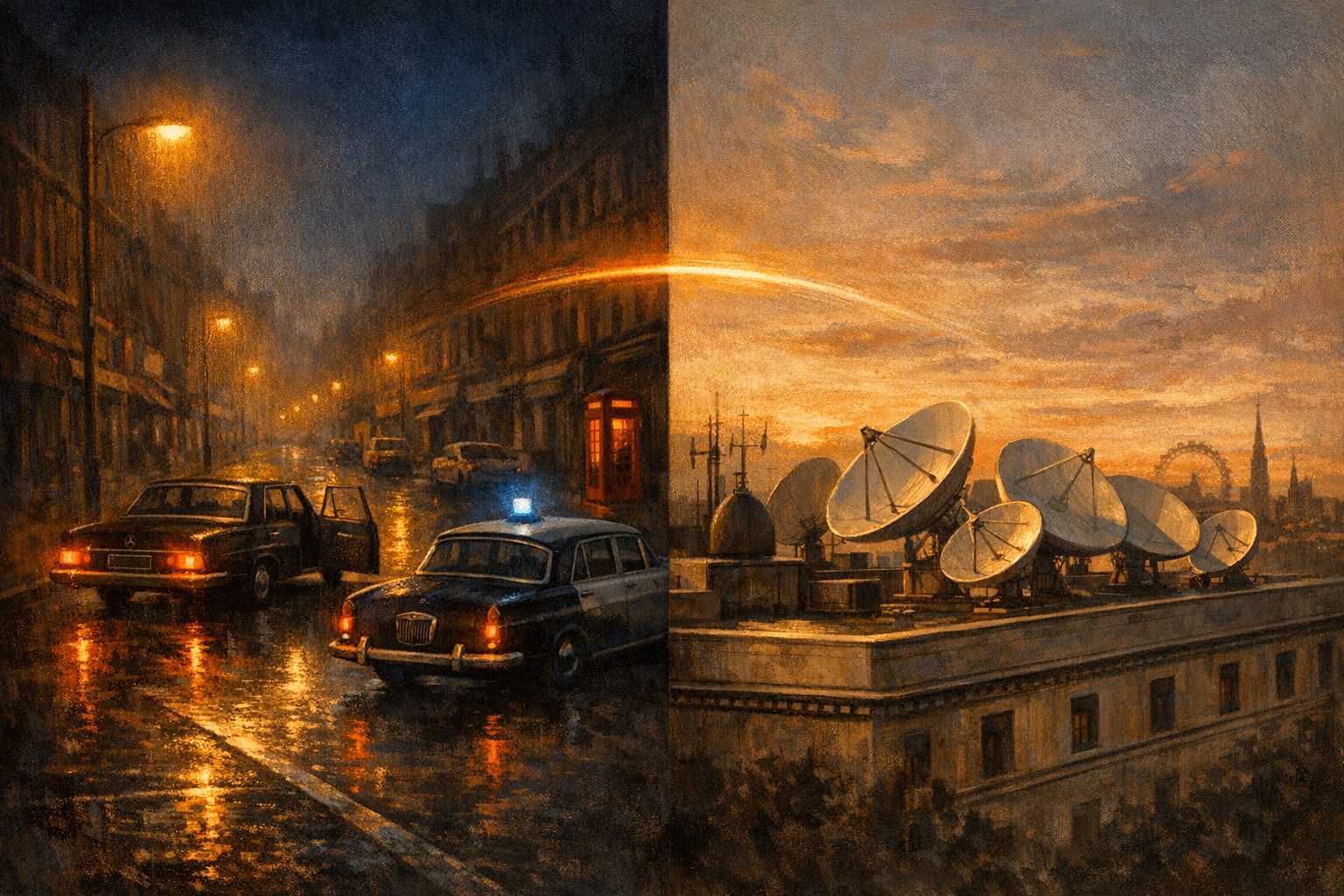
At one-thirty in the morning on the last day of August 1971, Constable Charles Shearer of the Metropolitan Police pulled over a swerving Mercedes on Tottenham Court Road. The driver was a thirty-four-year-old Russian man, neatly dressed, identifying himself as a Soviet Trade Delegation officer named Oleg Lyalin. He was extremely drunk. As Shearer began the breathalyser procedure, Lyalin lost his temper, drew himself up to his full height, and shouted at the constable that he could not be arrested. He was, he declared, a KGB officer. He had immunity. The constable should let him go.
The constable did not.
Lyalin was taken to West End Central police station, charged, and put in a holding cell to sober up. By the time the morning's duty officer arrived, the Soviet Trade Delegation had requested his release. By the time MI5 arrived, Lyalin had decided what to do.
He defected.
This was less of a surprise to MI5 than to anyone else, because they had been running him for four months.
Lyalin had walked into the British Security Service in the third week of April 1971, in a great deal of personal misery. He was unhappily married. He had fallen in love with his secretary at the Trade Delegation. He suspected that his marital problems would, when discovered by Moscow, end his career. He had decided to defect, in stages, by becoming an MI5 informant first and then crossing over later when the time was right. The Tottenham Court Road incident was not the time he had chosen. It was the time the choice was made for him.
What Lyalin had spent the spring and summer telling MI5 changed the shape of British intelligence. He worked, he said, for Department V (formerly Department 13) of the First Chief Directorate of the KGB, the section responsible for sabotage and assassination operations to be carried out in the event of war. His job was the United Kingdom. He had assembled a list of British politicians for assassination, a plan to infiltrate KGB agents disguised as official messengers into the Whitehall tunnel system to distribute poison gas capsules on the eve of hostilities, and a network of local sympathisers equipped with concealed radio sets along the North Yorkshire coast where seaborne sabotage teams would land. He had been planning to attack the country's emergency food reserves to starve the population. He had been planning, in his memorable phrase to his MI5 handlers, "a great deal."
He had also brought with him the names. The names of the more than a hundred KGB and GRU officers whom Moscow had quietly inserted into the Soviet Embassy in Kensington Palace Gardens, the Trade Delegation in Highgate, the Press Office, the Aeroflot office, and the cultural attaché. He named the head of the London KGB residency. He named the Director of Department V's UK desk back in Moscow. He explained which Britons were already on the KGB books as agents, and which had only ever been talent-spotted. By August 1971 MI5 had a complete order of battle for Soviet intelligence in Britain.
The British government had been complaining quietly to Moscow about the size of the Soviet intelligence presence in London for nearly a decade. Letters had been exchanged. Discreet warnings had been delivered. Moscow had ignored them. Now the Foreign Office had, courtesy of an unhappy KGB officer's marital problems and a London policeman's decision to enforce the drink-driving laws on a Soviet diplomat, the leverage to do something concrete about it.
On 24 September 1971, the British Foreign Secretary Sir Alec Douglas-Home summoned the Soviet Ambassador, Mikhail Smirnovsky, and handed him a list of one hundred and five names. Ninety of them were to leave Britain immediately. The other fifteen were currently outside the country and would not be permitted to return. The list was made public the same day. It was the largest expulsion of intelligence officers by any government in history, and it remains so.
Edward Heath, the British Prime Minister, gave private instructions about how to handle the inevitable Soviet protests. The Russians, he said, had earned a bloody nose, and Britain should not flinch from giving them one.
Moscow's reaction proceeded in the textbook order. Outrage. Denial. Threats of retaliation. Demand for revocation. When the British Ambassador in Moscow was finally summoned on 8 October 1971 to receive the formal Soviet response, the retaliation was the cancellation of a small number of joint projects and the expulsion of a much smaller number of British diplomats from Moscow than London had expelled. Quiet acceptance over the following months. Then, slowly, a rebuilding of the residency in London under different names, different cover, and a much shorter list of stations.
The KGB First Chief Directorate's analysis after Operation FOOT, captured in declassified documents released in the 1990s, came to two conclusions. The first was that the sheer scale of the British expulsion had been a tactical defeat: KGB officers were withdrawn across Western Europe in the panic that followed, in case Lyalin had revealed their names too. Several senior officers were dismissed or demoted, including the head of the KGB department responsible for Britain. The second was that the operational lesson was simply to rebuild more carefully and never again to put quite so many officers on a single host country's territory at once.
The lesson was about distribution, not abstention.
The KGB rebuilt the London residency by 1980. By 1985, Soviet intelligence in Britain was operating at roughly the same volume it had been at in 1970, just in different cover and with different names. The bloody nose had healed.
The Echo
In April of 2026, Austria's foreign ministry summoned the Russian ambassador to Vienna and presented him with a problem. The state broadcaster ORF had been investigating, over a period of months, the unusual number of satellite dishes and signal antennas that had been appearing on the rooftops of two Russian diplomatic properties in Vienna: the Russian Embassy and a larger Russian diplomatic compound in the Donaustadt district. ORF reported that there were eight large parabolic antennas on the embassy roof alone, that the antennas were movable, and that they re-oriented themselves during international events in Vienna to track specific satellite links. According to ORF's reporting and Austrian counter-intelligence assessments, the installations were sufficient to intercept the satellite internet traffic of the United Nations agencies, the International Atomic Energy Agency, the Organisation for Security and Cooperation in Europe, OPEC, and the various other international organisations that have made Vienna one of the world's three United Nations cities.
Vienna's particular value to a signals intelligence service is the same thing that has made it valuable to spies for centuries: it is full of things worth listening to.
The Austrian foreign ministry asked the Russians to waive diplomatic immunity for the three antenna operators so they could be questioned by Austrian prosecutors. The Russians declined.
On 4 May 2026, Austria's Foreign Minister Beate Meinl-Reisinger declared the three Russian diplomats personae non gratae and gave them seventy-two hours to leave the country. They were the eleventh, twelfth, and thirteenth Russian diplomats Austria has expelled since 2020. With the three new expulsions, the total stood at fourteen.
Meinl-Reisinger said in her statement: "Espionage is a security problem for Austria. In this government, we have changed course and are taking decisive action against it. We have made this unequivocally clear to the Russian side, also with regard to the array of antennas at the Russian embassy. It is unacceptable for diplomatic immunity to be used to engage in espionage."
The Russian Embassy in Vienna issued a statement calling the expulsion "outrageous, unjustified, politically motivated, and categorically unacceptable."
The structural play is the same one Heath ran in 1971. A host country has been quietly tolerating an outsized Russian intelligence presence for years. A specific revelation makes the toleration politically untenable. The host expels diplomats: enough to satisfy domestic outrage, not so many that the relationship breaks. The Russian side denounces, retaliates in token fashion, and waits.
The numbers are different. Heath expelled a hundred and five at once after a complete inventory had been delivered to him by a defector. Meinl-Reisinger expelled three, the latest of fourteen quietly removed since 2020, with the rooftop installation still standing. The KGB pulled officers across Europe in 1971 because they did not know how much Lyalin had given away. The SVR and GRU in 2026 know precisely what was photographed by ORF and precisely what was not.
The historical lesson of Operation FOOT, fifty-five years on, is that the bloody nose worked at the time and then did not. Within fifteen years the residency was the same size it had been before the expulsion, just better hidden and split across more cover. The constraint had been on the visibility of the operation, not on its scale.
Austria, on the slower scale of the past six years, appears to have already arrived at a more honest understanding of what an expulsion accomplishes. It does not stop the operation. It makes the operation more discreet for a season. It signals that further escalation will be met with further response. And it gives a foreign minister and a public broadcaster a clean, defensible moment of action.
The antenna forest will probably come down off the Donaustadt roof within the week.
A different one will go up somewhere quieter.
Last time, the bloody nose lasted fifteen years before it healed.
This time, what comes next?