Every day, we find the historical story hiding inside the headlines. Riveting narratives
that connect the past to the present, and make you wonder what happens next.
Choose your topics
You'll receive one email per topic, per day. Pick as many as you like.
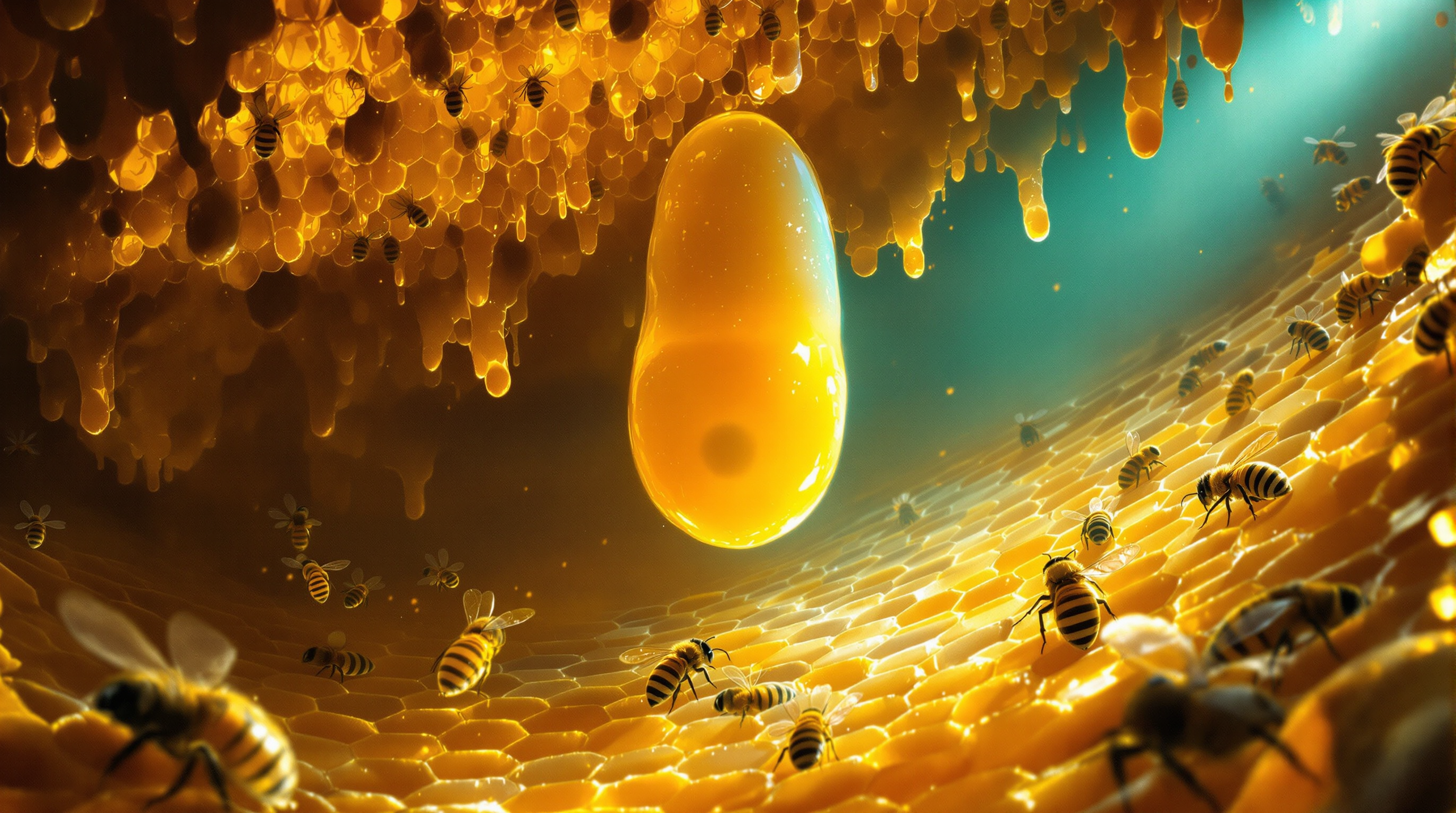
Queen and worker bees hatch from identical eggs, yet one lives for years and lays a million eggs while the others live for weeks and never breed. For a century the textbook answer was a single food: royal jelly. In 2026 a team at UC Riverside showed the real answer is grander. Specialised worker bees build the queen a palace: a peanut-shaped 'royal crib' of custom wax with its own chemistry, and they cluster to keep it warm. Raise a would-be queen in ordinary wax instead and she develops poorly and often dies. The jelly feeds her; the crib crowns her. We love a story with one secret ingredient. Nature almost never works that way.
•3 min readIn 2026 a team at the University of California, Riverside (its Center for Integrative Bee Research) showed that royal jelly alone does not make a queen: the environment does much of the work. A specialised caste of young worker bees acts as royal builders, constructing the large peanut-shaped 'royal crib' from a custom wax that is softer, melts at a higher temperature, and carries a distinct chemical signature of fatty acids and signals, and they alter their own physiology to raise the temperature around the cell, like underfloor heating. Crucially, when would-be queens were raised in ordinary worker-cell wax instead of the royal crib, the larvae developed poorly and many died: they needed the 'smell and feel' of the royal wax to transform at all. So queen determination is a whole system, diet plus architecture, temperature and wax chemistry plus the labour of many bees, not a single ingredient. It is a recurring lesson in biology: we love single-cause stories (one gene, one molecule, one food), but nature's marvels are usually built from many small causes acting together. A queen is built, not dosed.
New York Hospital, 3 May 1891: a young bone surgeon called William Coley rubbed Streptococcus pyogenes into the tumour of an Italian immigrant called Zola. Zola got a fever; his cancer disappeared. A hundred and thirty-five years later, thirty-two British bowel cancer patients given a short course of pre-surgical immunotherapy have just hit thirty-three months without a single relapse.
•5 min readAt AACR 2026 in San Diego, the British NEOPRISM-CRC trial (led by Dr Kai-Keen Shiu of UCL) reports that all 32 patients given pre-surgical pembrolizumab for stage 2/3 dMMR/MSI-high bowel cancer remain alive and relapse-free at 33 months of follow-up. The principle that Coley reached for in 1891 (pre-surgical immune activation) is now standard immunotherapy.
1868 to 1895, the Madras Presidency, London, and Uppsala
Guntur, 18 August 1868: during a total solar eclipse, Pierre Janssen saw a yellow line in the Sun's spectrum at 587.49 nanometres that matched no known element. It took twenty-seven years to find helium on Earth. This month, physicists in Erlangen and Ottawa used ordinary sunlight to make quantum-entangled photons without a laser.
•5 min readMax Planck Institute for the Science of Light and University of Ottawa physicists, led by Hanieh Fattahi and Robert W. Boyd, generate polarisation-entangled photon pairs directly from sunlight using spontaneous parametric down-conversion through a lithium niobate crystal, with Bell-state fidelity ~94% and Bell inequality S=2.54, while a separate Xiamen University group performs quantum ghost imaging with sunlight in Advanced Photonics.
Farnborough, June 1954. Arnold Hall's team pumped water in and out of a Comet fuselage for three thousand cycles until the metal split open at the corner of a square hatch. Seventy-two years later, Anthropic's Mythos is doing the same to the source code of the world's banks.
•6 min readAnthropic's new AI model Mythos has identified thousands of high-severity software vulnerabilities, including a 27-year-old flaw in OpenBSD, and is finding hundreds to thousands of chained weaknesses inside JPMorgan, Goldman Sachs, Bank of America, Citi, Morgan Stanley and Wells Fargo through the new Project Glasswing programme.
Chicago, autumn 1952. A 22-year-old graduate student named Stanley Miller put methane, ammonia, hydrogen and water in a glass flask, ran a spark across the gas, and produced five amino acids. The paper became the foundation of every textbook on the origin of life. Seventy-three years later, a Nature Astronomy paper says it would now fail the test for biology.
•5 min readYoffe et al, Nature Astronomy 12 May 2026 (s41550-026-02864-z): molecular-diversity biosignature using richness + evenness from ecology; biotic samples wide and even, abiotic narrow and uneven; Miller's 1953 result would fail the new test.
Magdalen College, Oxford, November 1935. Erwin Schrödinger invented a cat in a sealed steel box to prove that quantum mechanics was nonsense. Ninety years later, in a Vienna laboratory, physicists have placed ten thousand atoms in spatial superposition. The cat was supposed to be unbuildable.
•5 min readVienna matter-wave lab, November 2025 (Pedalino et al, Nature 649): ultracold sodium clusters of 5,000-10,000 atoms placed in spatial quantum superposition; macroscopicity μ=15.5, an order of magnitude beyond any prior matter-wave experiment.
1889 to 1971, Paris, Vienna, Riviera, Vatican, Montreux
Paris, 1 June 1889. Venice California, May 2026. A seventy-two-year-old professor at the Collège de France injected himself with crushed-testicle juice and a hundred and thirty-seven years later a forty-eight-year-old executive is doing it on a longer protocol with better instruments.
•5 min readBryan Johnson's $2M/yr Blueprint protocol (April 2026 routine: 4h46m, rapamycin dropped, lithium and NDGA added); Altos Labs 2025 mesenchymal-drift Cell paper; Loyal LOY-002 senior-dog drug at FDA, first lifespan drug in any species.
Naples, 17 March 1852. NASA, 15 May 2026. An Italian astronomer at a brass eyepiece named a point of light Psyche, and a spacecraft of the same name is about to slingshot past Mars on the way to find out what it is.
•5 min readNASA Psyche spacecraft Mars flyby, 15 May 2026: gravity-assist slingshot at 12,333 mph, 2,800 miles above Mars, redirecting Lindy Elkins-Tanton's mission toward late-2029 arrival at the largest M-type asteroid in the main belt.
New York, September 1912. Cambridge, May 2026. An Italian chemist's vivid prediction of a solar-fuel industry, and the Cambridge laboratory that just built the catalyst.
•4 min readCambridge / Reisner, Joule, May 2026: a solar photoreactor turns spent car-battery acid and plastic waste into clean hydrogen and acetic acid, running 260 hours without loss on a three-component carbon-nitride catalyst.
Pavia, October 1768. Wake Forest, April 2026. Two hundred and fifty-eight years between an Italian priest's question and the first molecular ingredient of an answer.
•5 min readCurrie / Brown / Poss, PNAS, mid-April 2026: SP6 and SP8 transcription factors are conserved switches in the regenerating epidermis of axolotls, zebrafish and mice; gene-therapy activation partially restores digit regeneration in adult mice.
Yorktown Heights, 1980. Yorktown Heights, May 2026. The same lab, the same architecture, the same temperature, answering a different question forty-three years later.
•5 min readQ-CTRL / IBM, 6 May 2026: 3,000-fold speedup on a Fermi-Hubbard simulation using a 120-qubit IBM superconducting quantum processor (Josephson-junction transmon qubits at 15 millikelvin). First practical quantum advantage on an industrial problem.