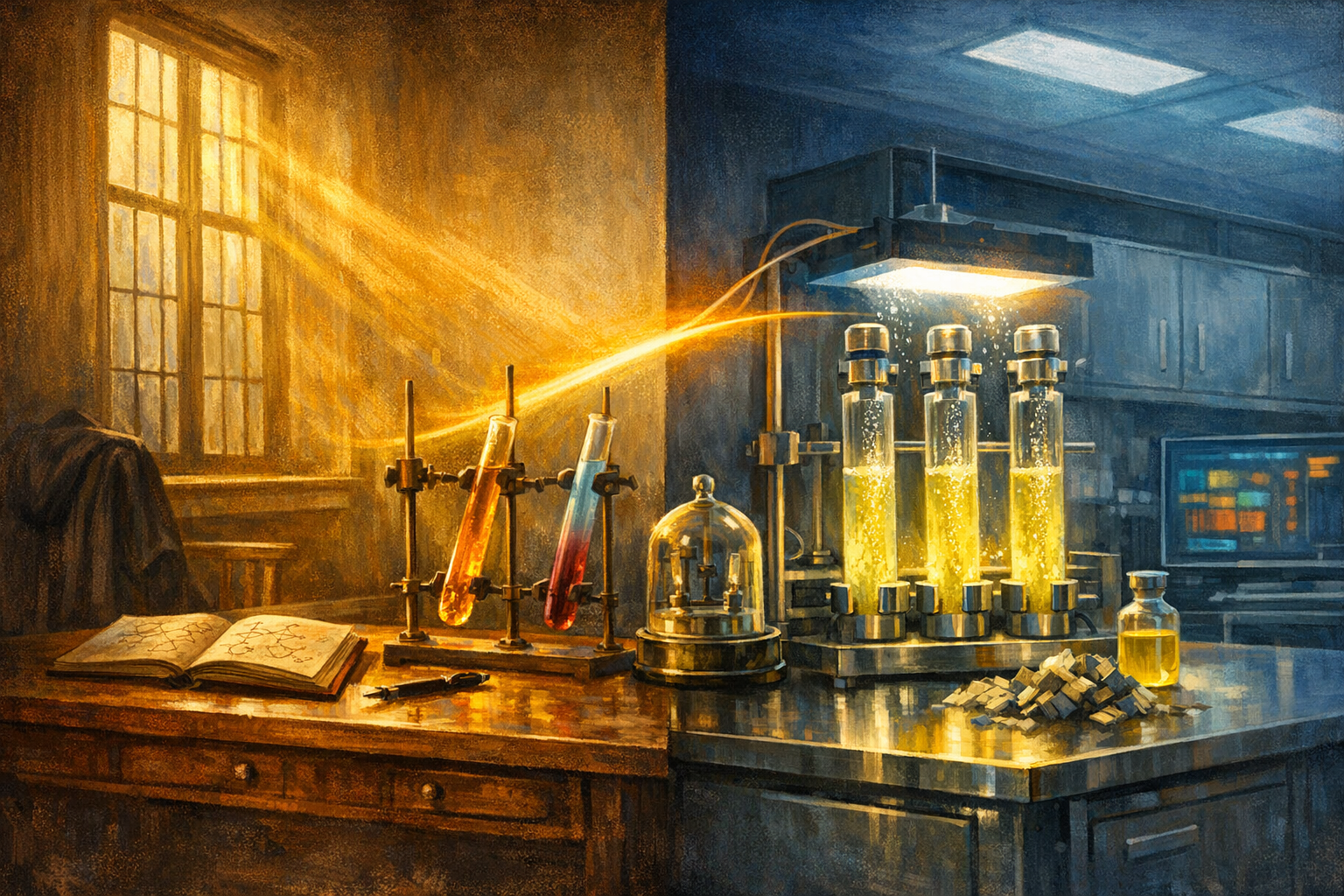
In a packed lecture hall at the VIII International Congress of Applied Chemistry in New York on a warm September afternoon in 1912, a fifty-five-year-old Italian chemist named Giacomo Ciamician stood at the lectern and read out a paper he had brought with him from the University of Bologna.
He had been working on photochemistry for twenty-three years. He was at that point one of the most prolific chemists in Europe. He would be nominated for the Nobel Prize nine times. He would never win.
The paper, which the journal Science would publish on the twenty-seventh of September of that year under the title "The Photochemistry of the Future," contained the prediction that humanity would one day replace the fossil fuels then powering the industrial revolution with sunlight, harvested directly by catalysts that imitated the way a plant leaf turned light into stored chemical energy.
Ciamician put it in vivid prose. "On the arid lands there will spring up industrial colonies without smoke and without smokestacks; forests of glass tubes will extend over the plains, and glass buildings will rise everywhere; inside of these will take place the photochemical processes that hitherto have been the guarded secret of the plants, but that will have been mastered by human industry, which will know how to make them bear even more abundant fruit than nature."
The audience listened politely. The world coal industry was at its absolute peak. The atomic theory of the chemical bond was four years away. The transistor was thirty-five years away. The catalyst he was describing did not exist.
This is the story of how, last week, a research group at Cambridge built the catalyst.
Ciamician died in 1922, ten years after the New York lecture. The chemistry department at the University of Bologna is named after him; the building of his old laboratory still stands. Photochemistry as a field continued, but as a branch of academic physical chemistry rather than as an industrial fuel source. Through the twentieth century the coal Ciamician wanted to replace ran the heavy industry, the oil that succeeded it ran the rest, and direct photochemical fuel production from sunlight remained a research curiosity.
Solar photovoltaics arrived. Bell Labs in 1954 built the first useful silicon photovoltaic cell. Solar thermal arrived. Wind arrived. None of them, however, were quite the thing Ciamician had been describing. He had wanted a catalyst that absorbed light, broke a water molecule into its components, and produced a fuel directly. The mainstream approach to renewable energy in the second half of the twentieth century went around this problem rather than through it. You generated electricity from sunlight, you used the electricity to do something else.
The direct photocatalysis route remained a quiet research backwater for most of the twentieth century. It accelerated only after the early 2000s, with the emergence of new visible-light-absorbing semiconductors. The most useful turned out to be a yellow ceramic called graphitic carbon nitride, first systematically investigated by Xinchen Wang at Fuzhou University in 2009 as a photocatalyst that splits water into hydrogen and oxygen under sunlight.
By the early 2020s the field had a clear engineering problem. Carbon nitride could split water, but it was inefficient on its own, and the value of clean hydrogen alone was not high enough to support a commercial reactor. The economics needed a second input that was free and a second output that was sellable.
Professor Erwin Reisner's laboratory at the Yusuf Hamied Department of Chemistry at the University of Cambridge has spent the past decade looking for that combination.
In a paper published this month in Joule, the Reisner group reported a solar reactor that takes in two industrial waste streams that Britain produces in enormous quantities (used car-battery acid and discarded plastic) and produces two industrial outputs (clean hydrogen and acetic acid) using only sunlight.
The chemistry is a sandwich. The first step takes waste plastic and the sulphuric acid recovered from spent lead-acid car batteries. The acid breaks the long polymer chains of the plastic into small chemical building blocks, including ethylene glycol. The second step exposes the broken-down plastic and the ethylene glycol to a slurry of three solid catalysts under visible sunlight: graphitic carbon nitride to absorb the photons, molybdenum disulphide to shuttle electrons to the protons (producing hydrogen), and a small amount of cobalt as a co-catalyst that triples the hydrogen production rate. The output of the reactor is clean hydrogen gas plus acetic acid, both useful industrial chemicals.
The reactor ran for two hundred and sixty hours in continuous operation without measurable loss in performance. Cambridge Enterprise, the university's commercialisation arm, is preparing to spin out the technology.
The arc closes. Ciamician's "forests of glass tubes" were not a metaphor. They were a literal specification for a future industry he was trying to argue into existence in 1912: glass photoreactors filled with light-absorbing catalysts, sunlight in, fuels out. One hundred and fourteen years later, the Reisner laboratory has built one. The catalyst is a yellowish ceramic powder Ciamician would not have recognised. The reactor is a glass tube of the kind he would. The two waste streams that go in (one of which is a polymer Ciamician would not have known about, since plastics in the modern sense did not yet exist in 1912) are precisely the kind of "abundant fruit" Ciamician imagined industry would extract from the things it had previously discarded.
Ciamician closed his 1912 paper with a sentence the photochemistry community has reprinted on every centenary celebration since. "If our black and nervous civilisation, based on coal, shall be followed by a quieter civilisation based on the utilisation of solar energy, that will not be harmful to progress and to human happiness."
He would, one suspects, have rather enjoyed the news.