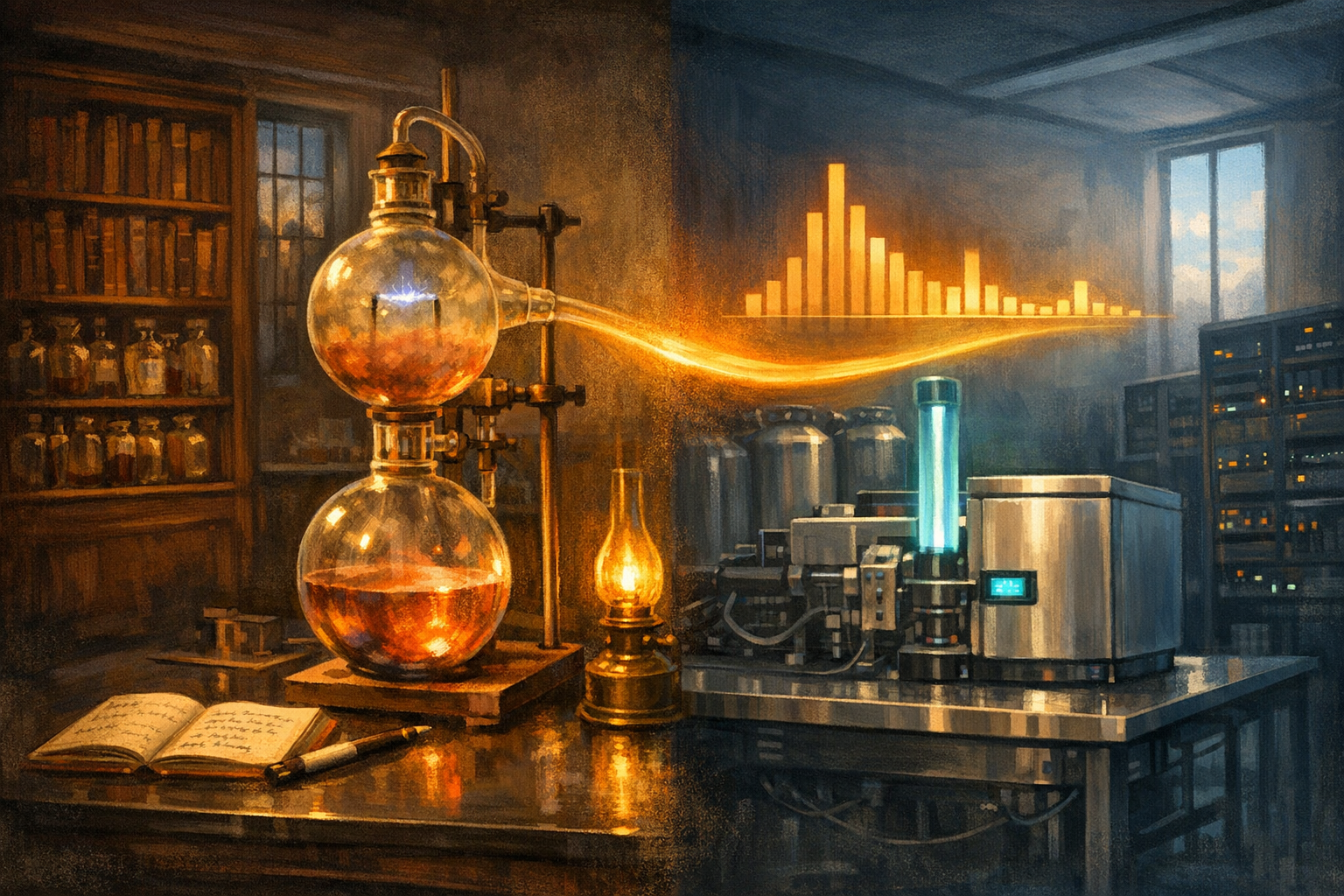
In the autumn of 1952, in a laboratory in the basement of the Jones Chemical Laboratory at the University of Chicago, a twenty-two-year-old graduate student named Stanley Miller assembled the simplest experimental apparatus he could justify, set it running on a Friday afternoon, and went home for the weekend.
The apparatus was four glass flasks connected by glass tubes. The lower flask held water. The upper flask held a mixture of methane, ammonia, and hydrogen, the gases that the geochemist Harold Urey had recently argued must have filled the atmosphere of the early Earth. Between the two flasks Miller had wired a pair of tungsten electrodes that would produce a continuous electric spark, standing in for lightning over the primordial ocean. A condenser at the bottom returned the cooled vapour to the water. The apparatus was meant to run for a week and produce nothing in particular.
It produced everything.
When Miller came back on Monday, the water in the lower flask had turned pale yellow. By the end of the run it was a dirty pink. He carried the cloudy liquid up to the analytical chemistry lab and ran a paper chromatograph against a library of reference compounds. Among the brown spots on the paper were five amino acids: glycine, alpha-alanine, beta-alanine, aspartic acid, and alpha-amino-n-butyric acid. Amino acids are the chemical units from which proteins are built. They are, in the language of biology textbooks, the building blocks of life. Until that Monday morning, no one had ever produced one from scratch by means anything like the conditions that had presumably existed on the early Earth.
Miller walked over to Urey's office and told him. Urey, who had won the Nobel Prize twenty years earlier for discovering deuterium, told him to write it up under his own name. The paper went into Science on the fifteenth of May, 1953. It was a page and a half long. It is one of the most influential page-and-a-half papers in the history of biology. For seventy years it has been taught as the experimental foundation of the modern theory that life on Earth arose from a "primordial soup" of organic chemistry energised by lightning, ultraviolet light, and atmospheric chemistry. Find amino acids on Mars or Europa, the textbook says, and you have probably found prebiotic chemistry that could lead to life.
The problem with the textbook is that, since the 1969 Murchison meteorite fell at a dairy farm in Victoria, Australia, we have known that the universe produces amino acids without any help from biology at all. The original 1970 analysis by Keith Kvenvolden's team at NASA Ames reported seventeen distinct amino acids in the Murchison samples, five of them protein-forming. By the 2010s the catalogued total had grown past ninety, including more than half of the twenty amino acids that life uses to make proteins. They had formed in the dust of a carbonaceous chondrite that had never been within a million miles of a living thing. In the half-century since, amino acids have turned up in meteorites of every class, in interstellar molecular clouds, and in cold dust around forming stars. In January 2025, NASA announced that the samples returned by the OSIRIS-REx mission from asteroid Bennu contained fourteen of the twenty protein-forming amino acids, including, for the first time in any extraterrestrial sample, tryptophan. The chemistry is everywhere.
Amino acids, it now seems clear, are not a biosignature. They are a signature of any small rocky body with a little energy and a little water.
This was awkward for the Mars exploration programme, which depended on amino acid detection as a positive result. The European Space Agency's Rosalind Franklin rover, currently scheduled for launch to Oxia Planum in 2028, is built around a mass spectrometer designed to find amino acids two metres below the Martian surface. NASA's Mars Sample Return programme, currently fighting for its budget, depends on the same kind of analysis on samples being cached by the Perseverance rover in Jezero Crater. Finding amino acids on Mars would be lovely. Finding them, in light of Bennu and Murchison, would not actually prove anything.
On the twelfth of May this year, a paper in Nature Astronomy proposed a way out.
The lead author is Gideon Yoffe, working with Fabian Klenner, Barak Sober, Yohai Kaspi, and Itay Halevy. The argument is borrowed from ecology. When ecologists measure biodiversity in a forest, they do not just count the number of species (the richness); they also measure how evenly the species are distributed (the evenness). A forest with two thousand individual trees of two species is poor biodiversity; a forest with two thousand individual trees of five hundred species, each represented in roughly comparable numbers, is rich.
The same statistics, the new paper argues, can distinguish biotic from abiotic chemistry. Biotic samples produce a wide and evenly distributed inventory of amino acids: hundreds of distinct molecules in roughly comparable abundances, because biological enzymes work on a vast catalogue of substrates. Abiotic chemistry, including Miller's primordial spark and the Murchison parent body, produces a much narrower and dramatically more uneven inventory: a few amino acids in very high abundance (glycine, alanine, aspartic acid: exactly the species Miller found) followed by a long tail of trace species in vanishing concentrations. The signal, the authors show, is robust under modelled space degradation. It works on samples millions of years old.
The implication is uncomfortable: the experiment Miller ran in 1953 would fail the 2026 biosignature test. The five amino acids that earned the paper its place in every biology textbook are an abiotic distribution. They are the pattern produced by sparks and water and inorganic gases, not by anything living.
The same goes for OSIRIS-REx, for Murchison, and presumably for the amino acids that Rosalind Franklin will hopefully extract from the Oxia Planum subsurface in 2028. The right question is not whether amino acids are present. The right question is what the distribution of amino acids looks like. If it is sparse and uneven, the answer is geochemistry. If it is rich and even, the answer is something else.
Miller died in 2007, sixteen years before the OSIRIS-REx samples came back. He had spent his career producing larger and richer Miller-Urey runs, including a 1958 hydrogen-sulfide-rich variant that was lost in a box of vials and rediscovered by his student Jeffrey Bada in 2007. The lost vials, reanalysed by Bada, contained twenty-three amino acids. Miller's apparatus had always been more productive than he reported.
It had never produced biology.
The trade is still measured, of course, on the count of molecules, the evenness of their abundances, the surface area of an ancient seabed. Some things in chemistry do not change.