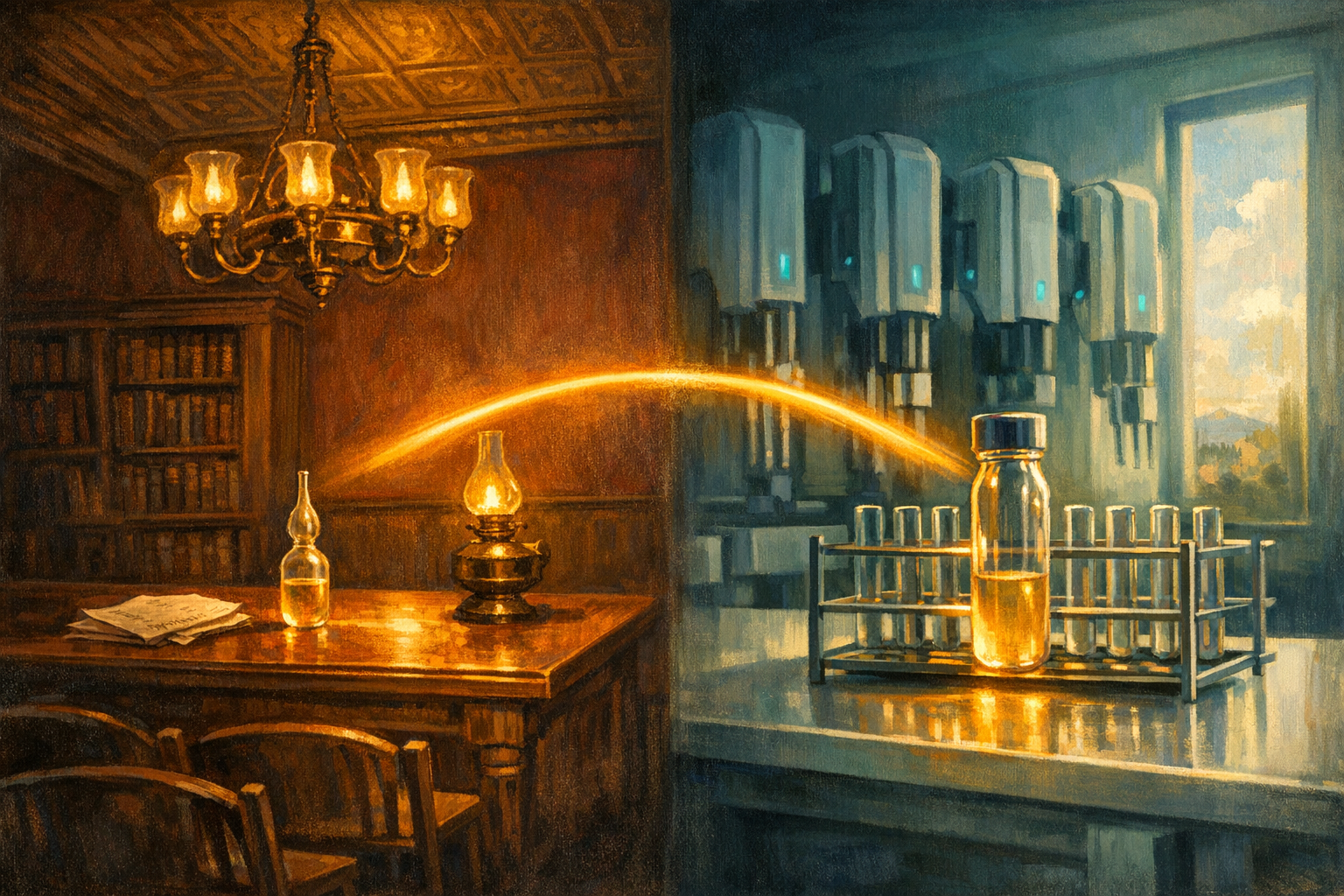
On the afternoon of 1 June 1889, in a meeting room at the Société de Biologie in Paris, a seventy-two-year-old man stood up and read a paper to his colleagues. The man was Charles-Édouard Brown-Séquard. He held three of the most distinguished chairs in European medicine. He had been the close collaborator of Claude Bernard. He had discovered the spinal-cord syndrome that bears his name. He had founded the Archives de Physiologie. He was a Fellow of the Royal Society. He occupied, at that moment, the chair of experimental medicine at the Collège de France.
He had come to the Société to tell his colleagues that over the previous three weeks he had injected himself, subcutaneously, on ten separate occasions, with a clear filtered emulsion consisting of a small quantity of water mixed with blood drawn from the testicular veins of dogs and guinea-pigs, semen, and juice expressed from a testicle crushed immediately after removal from a living animal.
He read the effects he had observed. His physical strength was restored. He could once again work fourteen hours a day. His mental performance had recovered. His constipation, a chronic complaint of his later years, had eased. And, in a sentence delivered to a roomful of physiologists with the measured precision the room expected, the arc of his urine had lengthened.
The next day the newspapers ran the story. By the end of June a Boston physician had announced that he was administering Brown-Séquard's fluid to consumptives. By the end of July a German chemist was selling it in vials at Charing Cross. By the end of December more than twelve thousand physicians in Europe and the Americas were injecting their patients with what the trade press had begun to call, with a brevity Brown-Séquard himself never used, the Elixir of Life.
The actual contents of the actual elixir were, almost certainly, biologically inactive. The extract was too dilute and too contaminated to deliver any meaningful quantity of testosterone, and the active hormone would not even be isolated until 1935. The improvement Brown-Séquard reported, and the improvement reported by twelve thousand physicians' patients, was the placebo effect, in the largest natural experiment on the placebo effect that medicine had ever run.
But the impulse the elixir released did not die when the bottles ran out. It moved, with the budget of the people who wanted it, from Paris to Geneva to Vienna to the Vatican.
In 1920, in a clinic outside Paris, the Russian-born surgeon Serge Voronoff performed his first xenotransplantation. He cut thin slices, a few millimetres across, from the testicles of a chimpanzee, and grafted them onto the testicles of a sixty-year-old French banker. By 1930 he had performed the operation on more than five hundred men. He charged the equivalent of a small country house. His Riviera estate kept its own troop of donor primates. The grafts, of course, were rejected immediately and replaced by scar tissue, which the patients felt with their hands and believed to be the grafted tissue still in place.
In Vienna, in the 1920s and 1930s, the endocrinologist Eugen Steinach proposed an operation that would have the same rejuvenating effect at a fraction of the cost. The operation was a unilateral vasectomy. The verb "to be Steinached" entered the vernacular. On 6 April 1934, in a consulting room in Harley Street, the Austrian sexologist Norman Haire performed the operation on William Butler Yeats. Yeats was sixty-nine. He spent the next five years writing some of his most extraordinary late poetry, including the lyrics that make up Last Poems. He attributed the surge to the operation. The historians of endocrinology are confident he was wrong.
In 1953, the Swiss surgeon Paul Niehans was summoned to the Vatican to treat a dying Pope Pius XII with an emulsion of sheep fetal cells. The Pope recovered. Niehans was appointed to the Pontifical Academy of Sciences in 1955. Konrad Adenauer received cellular injections from Niehans's protocol. So did Winston Churchill. So, reportedly, did Charlie Chaplin, Somerset Maugham and the Duke of Windsor. The cells, like the testicular extract and the chimpanzee grafts and the surplus vas deferens, were almost certainly inert in a meaningful biological sense.
This is the setting against which to read what is happening in May 2026.
In a converted office in Venice, California, a forty-eight-year-old former technology executive named Bryan Johnson runs a daily protocol that takes four hours and forty-six minutes from morning ultraviolet exposure to evening blue-light-blocking glasses, costs more than two million dollars a year, and is documented in granular detail on a website at protocol.bryanjohnson.com. He calls the project Blueprint, and the philosophy that animates it, Don't Die. In November 2025 his company raised sixty million dollars from a roster of investors that included Kim Kardashian and Paris Hilton. In April 2026 he announced that he had removed rapamycin from his supplement stack on account of side effects, added low-dose lithium and NDGA, and reduced his nicotinamide mononucleotide intake from daily to six days a week. He reports a biological age more than five years younger than his chronological one, measured on the DNA-methylation clocks that did not exist when Brown-Séquard was alive.
The serious science is moving on a different schedule, and is starting to bring back results. At Altos Labs, the four-billion-dollar reprogramming company founded by Jeff Bezos and Yuri Milner, Juan Carlos Izpisua Belmonte's group has just published a 2025 Cell paper on what it calls mesenchymal drift, a pervasive cellular signature of ageing across forty human tissue types, which a pulse of Yamanaka factors appears to partly reverse. In experiments with the kidney-transplant programme in Barcelona, aged donor kidneys perfused with the same Yamanaka pulse before transplantation into mice survived significantly longer than unperfused controls. At Loyal, a six-year-old San Francisco company founded by Celine Halioua, the senior-dog longevity drug LOY-002 has completed its 1,300-dog STAY efficacy trial across seventy clinics, received FDA acceptance of its safety package in January 2026, and is being prepared for an Expanded Conditional Approval filing later this year. If it lands, it will be the first drug approved by any regulator anywhere for lifespan extension in any species.
Brown-Séquard died on 1 April 1894 in Sceaux, a quiet suburb south of Paris, at the age of seventy-six. He had stopped injecting himself with the extract about three years earlier. Some of his patients had stopped too, when the bottles arrived and produced no effect. Many had not.
What changed in the hundred and thirty-seven years between the announcement at the Société de Biologie and the announcement on Blueprint's website is not the demand. The demand has been steady at least since Qin Shi Huang, the first emperor of unified China, dispatched the alchemist Xu Fu east in 219 BC to find the herb of immortality on the islands of the eastern sea. What changed is that some of it might now be starting to work.
The trade is still measured, of course, on the arc of urine, the count of cells, the angle of the DNA-methylation clock. Some things in this story do not change.