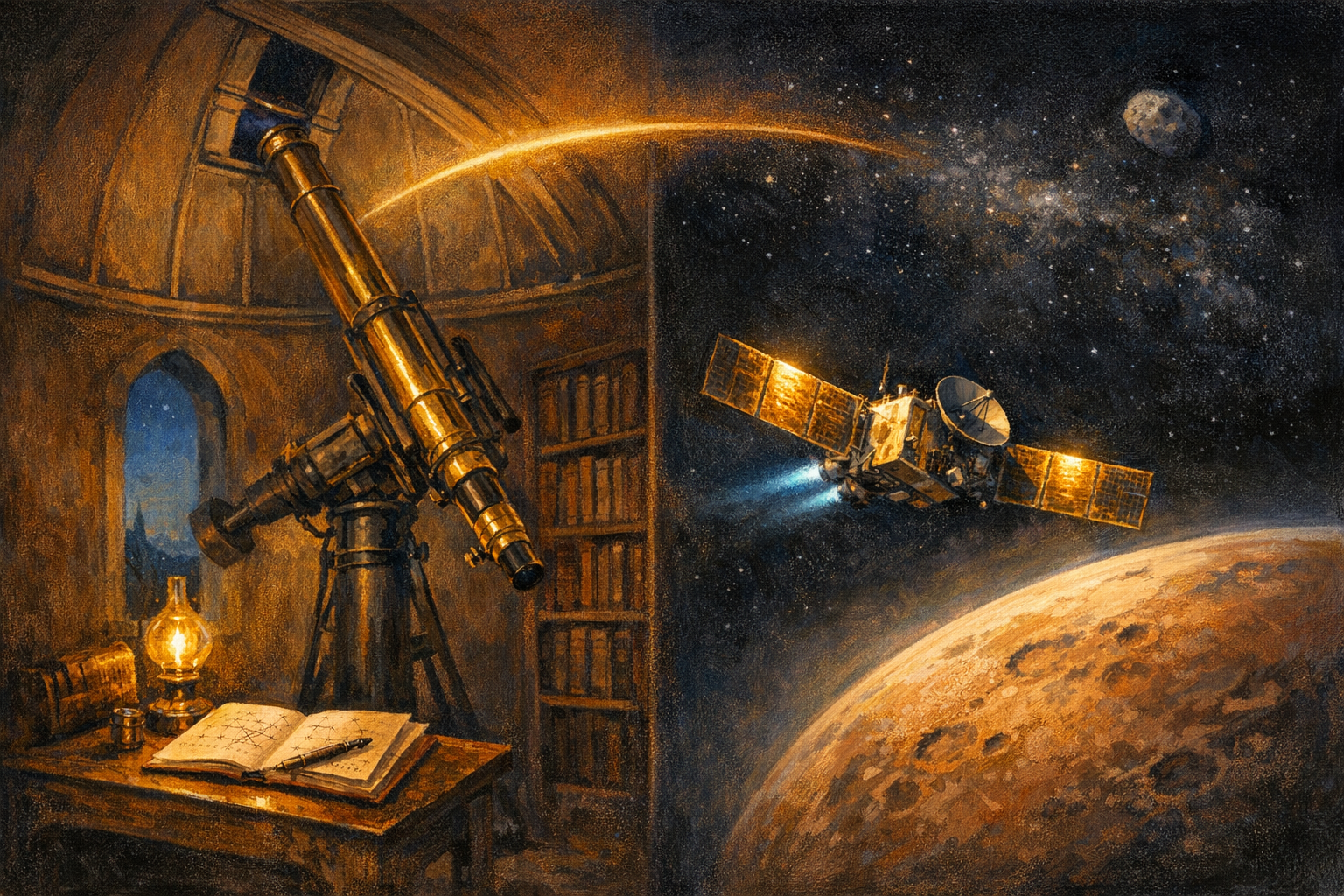
In an unheated tower of the Capodimonte Observatory on a hill above Naples, on the cold clear night of the seventeenth of March, eighteen fifty-two, a thirty-three-year-old Italian astronomer named Annibale de Gasparis pressed his eye to the brass eyepiece of a Cauchoix-Lerebours refractor and noticed a faint point of light in the constellation Sagittarius that had not been there the previous evening.
He measured its motion against the background stars. He recorded the position. He sent the discovery by post to the Astronomische Nachrichten in Hamburg. He named the new object Psyche, after the Greek goddess of the soul, with whom Eros had fallen in love.
De Gasparis was at that point Europe's most prolific discoverer of asteroids. Of the eighteen known when he started, he had personally found eight. He would find one more, Hygiea, the fourth-largest in the main belt, before retiring from observational work. He held the chair of astronomy at the University of Naples from 1860 until his death in 1892. The biographical literature mentions, repeatedly, that he was so devoted to his work that he never married.
He had no way of knowing what Psyche was made of. The spectroscope was seven years away. The discovery that the Earth itself has a metal core was fifty-four years away. The notion that some asteroids might be exposed metal cores of destroyed protoplanets did not exist in 1852.
On Friday this week, one hundred and seventy-four years after the night de Gasparis saw the point of light, a NASA spacecraft also called Psyche will fly past Mars at twelve thousand three hundred miles an hour, two thousand eight hundred miles above the planet's surface, using the gravity of Mars to slingshot itself toward the asteroid de Gasparis named.
This is the story of how, in the century and three-quarters between the discovery and the mission, the field figured out what Psyche probably is, and of what NASA is about to find out.
What de Gasparis had seen was a body roughly two hundred and twenty kilometres across at its widest dimension, orbiting the Sun once every five years in the outer reaches of the main asteroid belt. For its first hundred years in the catalogue, that was all anyone could say about it.
The first hint that asteroids might be made of different things came in the nineteen sixties, when reflectance spectroscopy could finally be done well enough to distinguish silicate-rich bodies from carbonaceous ones. By the nineteen seventies asteroids had been sorted into spectral classes: S for silicaceous, C for carbonaceous, M for metallic. Psyche, the field discovered, was the largest M-type body in the belt. Its visible-light spectrum looked like the spectrum of an iron-nickel meteorite, the kind that occasionally falls on the Earth and is later traced, on isotopic grounds, to the core of an asteroid destroyed somewhere in the early Solar System.
The theory that took shape was that Psyche might be an exposed metal core, the iron-nickel inner part of a former protoplanet whose silicate mantle had been stripped away by a violent collision four and a half billion years ago. If correct, the implication was extraordinary. The Earth's metal core is hidden inside the Earth. We can only sense it indirectly, through the shadows that earthquake waves cast as they refract around it. The Danish seismologist Inge Lehmann had inferred the existence of the solid inner core, in 1936, from a single fortuitous earthquake recorded in New Zealand. Geophysics has been working with that indirect approach ever since. Psyche, if it really were a metal core sitting in space, would let us look at one from the outside.
The radar studies that followed in the nineteen nineties, from the Arecibo and Goldstone telescopes, found a high radar reflectivity consistent with metal. The density estimates that followed in the twenty tens, however, made the picture more complicated. The bulk density of Psyche, derived from the gravitational pull it exerted on its tiny natural satellites, came in at about four grams per cubic centimetre. Pure iron-nickel has a density closer to eight. Either Psyche has very large internal voids, like a rubble pile of metal blocks loosely held together, or it is a mixture of metal and silicate rather than pure metal. The James Webb Space Telescope spectroscopy from twenty twenty-four, looking in the mid-infrared, found evidence of hydrated minerals on the surface, suggesting that whatever Psyche is, it is not a clean exposed core.
In two thousand and fifteen the geophysicist Lindy Elkins-Tanton at Arizona State University submitted a proposal to NASA's Discovery programme for a low-cost mission to find out what Psyche actually is. NASA accepted on the fourth of January twenty seventeen. The spacecraft launched on the thirteenth of October twenty twenty-three on a Falcon Heavy from the Kennedy Space Center, drifted out to the orbit of Mars on solar-electric propulsion, and is now using the gravity of Mars to bend its trajectory toward arrival at the asteroid in late twenty twenty-nine.
The flyby this Friday is a tuning exercise. The Psyche team plans to use the Mars approach to calibrate the spacecraft's multispectral imager and to practise the data-collection sequence that will be used at the asteroid four years from now. The Mars images will be a useful scientific by-product. They are not the point. The point is to make sure that the instruments still work after twenty months in space.
The arc closes. Annibale de Gasparis spent the rest of his life cataloguing other asteroids. He thought of Psyche, on the few occasions he wrote about it again, as a point of light he had given a name to. The notion that the point of light he had seen on a cold spring night in 1852 was probably a piece of the inside of a destroyed world, a piece of the kind of thing the Earth itself is made of at its very centre, only the kind that is normally entirely inaccessible to us, would have struck him as extravagant.
Lindy Elkins-Tanton's team will be in mission control at the Jet Propulsion Laboratory in California this Friday evening, watching the data come in from the Mars flyby. The asteroid de Gasparis named is still four years away.
He would, one suspects, have followed the news with interest.