Every day, we find the historical story hiding inside the headlines. Riveting narratives
that connect the past to the present, and make you wonder what happens next.
Choose your topics
You'll receive one email per topic, per day. Pick as many as you like.
Today's Echo · History & Current Events
1922 to 1928, the British Empire and the United States
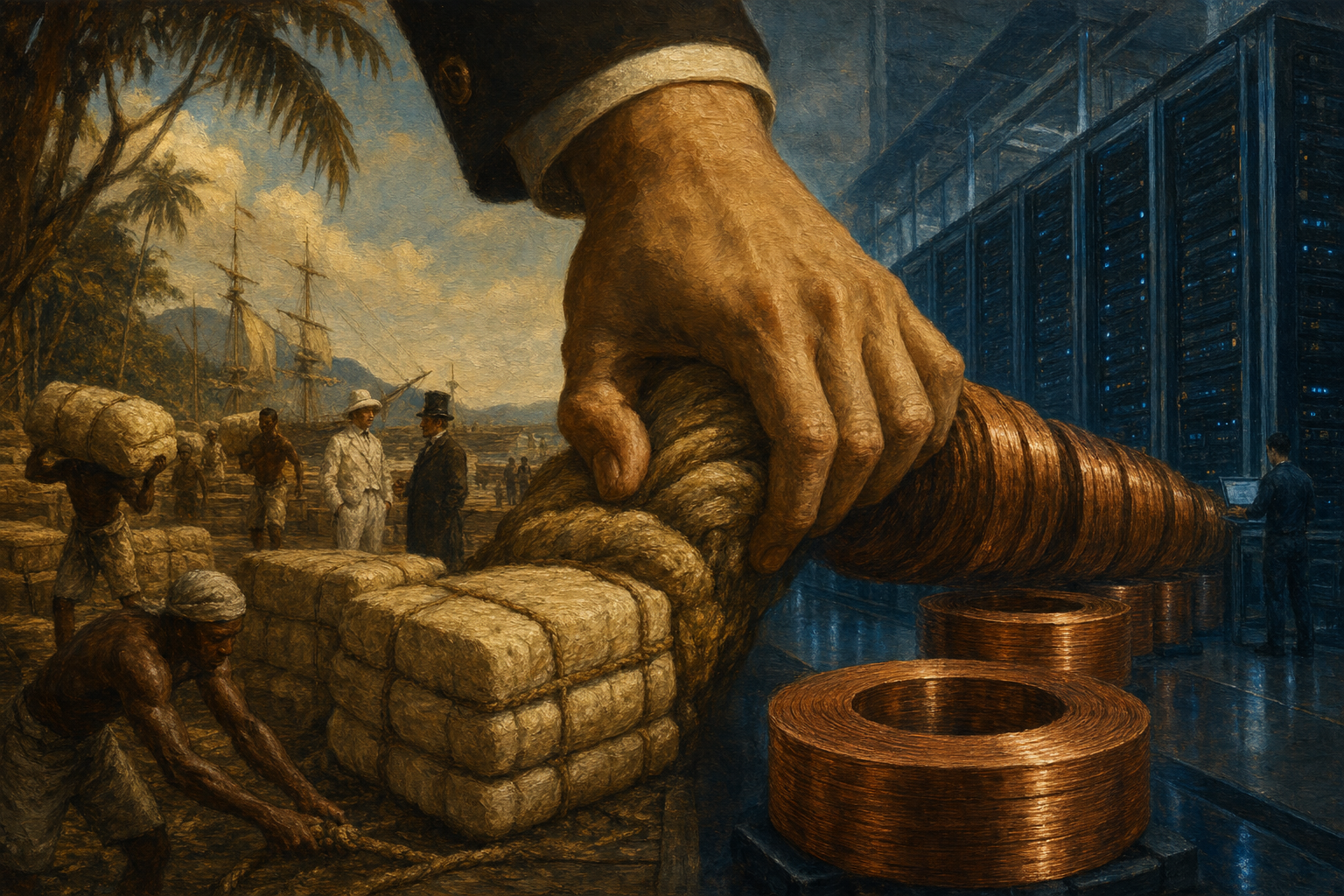
In 1925 the most valuable thing in America was a milky sap from trees on the far side of the world. Rubber ran every car, factory and phone line, Britain's colonies grew about three quarters of it, and Britain had just choked the supply: the Stevenson Plan restricted exports to drive the price from around thirteen cents a pound past a dollar. America, which bought most of the world's rubber, did not just pay. Commerce Secretary Herbert Hoover funded a global hunt for new supply, Harvey Firestone planted a million acres of Liberia, chemists chased synthetic rubber, and the cartel collapsed when the Dutch refused to join and flooded the market. Squeeze a customer hard enough and you do not make him pay; you teach him to never need you again. A century later it is copper for AI data centres and China's grip on rare earths, and the same scramble has begun.
•3 min readA century later the same dynamic has returned with metal instead of sap. The lifeblood of the AI age is copper (a single large AI-ready data centre can require up to about 50,000 tonnes) and rare earth elements used in magnets, motors and weapons. Analysts forecast a structural refined-copper deficit (J.P. Morgan projecting roughly 330,000 tonnes for 2026), with new mines averaging about 17.9 years from discovery to production. The choke point is as lopsided as rubber was in 1925: China processes around 90 percent of the world's rare earths and has used that control as leverage, prohibiting exports of gallium and germanium to the US from December 2024 and adding medium and heavy rare earths and magnets to its export-control list through 2025. Washington's response could have been written by Hoover: in February 2026 it launched a Strategic Critical Minerals Reserve (Project Vault), backed by a $10 billion EXIM loan, and pressed a global search for friendly supply, recycling and substitutes. The lesson of the rubber war is not that a choke point is permanent but the opposite: squeeze a customer hard enough and you teach him, and everyone watching, how to make sure he never needs you again.
Bolivia, 17 October 2003: a Chicago-educated technocratic president fled the country by helicopter after sixty-seven people were killed in two weeks of road blockades organised by a coca-grower congressman named Evo Morales. This week the streets of La Paz are blocked again. Morales is sixty-six, banned from running for office, and back at the architect's table.
•6 min readLa Paz under siege, May 2026. President Rodrigo Paz, six months in office, faces the same canyon-road blockades that brought down Sánchez de Lozada in 2003. Morales is barred from running for office. His networks are running the blockades.
June 1887 to June 1890, the German Empire under Bismarck and the early reign of Wilhelm II
Berlin, 18 June 1887: the German chancellor signed a secret three-year treaty with Russia at the same time he was bound by a public treaty against Russia. The arrangement held the European peace for three more years. Then his emperor died. Trump and Putin visited Beijing within a week of each other this month.
•7 min readBeijing, May 2026: Xi receives Trump (13-15 May) and Putin (19-20 May) at the Great Hall within a week. Energy and security joint statements with Russia; no treaty with the US; 'China holds the cards' framing.
August 1974 to December 2021, the Republic of Korea
Seoul, 15 August 1974: a 22-year-old woman watched her mother die at the National Theatre. Two presidencies, an assassination, an impeachment and a prison sentence later, the same arc is being walked in Peru. Keiko Fujimori is in her fourth presidential runoff on 7 June.
•6 min readPeru's 7 June 2026 presidential runoff: Keiko Fujimori (Fuerza Popular, 17.19%) versus leftist Roberto Sánchez (Juntos por el Perú, 12.03%). It is Keiko's fourth consecutive runoff, eight months after the death of her father Alberto Fujimori.
At dawn on 30 September 1980, four Iranian F-4 Phantoms refuelled in the air over the border, climbed deliberately high, then dropped to the deck and bombed Iraq's Osirak reactor. It was the first attack on a nuclear plant in human history. Forty-six years later something flew at the UAE's Barakah.
•6 min read17 May 2026 drone strike on the UAE's Barakah Nuclear Energy Plant: three drones, two intercepted, one hit a perimeter substation generator. No claim of responsibility. UAE adviser pointed at Iran's proxy network.
Reykjavík, 12 October 1986: Reagan and Gorbachev nearly abolished all nuclear weapons and signed nothing. The press called it a disaster. Within five years the Cold War was over. In Beijing this month, Trump and Xi did the same.
•6 min readThe Trump-Xi Beijing state summit (13-15 May 2026): no treaty signed, a walk to the Temple of Heaven, and parallel actions including Yuan Hua Hu's Hormuz transit, the cancelled Polish deployment, the Havana visit, and Kinmen tourism resumption.
Paris, 29 June 1853: Napoleon III handed a prefect a map and told him to air the city, unite it, beautify it. Three hundred and fifty thousand poor Parisians were pushed out of the centre. Lagos is doing the same thing this week.
•6 min readThe Lagos waterfront clearances in Makoko and other lagoon communities (Dec 2025-May 2026): 10,000+ displaced, 3,000+ homes destroyed, 12 dead from tear gas including two infants, for luxury 'Dubai of Africa' development.
Rome, 67 BCE: the grain ships could not get past the pirates. The Senate handed one man the entire Mediterranean, and he cleared it in three months. The Republic never recovered. The Strait of Hormuz, May 2026: same chokepoint, same emergency, same temptation.
•6 min readThe Strait of Hormuz blockade, Project Freedom, and the unilateral executive authority exercised in the 2026 Iran war.
In 1684 Pope Innocent XI bound the Habsburg empire, Poland, and Venice into a coalition against the Ottomans with an exclusivity clause: no separate peace. Fifteen years later, at Karlowitz, the Ottomans lost most of Hungary. On 15 May 2026 the IDF chief was received in Abu Dhabi.
•6 min readIDF chief Eyal Zamir received by Sheikh Mohammed bin Zayed in Abu Dhabi, 15 May 2026; Iron Dome batteries on UAE territory; the Abraham Accords (15 September 2020) functioning as a multi-power coalition against Iran.
1956 to 1972, Moscow, Camp David, Beijing, Wuhan, Ussuri
In 1956 Nikita Khrushchev denounced Stalin and embraced peaceful coexistence with the United States. By 1960 the Soviet Union had withdrawn more than a thousand advisors from China and the alliance was broken. On 14 May 2026 Xi Jinping told Donald Trump in Beijing that Iran could never have a nuclear weapon. China is Iran's patron.
•5 min readTrump-Xi Beijing summit, 14 May 2026: joint statement that Iran 'can never have a nuclear weapon' and Hormuz 'must remain open,' preceded by Hegseth's 16 April 2026 announcement of Chinese assurances to halt weapons supply to Iran.
1810s to 1914, Central Asia, Saint Petersburg, London, Berlin
On 31 August 1907 Britain and Russia ended a century of Great Game rivalry by carving up Persia, Afghanistan and Tibet into spheres of influence. The countries themselves were not consulted. Seven years later, the First World War. On 14 May 2026 Donald Trump arrives in Beijing to do the same kind of business with Xi Jinping.
•6 min readTrump-Xi Beijing summit, 14-15 May 2026: the first US state visit to China since 2017, with a 37-item agenda covering trade, rare earths, advanced-semiconductor controls, Taiwan, the Iran war, Hormuz, and bilateral AI regulation.