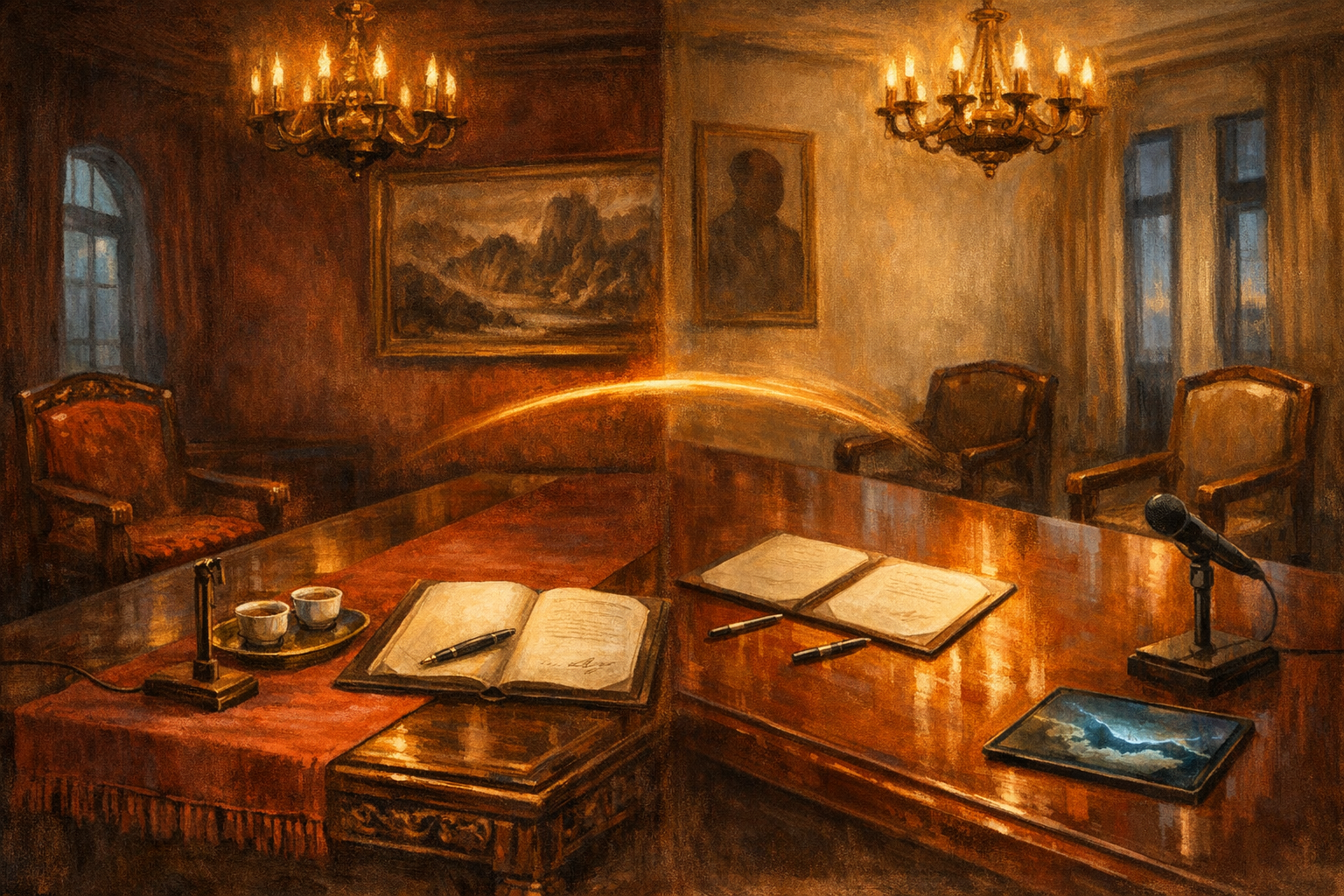
The joint statement from the Trump-Xi summit at the Diaoyutai State Guesthouse in Beijing on 14 May 2026 contained three Iran clauses and no Taiwan clauses. The two governments agreed that Iran "can never have a nuclear weapon," that the Strait of Hormuz "must remain open," and that no power should militarise the Strait or charge a toll for its transit. Xi told Trump that China would increase its purchases of American crude oil to reduce Chinese dependence on Middle Eastern supply. The Chinese position on Taiwan was confined to a verbal warning that mishandling the question would produce "clashes and even conflicts," delivered in private; it was not in the joint statement.
The Iran clauses had been pre-arranged. On 16 April 2026, twenty-eight days before the summit, the United States Secretary of Defense Pete Hegseth had announced that Beijing had provided "high-level assurances" to the White House that it would not send further weapons to Iran, including the surface-to-air missile batteries that US intelligence (reported by CNN on 11 April 2026) had assessed China was about to ship. Hegseth attributed the breakthrough to "the strong and direct relationship" between President Trump and President Xi.
Between January 2024 and April 2026, China had been Iran's primary external arms supplier. Beijing had transferred loitering munitions, advanced air defence batteries, the BeiDou satellite navigation system that the Islamic Republic used to mask its forces, and (in February 2025) one thousand tons of sodium perchlorate, the solid rocket fuel sufficient to power between two and three hundred Iranian medium-range ballistic missiles. Negotiations were under way through 2025 on CM-302 anti-ship cruise missiles and hypersonic glide vehicles. The total value of Chinese arms shipments to Iran since January 2024, according to Global Defense Corp, exceeded five billion US dollars. The HQ-16 medium-range and HQ-17AE short-range surface-to-air missile batteries that US intelligence detected China preparing for shipment in early April 2026 would have rebuilt the layered Iranian air defence that the Israeli June 2025 campaign had destroyed.
That shipment never moved. The Hegseth statement of 16 April was the public face of a private decision. The May 14 summit confirmed it.
The precise historical precedent for the move is sixty-seven years old.
On 25 February 1956, in a closed session of the Twentieth Congress of the Communist Party of the Soviet Union in Moscow, Nikita Khrushchev delivered the speech "On the Cult of Personality and Its Consequences." It denounced Joseph Stalin's terror, blamed him personally for the purges, and signalled the beginning of de-Stalinisation. Across the next three years Khrushchev pivoted the Soviet Union toward what he called "peaceful coexistence" with the United States: a doctrine that capitalism and communism would compete economically rather than militarily, and that nuclear war between the two blocs was unwinnable and must be avoided.
The Chinese leader Mao Zedong heard the doctrine as treason. The People's Republic of China had been founded on the 1 October 1949 declaration of Mao at Tiananmen, and from its first day it had depended on Soviet technical assistance: the steel mills of Wuhan, the aircraft factories of Shenyang, the nuclear programme initiated under the Sino-Soviet Treaty of 1957. Mao believed the communist world was on the offensive. He thought Khrushchev's détente with Eisenhower was Marxist revisionism.
In September 1959 Khrushchev visited the United States for the first time, spent thirteen days touring American factories and cornfields, and met Eisenhower at Camp David for two days of one-on-one talks. The newspapers called the result "the Spirit of Camp David." Khrushchev flew home, refuelled at Vladivostok, and then continued directly to Beijing to attend the tenth-anniversary celebrations of the People's Republic on 1 and 2 October 1959.
Mao was not pleased to see him. There was no honour guard at the Beijing airport. No senior Chinese leader gave a welcoming speech. When Khrushchev insisted, in the negotiations the next day, on delivering a remark to a small group of Chinese officials, no microphone was provided. He spoke without amplification. The negotiations themselves, over Taiwan, the Sino-Soviet nuclear-sharing programme, and the future of the alliance, broke down. Khrushchev left Beijing two days after he had arrived. He did not return.
In the summer of 1960, Khrushchev ordered the withdrawal of the entire Soviet advisory mission from China. More than a thousand engineers, scientists, and military officers were ordered home with seventy-two hours' notice; the contracts they had been working on, on the order of two hundred and fifty industrial and military projects across China, were cancelled. The 1957 Sino-Soviet nuclear-sharing agreement was repudiated. The split was institutionalised by 1961. In March 1969 Soviet and Chinese troops fought a brief but deadly border war at Zhenbao Island on the Ussuri River. The Sino-Soviet alliance had become a Sino-Soviet front.
Three years later, on 21 February 1972, Richard Nixon landed in Beijing. Mao Zedong, who had spent fifteen years denouncing American imperialism, received him in his private library. The Shanghai Communiqué was signed seven days later. The structural logic was clear: the patron who had abandoned the junior partner had created the condition under which the junior partner would defect to the patron's rival.
The 2026 question is whether the same trajectory is now possible for Iran.
Iran's strategic position as of the Trump-Xi summit is that its primary arms supplier has publicly committed not to ship further weapons. Its other major patron, the Russian Federation, has its own war and its own dependence on Chinese supply chains. Its junior allies (Hezbollah, the Houthis, the Iraqi militias) have been substantially degraded by Israeli and American action. Its currency, the rial, is trading at 1.8 million to the dollar. Its nuclear programme is the subject of an explicit Trump-Xi declaration. The supreme leader, Mojtaba Khamenei, took office two and a half months ago and has the religious credentials his father did not believe in.
If the analogy with the Sino-Soviet split is right, the path forward for Iran runs through the moment Mao reached in 1971. The country that has been abandoned by its patron looks, eventually, for an opening to the patron's rival. Mao's rival was Washington. Iran's rival, in this analogy, is also Washington. The proper analogue is Tehran's Shanghai Communiqué.
The Sino-Soviet split took fifteen years to mature into Nixon in Beijing. Iran's clock began on 16 April 2026 with the Hegseth statement, or on 14 May 2026 with the joint communique. It would not need to take fifteen years.
The Chinese leadership has just demonstrated something that the Iranian leadership had not previously believed possible. A patron, asked the right way, in the right venue, by the right rival, will choose the rival.