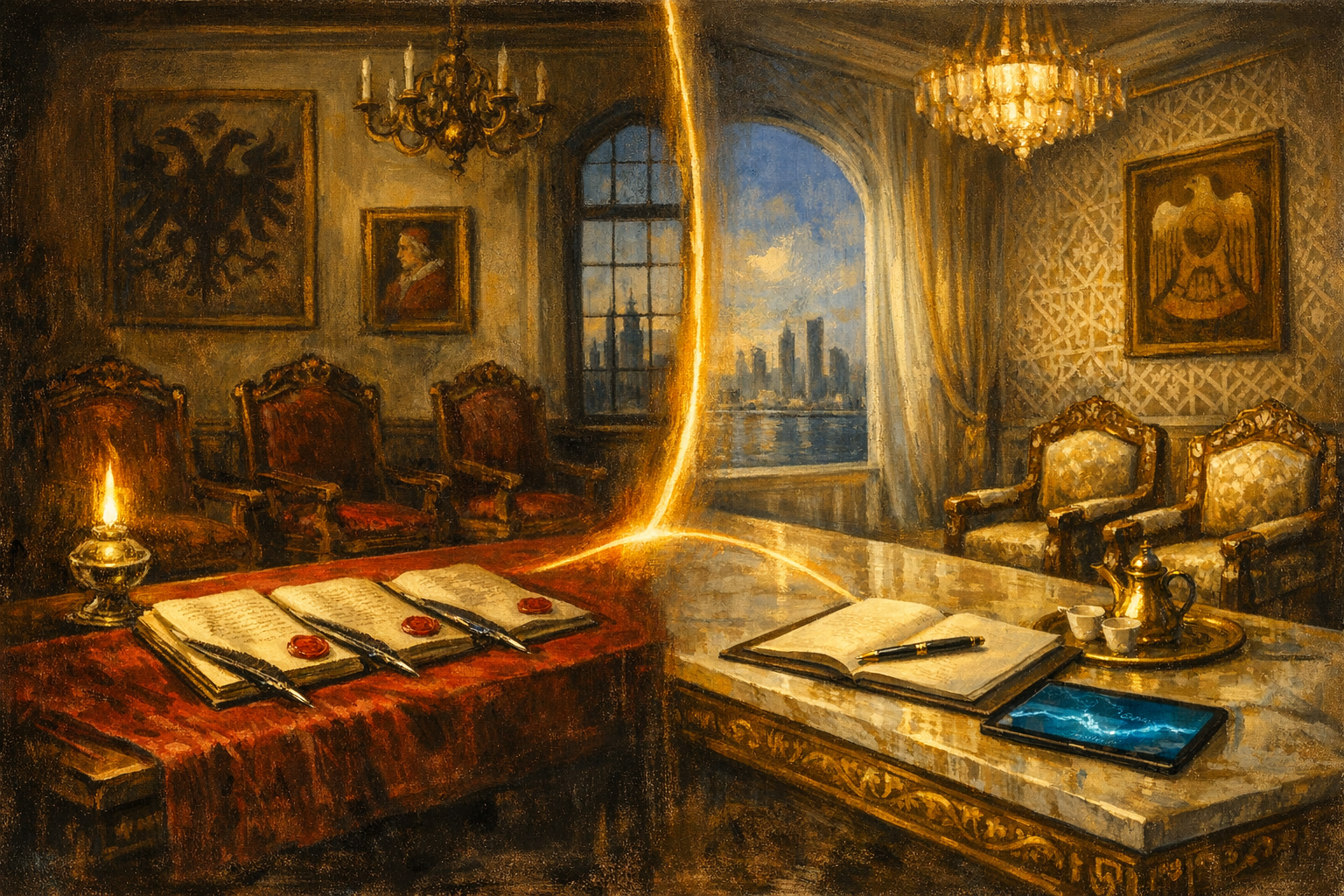
The Kan public broadcaster reported, on the morning of 15 May 2026, that Lieutenant General Eyal Zamir, the chief of the General Staff of the Israeli Defence Forces, had quietly travelled to the United Arab Emirates in the previous days, accompanied by other senior IDF officials, and had been received by Sheikh Mohammed bin Zayed, the president of the UAE. Days earlier Israeli press had reported that the heads of the Shin Bet and the Mossad had also visited the Gulf federation during the war, that Prime Minister Benjamin Netanyahu himself had made an unannounced visit (a claim the UAE denied), and that Israel had quietly shipped Iron Dome batteries and air-defence personnel to UAE territory in the second week of May. The UAE foreign ministry issued a careful statement that its relations with Israel were "public and conducted within the framework of the Abraham Accords." Iran's foreign ministry called the visit, when it broke, "unforgivable."
The Abraham Accords had been signed at the White House on 15 September 2020 by Benjamin Netanyahu, Sheikh Abdullah bin Zayed (the UAE foreign minister), and Sheikh Khalid bin Ahmed Al Khalifa (the Bahraini foreign minister), mediated by President Trump. They were the first Arab-Israeli normalisation agreements since the Israel-Jordan treaty of 1994. For five and a half years they had been a diplomatic instrument: ambassadors, trade agreements, direct flights, university exchanges. In May 2026 they became a military coalition.
The structural precedent for this kind of arrangement is three hundred and forty-two years old.
In the summer of 1683 the Ottoman Grand Vizier Kara Mustafa Pasha had laid siege to Vienna at the head of an army of well over a hundred thousand men. The city, defended by an imperial garrison of around fifteen thousand under Count Ernst Rüdiger von Starhemberg, held out for two months. On 12 September 1683 a relief army of approximately seventy thousand commanded by the Polish king John III Sobieski (with the Holy Roman Emperor Leopold I, who had fled the city, watching from Passau) and including Saxon and Bavarian contingents fell on the Ottoman camp from the heights of the Kahlenberg. The Ottomans were routed; Kara Mustafa fled to Belgrade and was strangled there by the Sultan's executioners in December. The siege had been Ottoman Europe's high-water mark. From Vienna, every road ran east.
Pope Innocent XI, who had spent five years before the siege borrowing from Italian bankers and Habsburg treasuries to fund the relief army, understood that the rout was an opportunity. The Ottomans had been at war with Europe for three and a half centuries. The Habsburgs had been at war with the Ottomans, in one form or another, since 1526. Sobieski's Poland had been at war with the Ottomans since the 1620s. Venice had been at war with the Ottomans since 1645 over Crete. Each of the Christian powers had its own quarrel and its own treaty calendar. None on its own could turn the rout at Vienna into an Ottoman retreat. The Pope set about building an alliance.
The model was the Treaty of Warsaw of 1683, which Sobieski had signed with Leopold to commit Poland to relieve Vienna. Innocent XI's diplomats took the Warsaw text and rewrote it to bind three Christian powers (Habsburg empire, Poland-Lithuania, the Venetian Republic) to make war on the Ottoman Empire together until all three made peace together. The exclusivity clause was the load-bearing detail: no member could conclude a separate peace, even on advantageous terms, without the other two. The Pope sworn the signatories in personally at Rome on 24 May 1684, declared himself patron of the League, and continued to subsidise the war from the apostolic treasury.
The signatures themselves were affixed on 5 March 1684 at Linz, in the audience hall of Leopold I's interim residence (Vienna was still under repair). The Polish ambassador Marek Matczyński signed for Sobieski; Domenico Contarini signed for the Doge of Venice; Leopold I signed for himself. The League was complete.
Russia joined two years later. Tsarine Sophia, acting as regent for her brothers Ivan V and Peter the Great, accepted the Pope's personal invitation on 26 April 1686, contingent on a perpetual peace with Poland that ceded Kiev to the Tsardom. Russia's participation was always more nominal than the others, but the symbolic weight of an Orthodox state joining a Catholic-organised alliance against Islam was the diplomatic story of the decade.
The Holy League's military record was methodical and astonishing. At the second battle of Mohács in August 1687 the imperial general Charles V, Duke of Lorraine, broke the Ottoman field army at the same site where Süleyman the Magnificent had broken the Hungarian kingdom in 1526. Belgrade fell to the Habsburgs in 1688. At the battle of Slankamen in August 1691 the imperial general Ludwig William, Margrave of Baden-Baden, killed the Ottoman Grand Vizier and twenty thousand Ottoman troops. At the battle of Zenta on 11 September 1697 Prince Eugene of Savoy, then thirty-three years old, surprised the Ottoman army crossing the Tisza River and destroyed it: thirty thousand Ottoman dead, including the Grand Vizier; four hundred imperial losses. The League's separate Venetian campaign retook the Peloponnese. Its Polish campaign reduced the Ottoman Sanjak of Podolia. Its Russian campaign took Azov.
On 26 January 1699 at Karlowitz on the Danube, the Ottoman Empire signed peace treaties with the Habsburg empire, the Polish-Lithuanian Commonwealth, and the Venetian Republic. The Ottomans ceded most of Hungary, all of Transylvania (which became an Austrian principality), Slavonia, Croatia, the Peloponnese, and significant parts of Dalmatia. It was the first time in three and a half centuries that the Ottoman Empire had lost substantial territory in Europe. Karlowitz did not destroy the Ottoman Empire (which would survive until 1922), but it permanently ended its European expansion. The fifteen years from Linz to Karlowitz had reversed the trajectory of three hundred and fifty.
The structural lesson of the Holy League is in two parts. First, multi-power coalitions against a regionally dominant power can be assembled across confessional, ideological, and historical lines when there is a convening third party. Pope Innocent XI was the convener of 1684. Donald Trump was the convener of 2020. Second, the binding instrument matters: the exclusivity clause that forbade separate peace was what gave the Holy League its leverage. The Abraham Accords, as written in 2020, are bilateral normalisation agreements rather than collective-security commitments. They do not contain an exclusivity clause. They are not, as drafted, the Holy League.
What May 2026 showed is that the Abraham Accords may yet operate as if they were. The IDF chief in Abu Dhabi, the Iron Dome batteries on UAE territory, the Shin Bet chief in the Gulf, the Mossad chief, the Israeli prime minister, the joint US-Israeli operations against Iran: this is what the Holy League looked like in its third year, with each member fighting its own theatre under a common political umbrella. The 1684 League's exclusivity clause was its formal strength; the 2026 coalition's informal strength is that the Iran war is functionally exclusive (none of its participants can sign a separate peace with Tehran without losing the others).
The Treaty of Karlowitz took fifteen years from the signing at Linz. The Abraham Accords are five and a half years old. The wars of the early 2026 are the third year of the Iran war that began with Operation Roaring Lion in June 2025.
What the Karlowitz arithmetic suggests is that the trajectory the Iran of the 1979 revolution had been on for forty-seven years is now reversible, and that the instrument of reversal is not a single battle or a single treaty but a multi-power coalition assembled by a convening third party and held together by the inability of any member to make a separate peace. The IDF chief in Abu Dhabi on 15 May 2026 is at year five and a half of fifteen. The arithmetic suggests another nine and a half.
Pope Innocent XI never lived to see Karlowitz. He died in 1689, six years after the relief of Vienna and ten before the peace. The convener does not need to live to see the result.