Every day, we find the historical story hiding inside the headlines. Riveting narratives
that connect the past to the present, and make you wonder what happens next.
Choose your topics
You'll receive one email per topic, per day. Pick as many as you like.
Today's Echo · History & Current Events
1922 to 1928, the British Empire and the United States
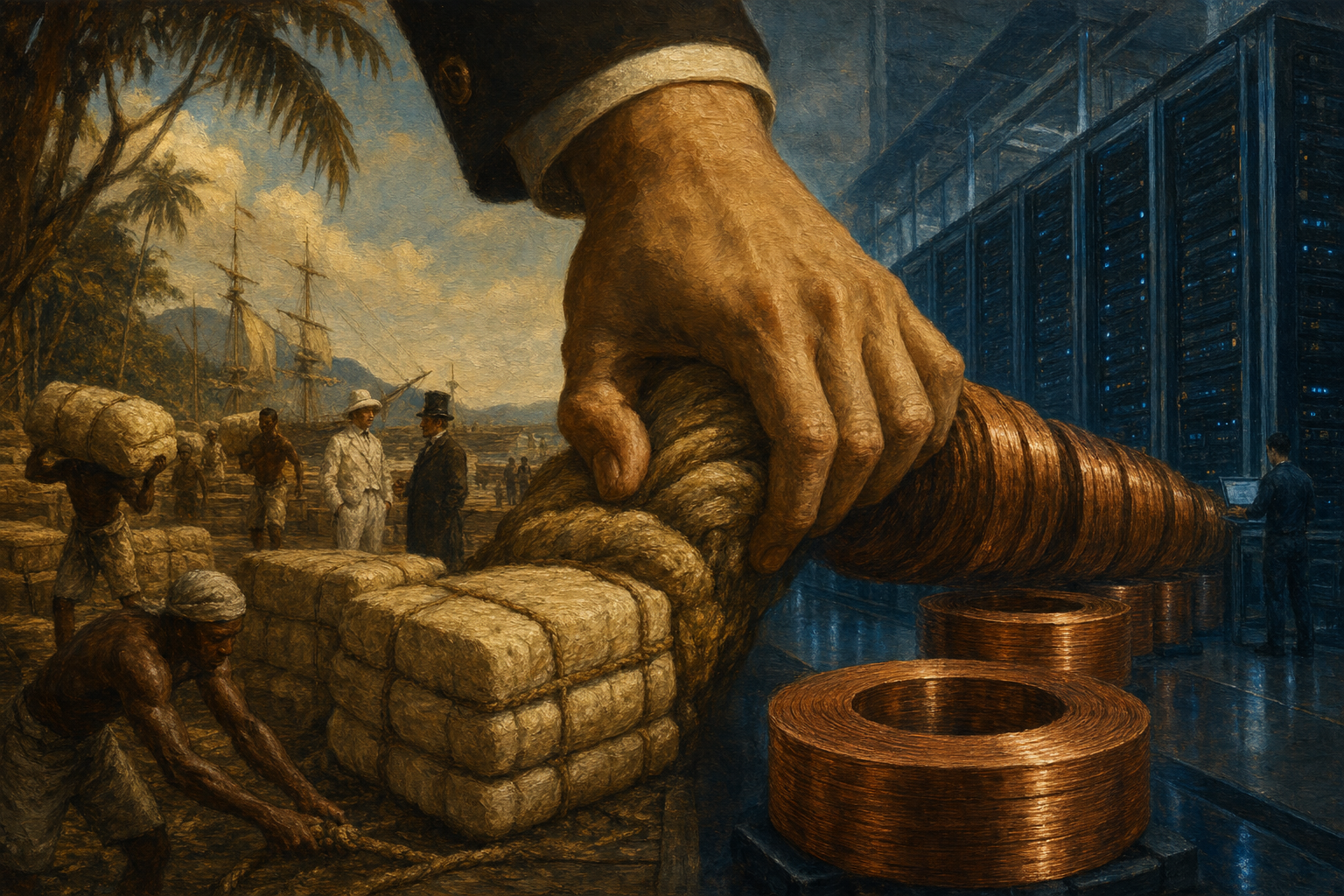
In 1925 the most valuable thing in America was a milky sap from trees on the far side of the world. Rubber ran every car, factory and phone line, Britain's colonies grew about three quarters of it, and Britain had just choked the supply: the Stevenson Plan restricted exports to drive the price from around thirteen cents a pound past a dollar. America, which bought most of the world's rubber, did not just pay. Commerce Secretary Herbert Hoover funded a global hunt for new supply, Harvey Firestone planted a million acres of Liberia, chemists chased synthetic rubber, and the cartel collapsed when the Dutch refused to join and flooded the market. Squeeze a customer hard enough and you do not make him pay; you teach him to never need you again. A century later it is copper for AI data centres and China's grip on rare earths, and the same scramble has begun.
•3 min readA century later the same dynamic has returned with metal instead of sap. The lifeblood of the AI age is copper (a single large AI-ready data centre can require up to about 50,000 tonnes) and rare earth elements used in magnets, motors and weapons. Analysts forecast a structural refined-copper deficit (J.P. Morgan projecting roughly 330,000 tonnes for 2026), with new mines averaging about 17.9 years from discovery to production. The choke point is as lopsided as rubber was in 1925: China processes around 90 percent of the world's rare earths and has used that control as leverage, prohibiting exports of gallium and germanium to the US from December 2024 and adding medium and heavy rare earths and magnets to its export-control list through 2025. Washington's response could have been written by Hoover: in February 2026 it launched a Strategic Critical Minerals Reserve (Project Vault), backed by a $10 billion EXIM loan, and pressed a global search for friendly supply, recycling and substitutes. The lesson of the rubber war is not that a choke point is permanent but the opposite: squeeze a customer hard enough and you teach him, and everyone watching, how to make sure he never needs you again.
Oliver Cromwell's son Richard inherited the English Commonwealth in September 1658. The New Model Army deposed him 264 days later. In March 2026, Ali Khamenei's son Mojtaba inherited the Islamic Republic of Iran. The exiled Pahlavi pretender is in Washington.
•6 min readTehran, 9 March 2026: the IRGC pressured the Assembly of Experts to elevate Mojtaba Khamenei, midranking cleric and son of the assassinated Ali Khamenei, to third Supreme Leader against his father's expressed opposition.
1971, Islamabad, Beijing, Washington, New Delhi, the Bay of Bengal and Dhaka
In 1971, Richard Nixon used Pakistan as the back channel to Beijing and sent the USS Enterprise into the Bay of Bengal to intimidate India. India responded by signing a friendship treaty with the Soviet Union and dismembering Pakistan in two weeks. Fifty-five years later, Donald Trump's Pakistan tilt is making New Delhi uneasy.
•6 min readBloomberg, 8 May 2026: One year after the May 2025 India-Pakistan crisis, Trump's warm Pakistan ties (the WLFI crypto MoU; White House reception of Field Marshal Asim Munir) are giving Islamabad diplomatic cover and worrying New Delhi.
9th century BC to 1939, Olympia, Berlin and the Polish border
Hitler invoked an ancient Greek convention in 1936 so the world's leaders could comfortably attend his Olympics. Three years later he invaded Poland. Ninety years later, Putin needed a three-day ceasefire to hold his Victory Day parade.
•5 min readRed Square, 9 May 2026: Putin presides over his smallest Victory Day parade in 26 years (no military hardware, 5 foreign leaders), made possible by a Trump-brokered 9-11 May ceasefire with 1,000-for-1,000 prisoner exchange.
1971 to 1977, Camp David, Manhattan, Tokyo, Rome, Washington
A Japanese zipper company sued over a 10 percent global tariff in 1971. The warning the 1975 court left behind is what just struck down Donald Trump's tariffs, twice.
•6 min readCourt of International Trade, 7 May 2026: 2-1 ruling against Trump's second 10 percent global tariff, imposed under Section 122 of the Trade Act of 1974. The administration is preparing to refund 166 billion dollars plus interest.
Berlin, May 1873. Beijing, May 2026. The same problem, on a much larger scale: what happens to a country that absorbs more money, faster, than it can possibly digest?
•6 min readChina holds $3.43 trillion in foreign-exchange reserves (February 2026) and ran a record $1.2 trillion 2025 trade surplus, into a financial system that has already produced the post-Evergrande property crisis.
Berlin, March 1930. Bucharest, May 2026. The same vote, twice.
•6 min readRomania's parliament topples Bolojan's pro-EU coalition 281-4 (5 May 2026) after the Social Democrats walk out over austerity, opening a path for the far-right AUR.
Tirana, October 1971. Mbabane, May 2026. The smallest ally casts the longest shadow, until its patron decides otherwise.
•8 min readTaiwan's President Lai Ching-te returns from his first overseas trip to Eswatini (5 May 2026), Taiwan's last African ally, escorted home by F-16Vs aboard King Mswati III's Airbus, a former China Airlines aircraft.
London, August 1971. Vienna, May 2026. A drunk KGB officer in handcuffs and an antenna forest on a roof. Two host countries, fifty-five years apart, finally saying enough.
•7 min readAustria expels three Russian diplomats on 4 May 2026 over a rooftop 'antenna forest' at Russian diplomatic properties in Vienna, repeating Operation FOOT's structural play at much smaller scale.
May 1801 to June 1805, Tripoli and the Mediterranean
Tripoli, May 1801. The Strait of Hormuz, May 2026. The same convoy operation, the same word: humanitarian.
•7 min readTrump's 'Project Freedom' (announced 3 May 2026, beginning 4 May) sends the US Navy to escort foreign vessels through the Strait of Hormuz, repeating Jefferson's 1801 convoy gambit.
December 1917 to March 1918, Brest-Litovsk and Petrograd
Brest-Litovsk, February 1918. Tehran, May 2026. The same gambit, in two languages.
•7 min readIran's 14-point counter-proposal to the US ceasefire offer (2 May 2026) attempts the maximalist diplomatic gambit Trotsky tried at Brest-Litovsk in February 1918.