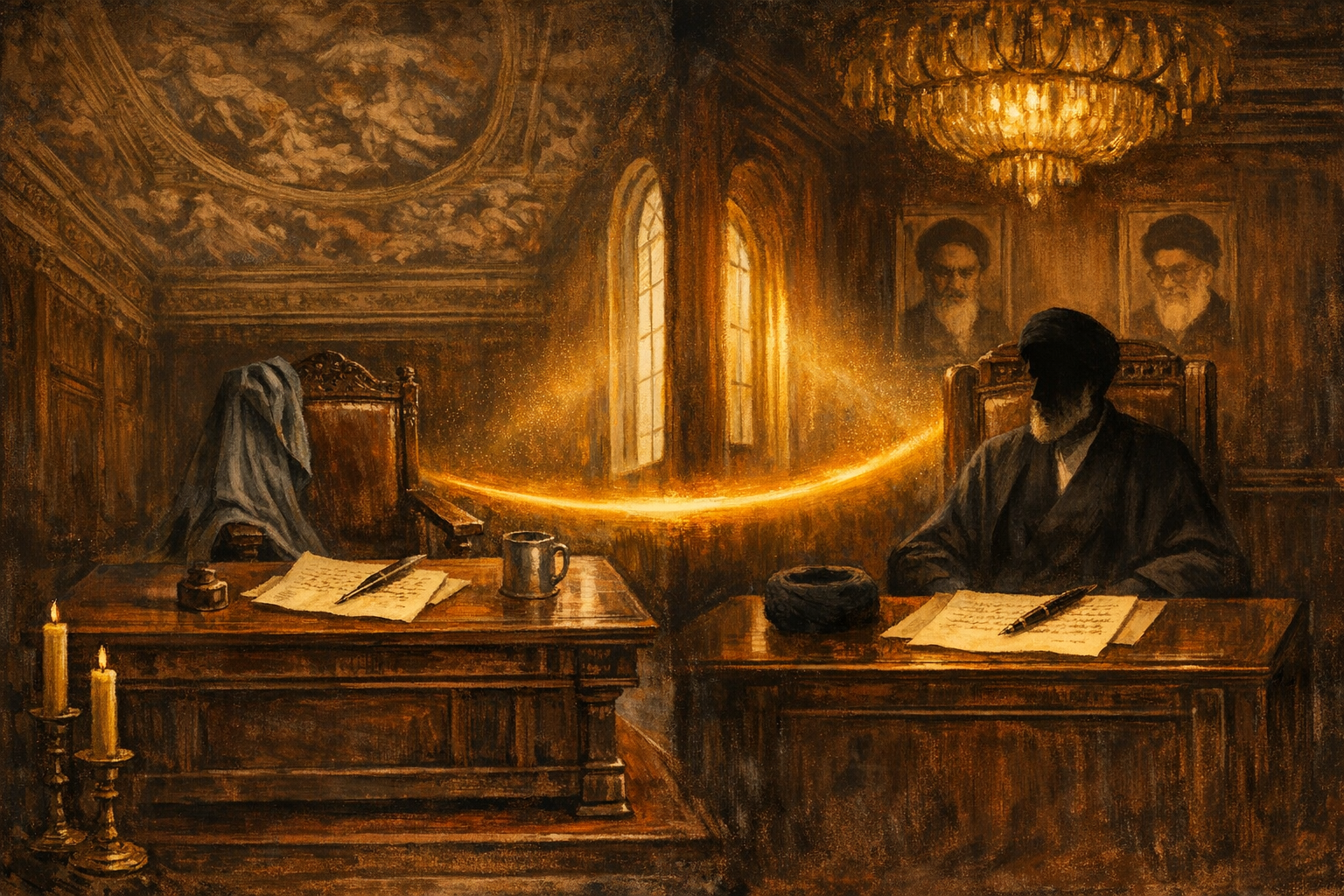
On the afternoon of 11 May 2026, the new Supreme Leader of the Islamic Republic of Iran made his first public appearance since the 2026 war began. He issued, by way of state broadcast, what the broadcaster described as "new and decisive directives" for military operations. The man at the lectern was Mojtaba Khamenei, a fifty-six-year-old midranking cleric who teaches theology at the Qom Seminary. He had been elevated to the rank of grand ayatollah nine weeks earlier, by a vote of the Assembly of Experts taken under what Iran International described as "repeated contacts and psychological and political pressure" from senior commanders of the Islamic Revolutionary Guard Corps. The father whose chair he now occupied, Ali Khamenei, had been killed on 28 February 2026.
Mojtaba is the son of the previous Supreme Leader. The previous Supreme Leader had reportedly opposed his son's succession for decades, on the entirely correct premise that hereditary rule was the one thing the Islamic Republic of Iran had been built specifically not to be.
The architect of the Islamic Republic was Ayatollah Ruhollah Khomeini. Between 21 January and 8 February 1970, while exiled in the Iraqi shrine city of Najaf, Khomeini delivered nineteen lectures to his students on a doctrine he called velayat-e faqih, the guardianship of the Islamic jurist. The lectures were transcribed by his students and published as Islamic Government: Governance of the Jurist. Their central argument was that political authority in an Islamic state belonged not to a hereditary monarch but to the most learned clerics, who would be selected by other clerics on the basis of scholarship and moral standing. Monarchy, Khomeini argued explicitly, was a "system of unbelief." The book became the founding text of the 1979 revolution that overthrew the Pahlavi dynasty. The Islamic Republic, by its own constitution, would not be a monarchy.
Three hundred and twenty years earlier, the founder of a different anti-monarchical republic had argued exactly the same thing.
Oliver Cromwell had become Lord Protector of the Commonwealth of England, Scotland and Ireland on 16 December 1653, four years after Parliament had executed Charles I. The Commonwealth was the only avowedly republican regime in English history. In February 1657, the Second Protectorate Parliament drafted a Humble Petition and Advice offering Cromwell the crown of England. He thought about it for two months. On 13 April 1657, in a hall at Whitehall, he refused. "I would not seek to set up that which Providence hath destroyed," he told the parliamentarians, "and laid in the dust." Three weeks later, on 8 May 1657, he accepted a revised version of the Petition that made him Lord Protector for life, with the right to nominate his successor. He selected his eldest surviving son, Richard.
Oliver Cromwell died on 3 September 1658. Richard took office the same day. He was thirty-one years old. He had no military command, no political base, and no record of his own. Within six months it was clear to everyone in London that the New Model Army, the institution Oliver had used to crush the king and rule the country, regarded the son as an inadequate inheritance. On 6 April 1659, the army's general council of officers presented a formal petition to Richard demanding higher taxes to fund the regime. He forwarded it to Parliament. On 12 April, Parliament responded by attempting to impeach a major-general for actions against a Royalist sympathiser. The army interpreted the impeachment as a civilian attempt to dismantle military authority. On 22 April, the army dissolved Richard's Parliament. On 7 May, the army recalled the Rump Parliament that Oliver had himself dissolved six years earlier. On 25 May 1659, after the Rump agreed to pay his debts and provide a pension, Richard Cromwell delivered a formal letter resigning the position of Lord Protector. He had ruled for two hundred and sixty-four days. The Royalist pamphleteers immediately gave him the nickname Tumbledown Dick.
Eleven months later, General George Monck, a parliamentary commander who had spent the previous year quietly negotiating with the exiled Stuarts, marched his army from Scotland into London and convened a new Parliament. On 29 May 1660, Charles II, son of the executed king, entered London. The English Commonwealth was over. The anti-monarchical republic Oliver Cromwell had founded had lasted, from the regicide of 1649 to the Restoration of 1660, eleven years. The son had inherited it for nine of those one hundred and thirty-two months. The deposed dynasty had been waiting in exile.
The mechanism in Tehran in 2026 was different. Oliver Cromwell had designated Richard as his successor in the Humble Petition of 1657. Ali Khamenei did not designate Mojtaba; for decades he opposed his son's succession, fearing exactly the parts of the religious and political establishment that categorically reject hereditary succession. When Khamenei was killed in late February 2026, the Assembly of Experts convened an emergency election. The five-day vote, from 3 to 8 March, was reportedly conducted under IRGC pressure on individual members of the eighty-eight-cleric body. Mojtaba was announced as the new Supreme Leader on 9 March 2026. The Assembly had to elevate him to grand ayatollah on the same day, formally, even though his religious credentials had not previously qualified him for the rank.
The Iranian succession is therefore exactly the structure Khomeini's doctrine had been designed to prevent. A clerical body whose function under velayat-e faqih was to identify the most learned jurist instead identified the son of the previous Supreme Leader, elevated him post hoc to the necessary religious rank, and did so under pressure from a praetorian military. The Islamic Revolutionary Guard's role in the elevation of Mojtaba Khamenei is, structurally, the New Model Army's role in maintaining and then ending the Cromwellian Protectorate. The praetorian guard of an anti-monarchical regime tends, in the end, to be the institution that hands the regime over to a son.
Reza Pahlavi was born in Tehran on 31 October 1960, the eldest son of the last Shah. He has lived in exile in the United States since 1979. He is now sixty-five years old. In a March 2026 60 Minutes interview he set out four conditions for what he calls a transitional Iran: territorial integrity, separation of religion and state, equality of all citizens under the law, and individual liberty. He said he would not seek an automatic restoration of the constitutional monarchy his father had occupied. Donald Trump, asked about the Pahlavi family in early 2026, said the prince "appeared very nice" but questioned his ability to mobilise sufficient domestic support to take power.
Charles II had been answered the same question, in 1659, in Brussels.
Mojtaba Khamenei is now the third Supreme Leader of Iran. He took office on 9 March 2026. His father did not want him in the chair. The Assembly of Experts that elevated him did so under explicit pressure. The Islamic Republic of Iran has been in existence for forty-seven years. Richard Cromwell's tenure was two hundred and sixty-four days.
The Royalist pamphlet that gave Richard his nickname was printed in London in May 1659, the same month he resigned. The pamphleteer who chose the words Tumbledown Dick did not know that the King would land at Dover within twelve months, and that the Commonwealth would end within thirteen. The pamphleteer was guessing.
The guess was right.