In the second week of May 2026, the Bloomberg news service reported a single recurring observation from senior Indian foreign-policy officials: they had not seen Washington this close to Islamabad in fifty-five years, and they did not like what they remembered about the last time.
On 7 May 2025, India had launched Operation Sindoor, a 23-minute series of missile strikes on what Indian intelligence identified as terrorist-training infrastructure belonging to Jaish-e-Mohammed and Lashkar-e-Taiba inside Pakistan and Pakistani-administered Kashmir. The strikes were the answer to the 22 April 2025 attack at Pahalgam, a Kashmir tourist site, in which gunmen had killed twenty-six civilians, twenty-five of them Indian Hindu tourists, in front of their families. The Indian-Pakistani exchange that followed lasted four days. Both countries' Directors General of Military Operations agreed a ceasefire on 10 May 2025; the agreement was brokered by Vice President J. D. Vance and Secretary of State Marco Rubio over a single afternoon of telephone diplomacy.
Twelve months later, the ceasefire is still in force. But in April 2026 Pakistan lifted an eight-year ban on cryptocurrency. In the same month it signed a memorandum of understanding with World Liberty Financial, the crypto venture in which President Trump's family holds 22.5 billion governance tokens worth approximately 3.8 billion dollars. A delegation led by World Liberty's chief executive met with Pakistan's army chief, Field Marshal Asim Munir, in Rawalpindi. Three weeks later President Trump received Munir at the White House. Indian foreign-policy officials told Bloomberg they were uneasy in a way they had not been uneasy since the Bangladesh war.
The Bangladesh war was the original. To understand the Indian unease in May 2026 you have to go back to a stomach ache that probably did not happen, in a guest house in the Pakistani hill town of Nathiagali, on the afternoon of 9 July 1971.
Henry Kissinger, then Richard Nixon's National Security Advisor, had landed in Islamabad on 8 July 1971 on a tour code-named POLO I. His published schedule had him in Pakistan for forty-eight hours of meetings with President Yahya Khan. In Kissinger's later memoir of the trip, he described the cover story he had agreed in advance with Yahya: on the second evening in Islamabad, Kissinger would complain of a stomach ache. The discomfort would worsen. The Pakistani president would solicitously offer the use of his rest house in the Murree Hills, sixty miles to the north-east in cooler air, for the National Security Advisor to recover. Kissinger and a small party of three NSC staff would slip out of Chaklala Airport in the early hours of the next morning aboard an unmarked Pakistani aircraft, fly to Beijing, conduct seventeen hours of negotiations over two days with Premier Zhou Enlai, and return to Islamabad before the press knew he had ever left.
The cover story worked. Kissinger reappeared in Islamabad on 11 July 1971 having opened the diplomatic door to the People's Republic of China. President Nixon announced the breakthrough to the world on the evening of 15 July 1971. The State Department had not been told. Neither had the Indians.
The Indians worked it out quickly. Within a week of Kissinger's return Henry Kissinger met Lakshmi Kant Jha, the Indian ambassador in Washington, and told him that the United States would not intervene if China entered a war between India and Pakistan. Indira Gandhi was prime minister of India; she had been weighing intervention in East Pakistan since the West Pakistani army began its campaign against Bengali civilians in March. The Kissinger-Jha conversation tipped the balance. On 9 August 1971, less than a month after Kissinger's secret Beijing trip, India's foreign minister Swaran Singh and the Soviet foreign minister Andrei Gromyko signed the Indo-Soviet Treaty of Peace, Friendship and Cooperation in New Delhi. The treaty was, in essence, a security guarantee. Its operative clause committed each side to immediate consultations if either was attacked or threatened. The unwritten meaning was clearer: India was no longer a non-aligned power, and any Chinese intervention in a future Indo-Pakistani war would be a Chinese intervention against the Soviet Union.
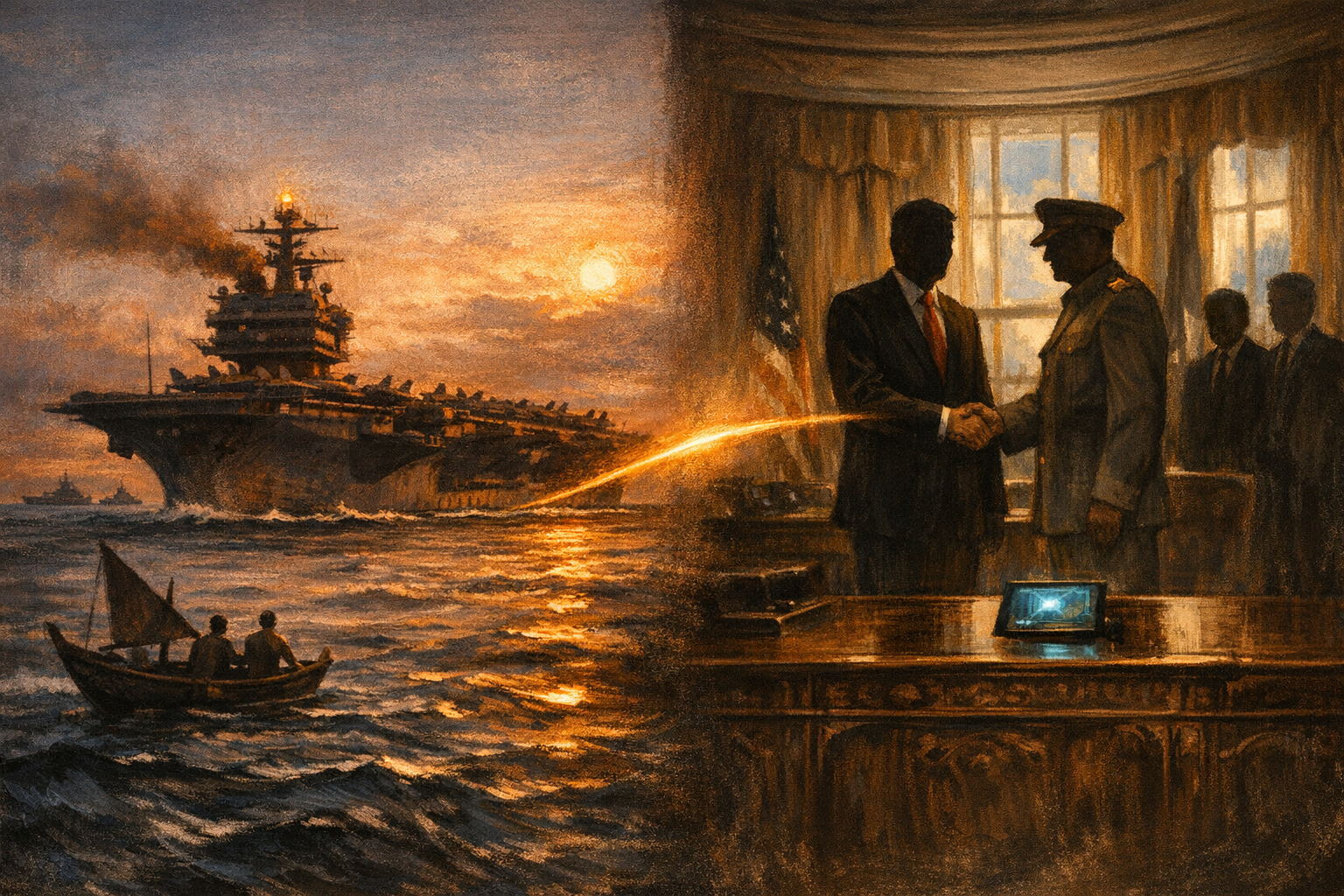
The Indo-Pakistani phase of the war began on 3 December 1971, when Pakistani aircraft struck Indian airbases under Operation Chengiz Khan. India intervened on the side of the Bengali resistance the same day. Within ten days the Pakistani army in East Pakistan was on the verge of collapse. On 10 December 1971 Nixon instructed Kissinger to ask Beijing to move Chinese forces toward the Indian border in Sikkim. Mao did not oblige. On 12 December 1971 Nixon ordered Task Force 74 of the United States Seventh Fleet to sail for the Bay of Bengal. The task force was led by the USS Enterprise, at 75,000 tons the largest nuclear-powered aircraft carrier in the world, carrying more than seventy fighters and bombers, accompanied by the guided-missile cruiser USS King, three destroyers and the amphibious assault ship USS Tripoli. The official cover story was an evacuation of American citizens from Dhaka. The actual purpose was to intimidate India. The task force crossed the Malacca Straits on the night of 13 to 14 December 1971 and entered the Bay of Bengal on the morning of 15 December. On 18 December the Soviet navy began trailing it through the Indian Ocean.
It made no difference. On 16 December 1971, with the USS Enterprise still steaming north into the Bay of Bengal, the Pakistani garrison in Dhaka surrendered. Bangladesh emerged. The Indo-Pakistani war was over in thirteen days. Yahya Khan resigned four days later. Kissinger's back channel and Nixon's gunboat had achieved nothing except the persuasion of Indira Gandhi that the United States would be her enemy in any future South Asian crisis, and the persuasion of every Indian foreign secretary for the next fifty years that strategic non-alignment was a fragile fiction.
The pattern matters because the pattern is rhyming. President Trump's family currently holds 3.8 billion dollars of crypto governance tokens in a company that has just signed a deal with Pakistan's Crypto Council. Pakistan's army chief, Field Marshal Asim Munir, has been hosted at the White House. The Pakistan Crypto Council chair, Bilal bin Saqib, signed the Trump-family deal in the weeks before the Pahalgam attack. India's foreign secretary has been making the rounds in Washington asking what the deal means. The answer being given in Washington is that it does not mean anything. India is not persuaded. New Delhi is once again drafting the Indian foreign policy of the next half-century in the shadow of an American tilt toward Pakistan whose architects insist it is not a tilt.
The 1971 tilt cost Pakistan an entire wing of its country, and cost the United States its standing in New Delhi for a generation. The 2026 tilt has not cost anyone anything yet. But the Indian foreign-policy community is no longer reading Bloomberg for news of the relationship; it is reading Bloomberg for guidance on what comes after, and what to prepare for.
Henry Kissinger died in 2023. He never apologised for 1971. The cables released by the State Department in 2002, when they were declassified, confirmed every Indian suspicion about the back channel, the stomach ache, the cover story, and the Enterprise. The Indian foreign-policy community has been waiting fifty-five years for the second tilt. It is reading the cables again this week.