Every day, we find the historical story hiding inside the headlines. Riveting narratives
that connect the past to the present, and make you wonder what happens next.
Choose your topics
You'll receive one email per topic, per day. Pick as many as you like.
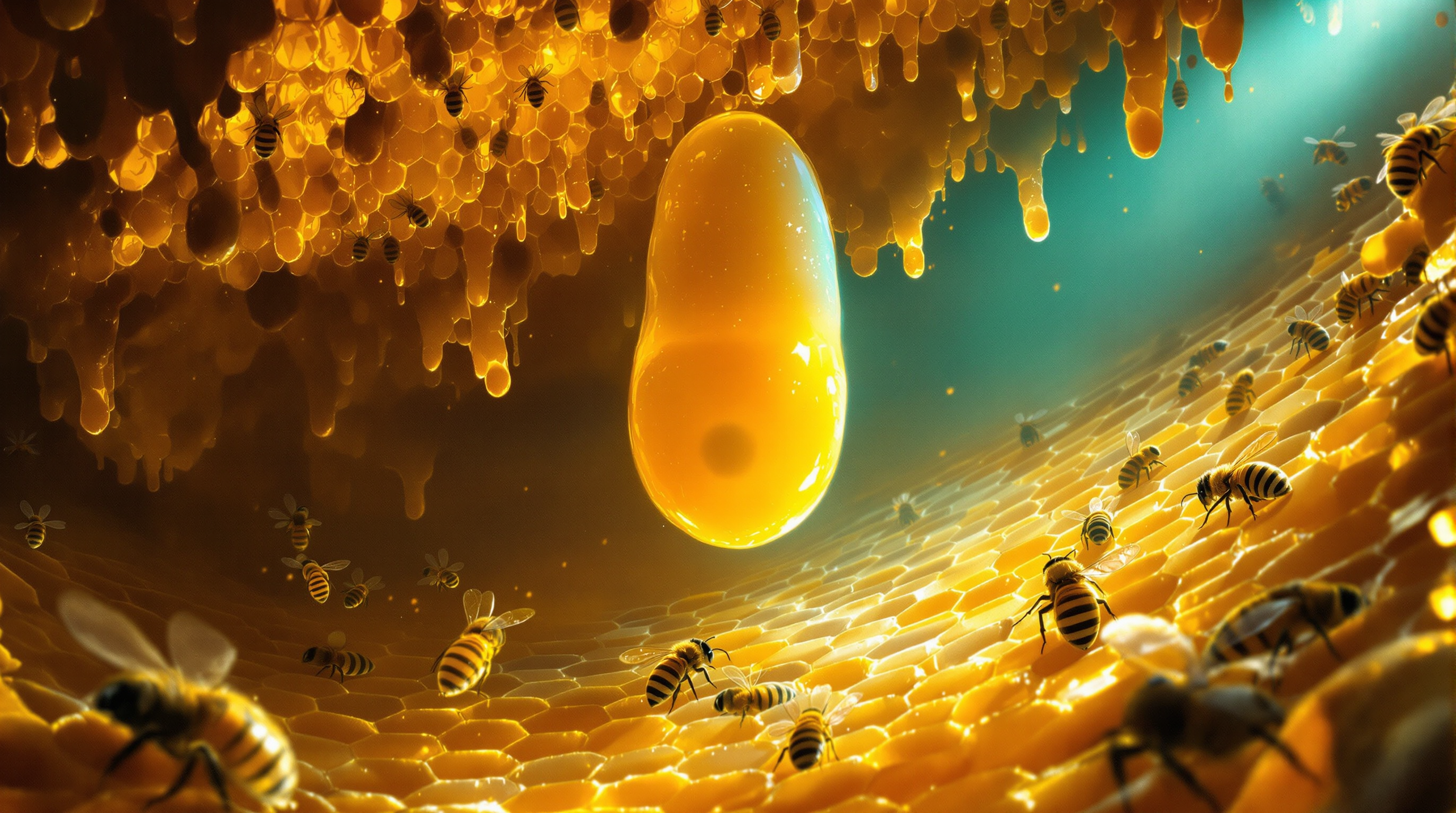
Queen and worker bees hatch from identical eggs, yet one lives for years and lays a million eggs while the others live for weeks and never breed. For a century the textbook answer was a single food: royal jelly. In 2026 a team at UC Riverside showed the real answer is grander. Specialised worker bees build the queen a palace: a peanut-shaped 'royal crib' of custom wax with its own chemistry, and they cluster to keep it warm. Raise a would-be queen in ordinary wax instead and she develops poorly and often dies. The jelly feeds her; the crib crowns her. We love a story with one secret ingredient. Nature almost never works that way.
•3 min readIn 2026 a team at the University of California, Riverside (its Center for Integrative Bee Research) showed that royal jelly alone does not make a queen: the environment does much of the work. A specialised caste of young worker bees acts as royal builders, constructing the large peanut-shaped 'royal crib' from a custom wax that is softer, melts at a higher temperature, and carries a distinct chemical signature of fatty acids and signals, and they alter their own physiology to raise the temperature around the cell, like underfloor heating. Crucially, when would-be queens were raised in ordinary worker-cell wax instead of the royal crib, the larvae developed poorly and many died: they needed the 'smell and feel' of the royal wax to transform at all. So queen determination is a whole system, diet plus architecture, temperature and wax chemistry plus the labour of many bees, not a single ingredient. It is a recurring lesson in biology: we love single-cause stories (one gene, one molecule, one food), but nature's marvels are usually built from many small causes acting together. A queen is built, not dosed.
In 1914 a public-health doctor named Joseph Goldberger figured out what pellagra was. It took twenty-three more years to discover what was missing. This week, after a century of antidepressants, scientists in Montreal pinpointed two specific brain cells that go wrong in major depression. The pattern is older than either disease.
•5 min readMcGill paper pinpoints two specific brain-cell types altered in major depression
In 1912 a German meteorologist proposed that the continents had once been joined and were drifting apart. The geological establishment ridiculed him for fifty years. He died alone on the Greenland ice cap in 1930. This week, in the place where humanity first stood up, scientists confirmed his prediction in real time.
•4 min readTurkana Rift enters the necking phase, the last stage before East Africa breaks apart
In October 1903 the New York Times said powered flight was a million years away. Sixty-nine days later, two bicycle mechanics proved them wrong. This week, a robot did it again.
•5 min readSony's Project Ace defeats top-25 professional table tennis players, overturning Moravec's paradox
In 1866 an Augustinian friar in Brünn published the laws of inheritance, and the scientific world ignored them for thirty-five years. A neglected idea has just walked back in.
•4 min readThe return of symbolic reasoning in artificial intelligence
In 1911, a Dutch physicist cooled mercury to near absolute zero and watched electricity do something impossible. In 2026, it happened again, in a sheet of carbon one atom thick.
•4 min readGraphene Dirac fluid violates the Wiedemann-Franz law
In 1898, a chemist warned the world was running out of nitrogen. In 1909, Fritz Haber pulled it from the air. In 2026, CATL is pulling batteries from salt.
•4 min readSodium-ion batteries: CATL and BYD mass-producing batteries from salt to replace lithium
In 1942, Fermi held a chain reaction for 28 minutes in a squash court. In 2026, KSTAR held fusion plasma for 102 seconds. The fire is different. The question is the same.
•3 min readKSTAR fusion plasma record and the path to commercial fusion
In 1667, a physician transfused lamb's blood into a dying boy. It worked. Then someone died, and the world banned it for 150 years. Now we're crossing the species barrier again.