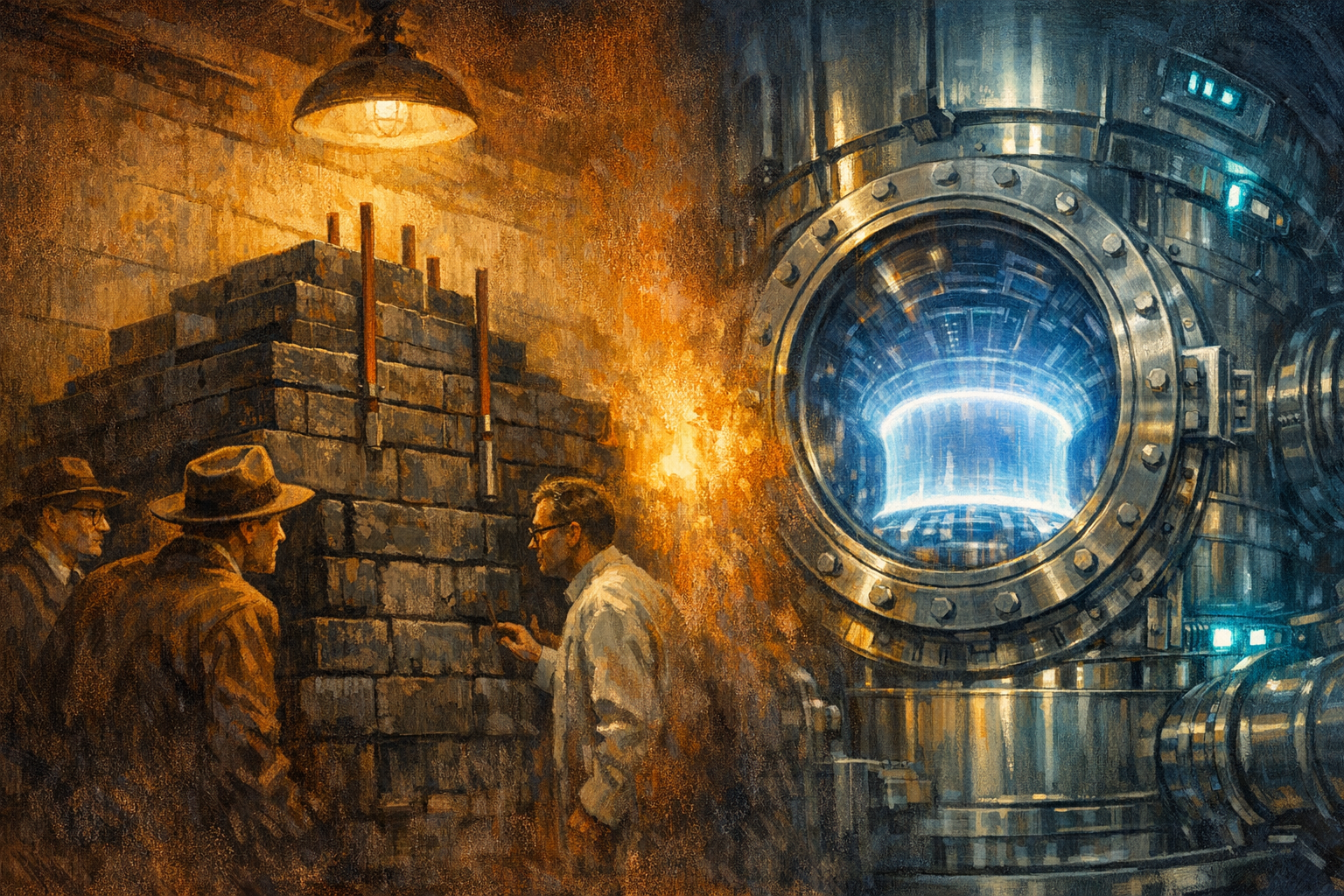
On the afternoon of December 2nd, 1942, in a squash court beneath the bleachers of a football stadium at the University of Chicago, a physicist named Enrico Fermi pulled a cadmium rod out of a pile of graphite blocks and changed the world.
The pile was called Chicago Pile-1. It was the first nuclear reactor ever built: a crude stack of 40,000 graphite blocks and clusters of uranium, assembled by hand over seventeen days in a converted racquets court under the west stands of Stagg Field. It had no cooling system. It had no radiation shielding. It had no containment structure of any kind. What it had was cadmium control rods, which absorbed neutrons and kept the chain reaction from running away, and a backup plan: a liquid control squad standing on the balcony above the pile, led by a physicist named Samuel Allison, holding buckets of cadmium nitrate solution ready to pour over the reactor if the rods failed.
At 3:25 in the afternoon, Fermi ordered the last control rod withdrawn. The neutron counters climbed. The Geiger counters chattered. For twenty-eight minutes, the first controlled nuclear chain reaction in history sustained itself in a room full of scientists who had bet their lives on the mathematics being right.
Then Fermi said, "The reaction is self-sustaining." He smiled, and ordered the rods reinserted. Arthur Compton picked up a telephone and called James Conant in Washington. "The Italian navigator has landed in the new world," he said. Conant asked, "How were the natives?" Compton replied, "Very friendly."
Twelve years later, the Soviet Union connected the Obninsk reactor to its power grid, the first nuclear plant to generate electricity for civilian use. Two years after that, in 1956, Britain opened Calder Hall, the first large-scale commercial nuclear power station. The gap between proving fission could be controlled and plugging it into a grid was twelve to fourteen years.
Fusion has been waiting much longer.
The hydrogen bomb proved in 1952 that fusion worked. But a bomb is not control. A bomb is the opposite of control. For seventy-four years, physicists have been trying to do with fusion what Fermi did with fission: sustain it, hold it, make it useful. The problem is temperature. Fission requires a pile of graphite. Fusion requires a plasma hotter than the core of the sun, held in place by magnetic fields, stable long enough to produce more energy than it consumes.
In early 2026, South Korea's KSTAR tokamak held a plasma at one hundred million degrees Celsius for one hundred and two seconds. The previous record had been forty-eight seconds. One hundred and two seconds does not sound like much. Neither did twenty-eight minutes in a squash court.
The structural parallel is almost exact. Chicago Pile-1 proved that fission could be controlled. KSTAR's one hundred and two seconds is proving that fusion can be sustained. Both are threshold moments: the point where "it works in theory" becomes "it works in practice, if we can keep it going."
The question is not whether fusion works. Fusion works. The question is how long the gap will be between the squash court moment and the grid. For fission, the gap was twelve years. For fusion, it has already been seventy-four, and counting. KSTAR's record suggests the countdown may finally have started.
Fermi's pile ran for twenty-eight minutes. KSTAR's plasma lasted one hundred and two seconds. The fire is different. The question is the same. Can you hold it?