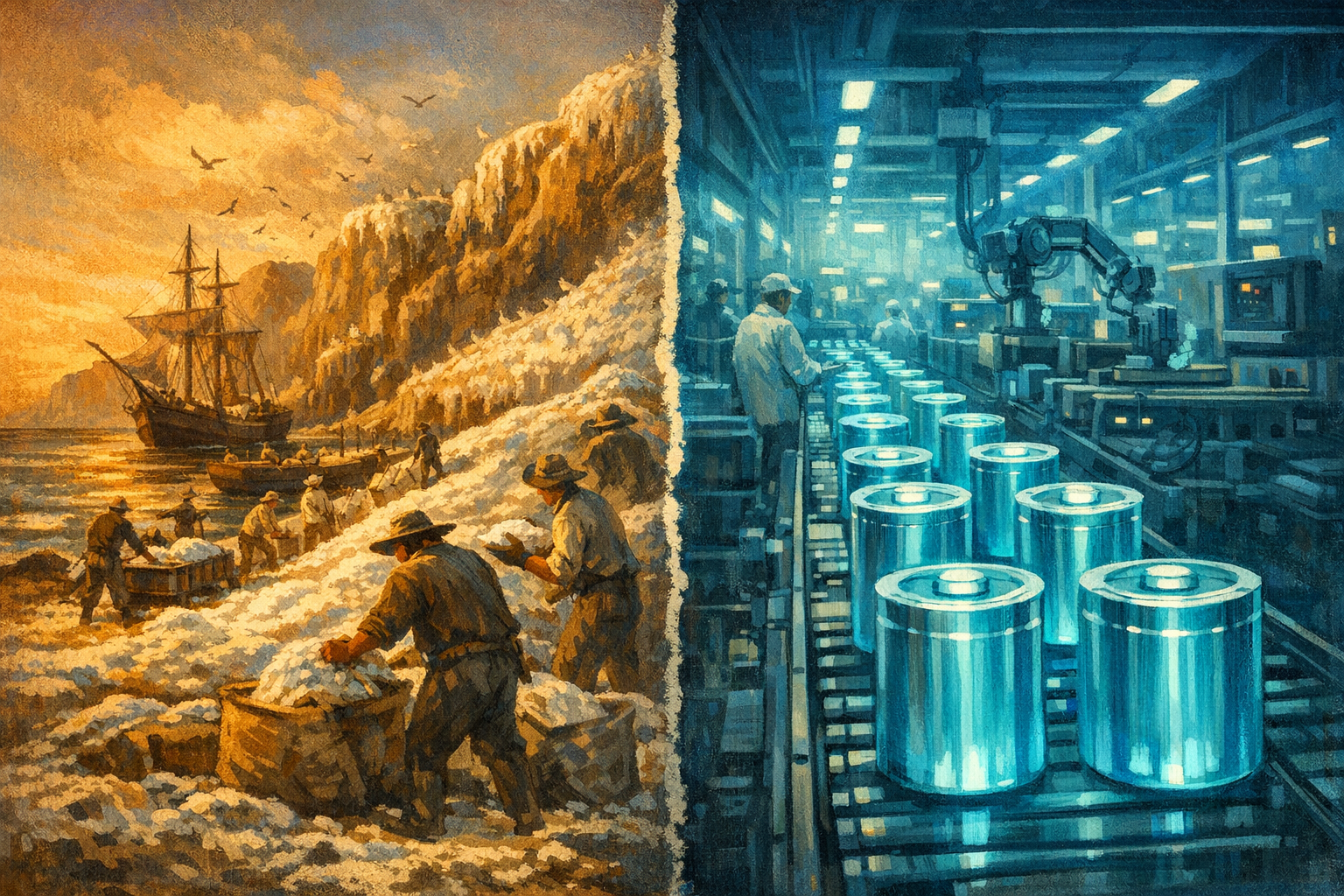
In 1898, Sir William Crookes stood before the British Association for the Advancement of Science and told the audience that civilisation was running out of nitrogen.
The problem was wheat. Wheat needs nitrogen to grow. For most of human history, nitrogen came from the soil, replenished by crop rotation, manure, and the occasional flooding river. By the late nineteenth century, industrial agriculture had stripped the soil faster than nature could replenish it. The only concentrated source of nitrogen available at scale was guano: bird droppings, accumulated over millennia on remote Pacific and South American islands, rich in nitrogen, phosphate, and potassium.
The guano trade had been one of the strangest booms of the nineteenth century. In 1856, the US Congress passed the Guano Islands Act, which allowed any American citizen to claim any unclaimed island containing guano deposits, and committed the US Navy to their defence. Roughly two hundred islands were claimed. Peru fought wars over the Chincha Islands, whose guano was worth more per ton than most metals. By the 1870s, the supply was running out. By 1880, all known deposits had been mined bare.
Crookes told the British Association that without a synthetic source of nitrogen, the world would face a wheat famine within a generation. The mathematics were straightforward: the population was growing, the soil was depleting, and the birds could not produce droppings fast enough to feed a planet.
Eleven years later, in July 1909, a German chemist named Fritz Haber demonstrated that he could pull nitrogen directly from the air. His laboratory apparatus produced roughly 250 millilitres of liquid ammonia every two hours. It was not impressive to look at. It was the most important chemical reaction in the history of the species.
Carl Bosch, an engineer at BASF, spent the next four years scaling Haber's process to industrial production. By 1913, a factory in Ludwigshafen was producing synthetic ammonia by the ton. The guano islands became irrelevant overnight. Today, the Haber-Bosch process consumes roughly one to two percent of the world's total energy output and produces enough synthetic fertiliser to feed approximately half the people on Earth.
Both men won Nobel Prizes. The process that feeds four billion people is also the process that enabled Germany to manufacture explosives throughout the First World War without access to Chilean saltpeter. Every abundance has a shadow.
Time Rhymes. New story every day. If you want tomorrow's, subscribe.
In January 2026, CATL, the world's largest battery manufacturer, began mass-producing sodium-ion batteries for commercial vehicles.
The batteries are made, in the most reductive sense, from salt. Sodium, the element that makes table salt salty, is the sixth most abundant element on Earth. It is in seawater. It is in rock deposits on every continent. It is, for practical purposes, unlimited.
Lithium, the element that powers virtually every battery in every phone, laptop, and electric vehicle on the planet, is not. Lithium is concentrated in a handful of countries: Chile, Argentina, Bolivia, Australia, and, for processing, China. Its price is volatile. Its extraction is environmentally destructive. Its supply chain is a geopolitical chokepoint.
CATL's second-generation sodium-ion batteries, entering mass production in 2026, have an energy density of 175 watt-hours per kilogram, comparable to the lithium iron phosphate batteries that currently dominate the Chinese EV market. They cost roughly $70 per kilowatt-hour, heading toward $40 by 2027. They are safer (sodium does not catch fire as readily as lithium), they work better in cold weather, and they are recyclable. A quarter of a million delivery vans in China are already running on sodium. BYD has developed sodium cells with a cycle life of 10,000 charges. The trade-off is weight: sodium-ion batteries store less energy per kilogram than the best lithium cells, which matters in passenger cars but matters much less in delivery vans, buses, and grid storage, where cost per cycle matters more than weight.
The structural parallel to Haber-Bosch is the substitution. In 1898, the world's food supply depended on a finite resource (guano) concentrated on a few remote islands. By 1913, it depended on nitrogen pulled from the air, which is 78 percent of the atmosphere and available everywhere. In 2025, the world's battery supply depends on a finite resource (lithium) concentrated in a few countries. In 2026, it is beginning to depend on sodium, which is dissolved in every ocean and buried under every continent.
Haber-Bosch did not merely solve the nitrogen problem. It made the nitrogen problem disappear. The question was never whether there was enough nitrogen. There was always enough nitrogen. The question was whether anyone could reach it. Haber reached it. The islands became irrelevant.
The question for sodium-ion is the same. There was never a shortage of sodium. There was a shortage of the engineering required to make it store electricity as well as lithium. If CATL and BYD have solved that problem (and a quarter of a million delivery vans suggest they have), then the lithium chokepoint does not need to be negotiated. It needs to be bypassed.
Crookes warned of a nitrogen famine. Haber made it a footnote. The world is warning of a lithium shortage. The answer, it turns out, was in the salt.