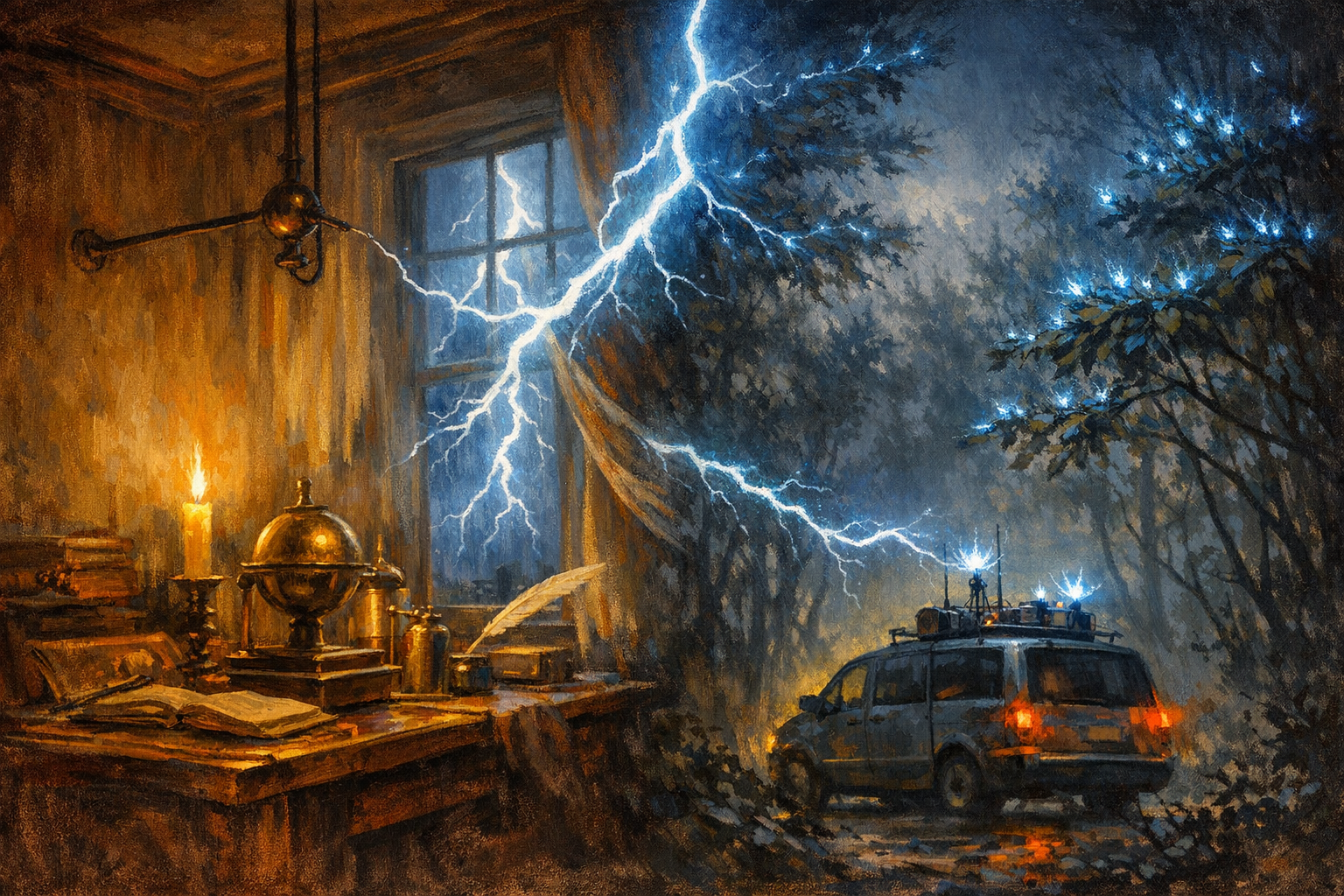
On August 6, 1753, a physicist named Georg Wilhelm Richmann was attending a meeting of the Russian Academy of Sciences in St. Petersburg when he heard thunder. He grabbed his engraver, a man named Sokolov, and ran home.
Richmann had spent months building an apparatus to measure atmospheric electricity. An iron rod extended from his roof down into his study, connected to an instrument of his own invention: an electrometer, designed to quantify the electrical force of a storm. Benjamin Franklin had recently proposed that lightning was electrical. Richmann wanted to prove it, and more than that, he wanted to measure it.
When he reached his study, the storm was overhead. He leaned toward the electrometer to take a reading. A globe of light appeared from the apparatus and struck him in the forehead. The explosion that followed was described by witnesses as sounding "like that of a small cannon." It split the door frame, tore the door off its hinges, and knocked Sokolov unconscious.
Richmann was killed instantly. He had a red spot on his forehead, his left shoe was blown open, and parts of his clothing were singed. He was 42 years old. He was the first person in recorded history to die while conducting an electrical experiment.
The incident caused a sensation across Europe. For a brief period, it nearly halted atmospheric electricity research entirely. The message seemed clear: the sky's electricity was real, it was powerful, and it would kill you if you got too close.
But people had been watching atmospheric electricity for far longer than Richmann. They just did not call it that.
Ancient sailors watched luminous blue flames dance on the tips of their masts during storms and called them St. Elmo's fire, after St. Erasmus of Formia, the patron saint of sailors. Pliny the Elder described the phenomenon in the first century. Julius Caesar noted it in his account of the African campaign. When Columbus crossed the Atlantic in 1493, his crew reported that "St. Elmo appeared on the topgallant mast with seven lighted tapers." Charles Darwin, aboard the Beagle in 1832, wrote that "the very masts are pointed with a blue flame."
The phenomenon is corona discharge: when a strong electric field surrounds a pointed conductor, electricity leaks from the tip into the air, ionizing the gas around it and producing a faint glow. Masts, steeples, lightning rods, and, scientists suspected, the tips of tree leaves.
The suspicion was decades old. Atmospheric scientists had theorized since the 1950s that forests under thunderstorms must produce corona discharges, millions of tiny sparks leaking from every leaf tip into the charged air above. The effect, if it existed at scale, would fundamentally change how scientists understood the electrical exchange between the Earth and the atmosphere. But nobody had ever seen it happen in nature.
In June 2024, four Penn State researchers set out to try. They converted a 2013 Toyota Sienna into a mobile atmospheric observatory, mounting a custom-built telescopic UV camera on the roof. The team, led by meteorologist P. J. McFarland, drove down the eastern seaboard chasing thunderstorms.
In a parking lot at the University of North Carolina at Pembroke, they found one. They pointed the camera at a sweetgum tree. A storm passed directly overhead. Over the next two hours, the camera captured hundreds of tiny ultraviolet flashes dancing along the branches and at the tips of leaves. They moved the camera to a nearby loblolly pine. The same thing. Tiny sparks, invisible to the naked eye, shimmering across the canopy.
They had filmed corona discharge happening in nature for the first time. Their results, published in Geophysical Research Letters in 2026, confirmed what atmospheric scientists had suspected for seventy years: whenever a thunderstorm rolls over a forest, every treetop underneath it is quietly glowing with electricity.
The Echo
The structural parallel is precise. In 1753, Richmann built the most sophisticated atmospheric electricity instrument of his era and it killed him. The electricity he was trying to measure was flowing through the air around him, invisible and lethal, and his attempt to capture it in a controlled setting ended in the first documented death by experimental physics.
Two hundred and seventy-one years later, a team of four scientists captured the same phenomenon from a parking lot, using a modified minivan and a UV camera. The electricity was always there. It was always flowing from the tips of every pointed object into the charged atmosphere above. From the masts of Roman galleys. From the steeples of medieval churches. From the leaves of every tree in every forest under every thunderstorm, for as long as trees and thunderstorms have existed.
Richmann died trying to bring the sky's electricity into his laboratory. He did not need to. The electricity was already in the trees. It had been there the whole time. It took 271 years and a Toyota Sienna to see it.