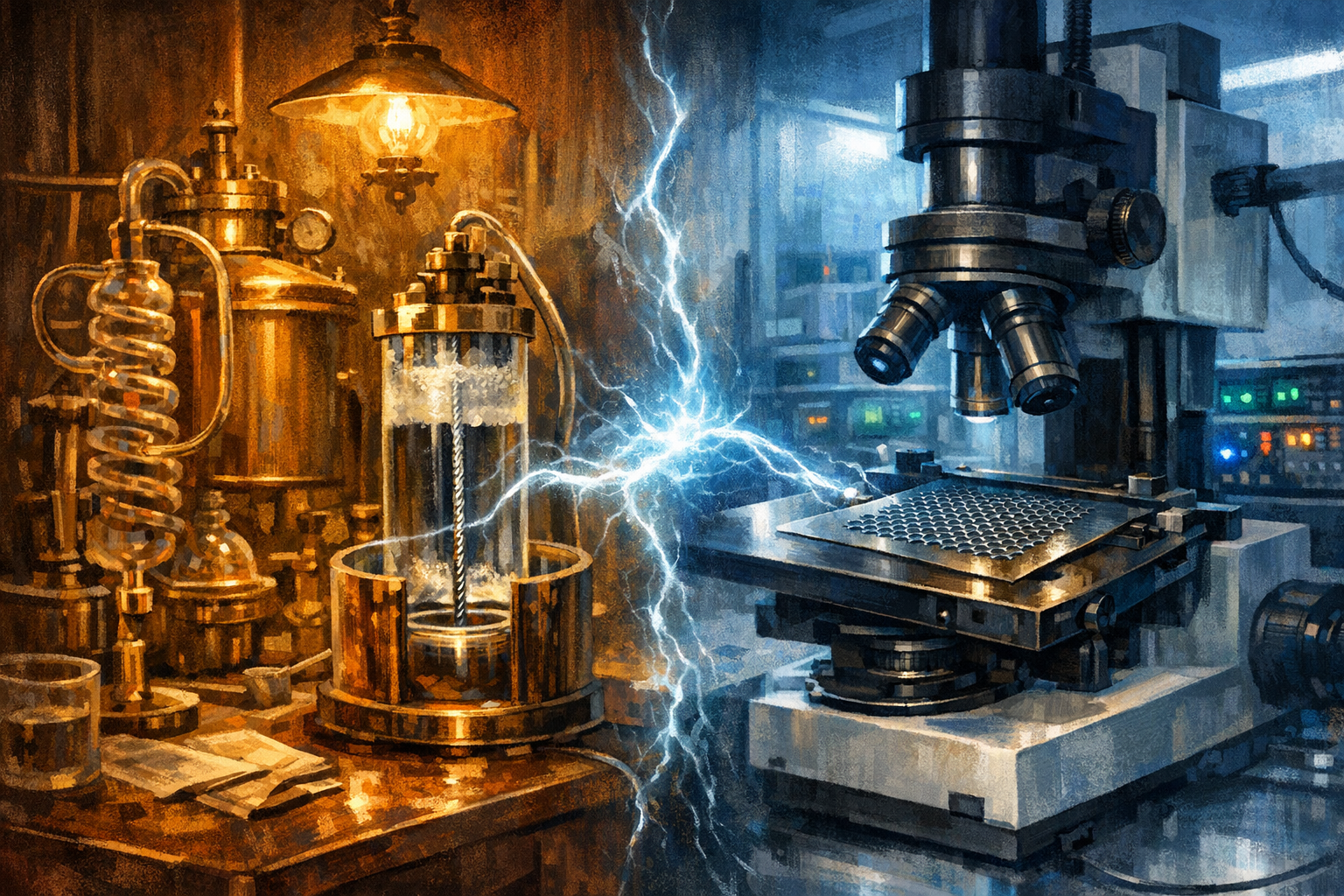
On July 10, 1908, in a basement laboratory at the University of Leiden, a Dutch physicist named Heike Kamerlingh Onnes did something nobody had done before. He liquefied helium.
This does not sound dramatic. It was. Helium is the most stubborn element on the periodic table. It resists liquefaction more fiercely than any other gas. To force it into a liquid, Onnes had to cool it to 4.2 Kelvin: four degrees above absolute zero, colder than the surface of Pluto, colder than anything that had ever existed on Earth.
He had spent years preparing. In 1904, he founded a dedicated cryogenics laboratory at Leiden, filling it with cascading refrigeration stages, vacuum-insulated Dewar flasks with silvered walls, and pumps large enough to fill a room. His colleagues called it the coldest place on Earth. It was not a figure of speech.
When the helium finally liquefied, Onnes had access to a temperature range nobody had explored. He began cooling metals to see what happened to their electrical resistance. The prevailing theories disagreed. Lord Kelvin predicted resistance would rise to infinity near absolute zero, as electrons froze in place. James Dewar predicted it would decrease smoothly to a small residual value. Both were reasonable. Both were wrong.
On April 8, 1911, Onnes cooled a thread of mercury wire to 4.2 Kelvin and measured its resistance. It did not rise. It did not decrease smoothly. It dropped to zero. Not approximately zero. Not nearly zero. Exactly zero. The electrical current flowed without any resistance at all.
Onnes wrote five words in his laboratory notebook, in Dutch: "Kwik nagenoeg nul." Mercury practically zero.
He had discovered superconductivity: a state in which electrical current flows without friction, without loss, without decay. A current started in a superconducting ring will, in theory, flow forever. Onnes reported his finding one week later at the first Solvay Conference in Brussels, in front of Einstein, Curie, Planck, and Rutherford. He won the Nobel Prize in Physics in 1913.
But here is the detail that makes the story extraordinary: nobody could explain it. The theoretical framework for superconductivity, called BCS theory after its three authors (Bardeen, Cooper, and Schrieffer), did not arrive until 1957, forty-six years after the observation. For nearly half a century, physicists could reproduce the phenomenon, build devices around it, and cool larger and more exotic materials to trigger it, but they could not explain why it happened.
The applications came anyway. Superconducting magnets now power every MRI machine in every hospital on Earth. They steer particles around the 27-kilometre ring of the Large Hadron Collider at CERN. They levitate maglev trains in Japan and China. They are essential components in the quantum computers being built by Google, IBM, and a dozen startups. All of this from five words in a notebook: mercury practically zero.
The Echo
In 2025, a team led by Arindam Ghosh at the Indian Institute of Science in Bangalore, working with Kenji Watanabe and Takashi Taniguchi at Japan's National Institute for Materials Science, observed something that would have made Onnes reach for his notebook again.
They cooled an ultra-clean sheet of graphene, a material made of carbon just one atom thick, to cryogenic temperatures and measured how its electrons conducted heat and electricity. In every normal metal, these two properties are locked together by the Wiedemann-Franz law, an empirical rule established in 1853 by Gustav Wiedemann and Rudolph Franz: good electrical conductors are also good thermal conductors, and the ratio between them is predictable.
In the graphene, the electrons violated that law by a factor of more than 200. Electrical conductivity went up while thermal conductivity went down. The electrons were not behaving like particles bouncing through a lattice. They were behaving like a frictionless liquid, flowing collectively with almost no viscosity. The team identified this state as a Dirac fluid, an exotic form of matter that mimics the quark-gluon plasma observed in particle colliders at CERN: the primordial soup of the universe, recreated in a sheet of pencil lead.
The structural parallel is precise. In 1911, Onnes cooled mercury and watched electrons do something that violated every prediction. The observation came decades before the explanation. In 2025, Ghosh's team cooled graphene and watched electrons do something that violated a 170-year-old law. The Dirac fluid has been theorized, but a complete understanding of its behaviour is still emerging.
When Onnes discovered superconductivity, critics said it was a laboratory curiosity, a phenomenon confined to impractically cold temperatures with no conceivable application. Today, superconductors are inside every hospital, every particle accelerator, and every quantum computer on the planet.
The pattern holds. When electrons start behaving in ways that break the textbook, the textbook is about to get a new chapter. The last time someone found a frictionless current, it took 46 years to explain and changed the world. The clock on this one started in 2025.
Mercury practically zero. Graphene practically infinite. The current flows.