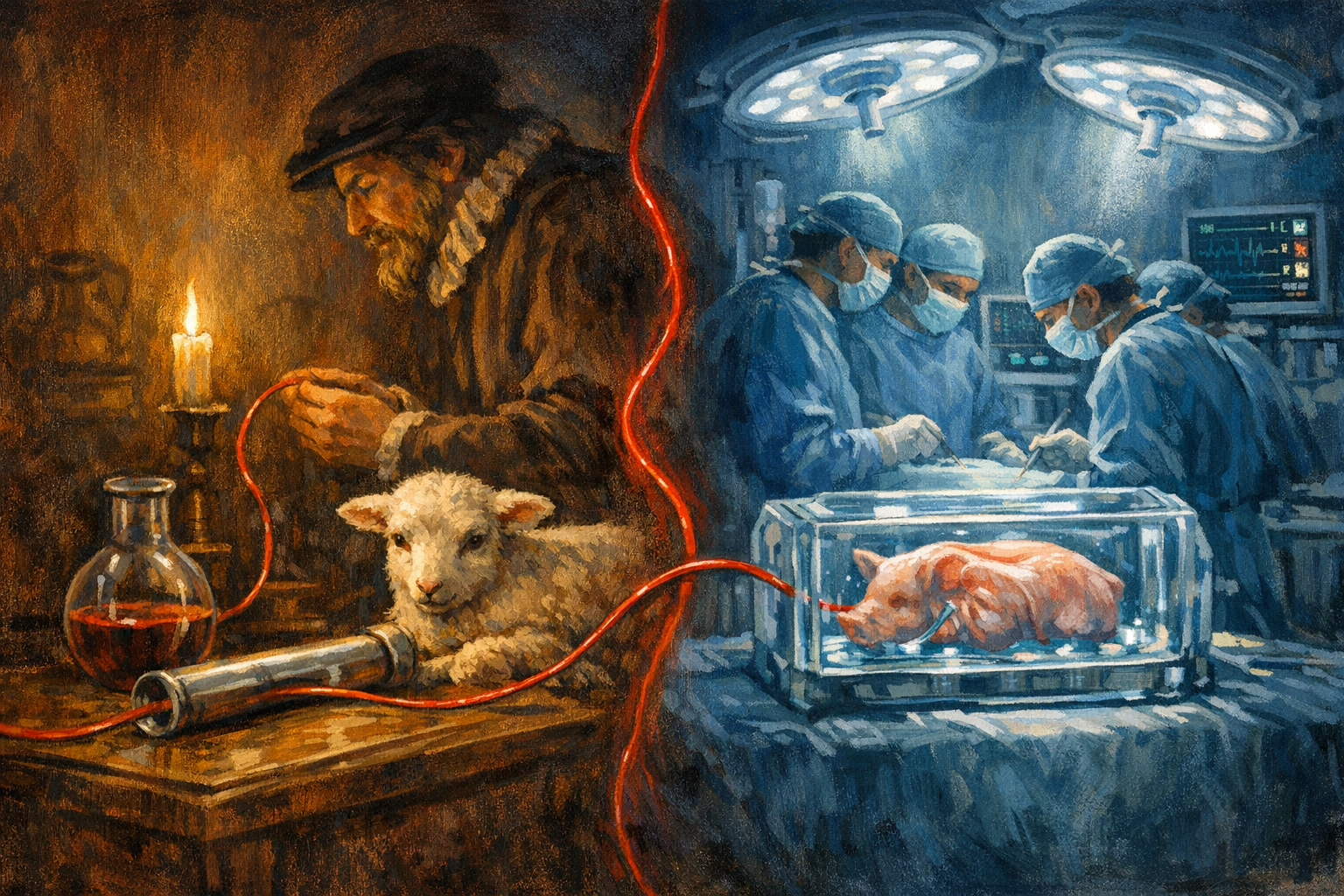
On a June afternoon in 1667, a French physician named Jean-Baptiste Denys drew blood from a lamb, connected a silver tube to the vein of a fifteen-year-old boy, and let it flow.
The boy had been sick for months. His doctors had bled him twenty times, the standard treatment for fever in seventeenth-century Paris, and each time he got worse. By the time Denys saw him, the boy was half dead from the cure. Denys had a different idea. He had been reading the work of Richard Lower, an English physician who had successfully transferred blood between dogs at Oxford in 1665, and he believed the same principle could save a human life. Not with human blood. With the blood of a lamb.
The logic was theological as much as medical. Lamb's blood was pure, Denys argued. It carried none of the vices that corrupted human blood: no alcohol, no rage, no melancholy. If the boy's own blood was failing him, the blood of an innocent animal might restore what the physicians had drained away.
He transfused roughly eight ounces. The boy's pulse quickened. His colour returned. He sat up, asked for food, and within days was walking. Denys published the result. The medical establishment was horrified.
Over the next eighteen months, Denys performed several more transfusions. Most of his patients survived. Then, in the winter of 1668, a man named Antoine Mauroy died after receiving calf blood. Mauroy had been mentally ill, and Denys believed the transfusion could calm his violent episodes. It did not. After the third treatment, Mauroy collapsed and died. A police investigation later found vials of arsenic powder in his wife's possession, and she came under suspicion of poisoning him. But the damage was done. Denys was put on trial. He was acquitted, but the court's message was clear: stop.
In January 1670, the Parlement de Paris banned blood transfusions entirely. England's Royal Society quietly dropped the subject. For a hundred and fifty years, the practice was effectively frozen. When the English obstetrician James Blundell finally revived it in 1818, performing the first human-to-human blood transfusion, he was starting nearly from scratch. A century and a half of potential progress, lost to one death and the fear it unleashed.
In January 2024, surgeons at Massachusetts General Hospital transplanted a genetically modified pig kidney into a living human patient. The pig's genome had been edited by a company called eGenesis: sixty-nine genetic modifications, removing pig genes that trigger human immune rejection and adding human genes that help the organ survive. The patient came off dialysis. By October 2025, he had lived with the pig kidney for two hundred and seventy-one days, the longest functioning xenotransplant in history. A second patient has been off dialysis since June 2025.
The structural parallel is almost exact. In 1667, Denys put animal biology into a human body to solve a problem that human medicine could not. In 2026, surgeons are doing the same thing with a precision that Denys could not have imagined, but the fundamental act is identical: crossing the species barrier because the alternative is death.
More than 100,000 Americans are on the organ transplant waiting list. Roughly seventeen die every day waiting. The pig kidney is not a curiosity. It is an answer to a crisis that human-to-human donation has never been able to solve.
The question the parallel raises is not whether the science works. The science works. The question is what happens when the first high-profile patient dies, because eventually one will. Denys's transfusions worked until Mauroy died, and then the world banned them for a hundred and fifty years. The lesson of 1667 is not that crossing the species barrier is dangerous. It is that one death, in the wrong political moment, can freeze an entire field of medicine for generations.
The lamb's blood saved the boy. The calf's blood killed the politics. The pig kidney is saving lives right now. The only question is whether we have learned enough from Denys to keep going when the first headline hits.
Jean-Baptiste Denys died in 1704, forgotten. Blood transfusion went on to save more lives than almost any other medical procedure in history. It just took a hundred and fifty years longer than it should have.