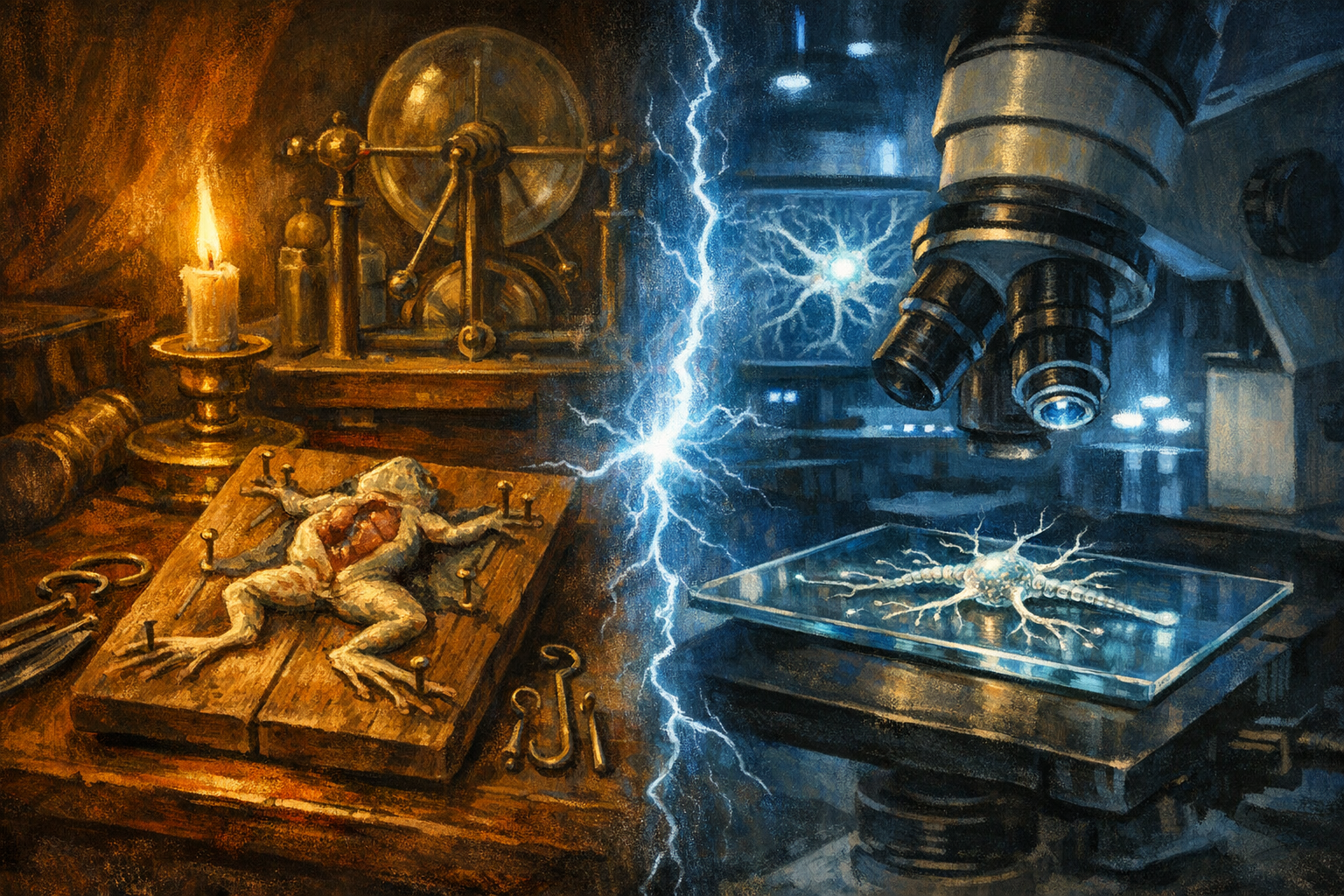
On a November afternoon in 1780, in a laboratory at the University of Bologna, a dead frog's leg kicked.
Nobody had meant it to happen. Luigi Galvani, the professor of anatomy conducting the dissection, watched as his assistant touched a metal scalpel to the frog's crural nerve at the same moment a nearby electrostatic machine discharged a spark. The leg convulsed. The frog had been dead for hours. Its muscles contracted as if it were alive.
Galvani spent the next decade chasing the phenomenon. He tried different metals. He tried lightning. He hung frog legs from brass hooks on an iron railing during thunderstorms, and the legs twitched when the lightning struck. But then he noticed something stranger: the legs also twitched in fine weather, with no storm at all, whenever the brass hook touched the iron railing. That was the real puzzle. The electricity was not coming from the sky.
In 1791, he published his findings in a treatise called "De Viribus Electricitatis in Motu Musculari Commentarius": Commentary on the Effect of Electricity on Muscular Motion. His conclusion was radical. The frog's body contained its own electricity. He called it animal electricity, an innate vital force flowing through the nerves and muscles of every living creature.
The scientific world split in two.
Alessandro Volta, a physicist at the University of Pavia and one of the most respected experimentalists in Europe, said Galvani was wrong. The electricity, Volta argued, came from the junction between the two different metals, not from the tissue. The frog was a conductor, not a source. To prove it, Volta built a stack of alternating zinc and copper discs separated by brine-soaked cardboard. No frog. No tissue. Just metal and salt water. It produced a steady current. He called it a pile. The world called it a battery. It was 1800, and the voltaic pile became the foundation of electrical engineering.
Galvani died in 1798, two years before Volta's battery, stripped of his university position after refusing to swear loyalty to Napoleon's government. He never saw the invention that his rival built to disprove him.
Here is the part that took two centuries to resolve: they were both right. Volta was correct that two metals in contact generate electricity. Galvani was correct that biological tissue runs on its own electrical signals. The nervous system is an electrochemical network. Every thought, every heartbeat, every sensation is a signal carried by ions flowing across cell membranes. Galvani could not explain the mechanism, but his intuition was sound. The body is electric.
In April 2026, engineers at Northwestern University announced that they had printed artificial neurons capable of sending signals to living brain cells and triggering real neural responses. Not electrodes stimulating tissue from the outside. Not sensors reading signals passively. Artificial neurons that speak the electrochemical language of the brain, activating real neurons in mouse brain tissue as if they belonged there.
Galvani made a dead frog's leg kick by bridging metal to nerve. Two hundred and forty-six years later, engineers are building synthetic cells that talk to real ones. The bridge between the artificial and the biological, which Galvani stumbled onto in a Bologna laboratory, is being crossed from the other side.
The unit of electric potential is named after Volta. The word for making dead things move with electricity is named after Galvani. Between the two of them, they gave us both the battery and the nervous system. The first let us power machines. The second may let us repair minds.
A dead frog kicked on a November afternoon. The question it raised is still being answered.