Every day, we find the historical story hiding inside the headlines. Riveting narratives
that connect the past to the present, and make you wonder what happens next.
Choose your topics
You'll receive one email per topic, per day. Pick as many as you like.
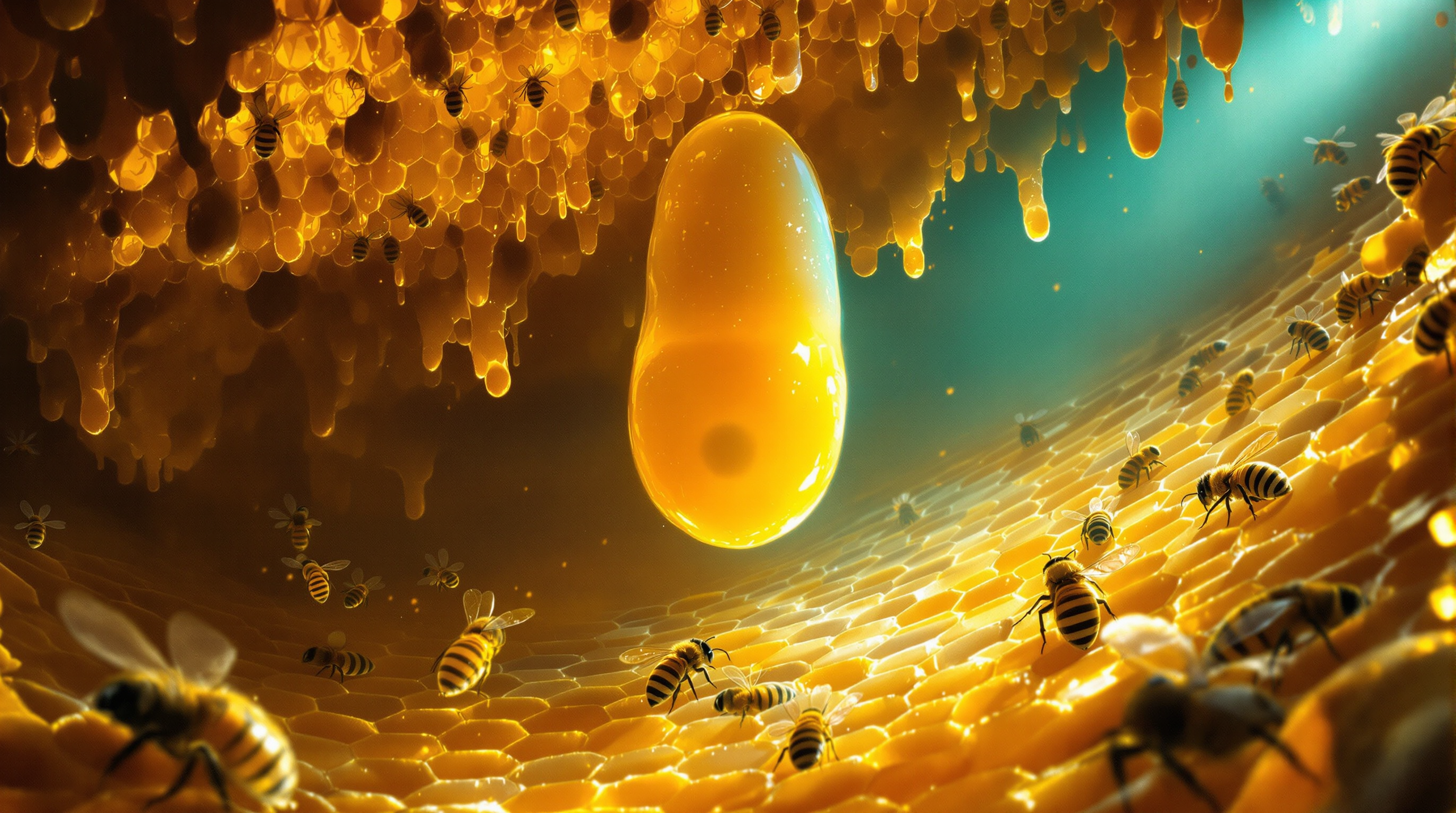
Queen and worker bees hatch from identical eggs, yet one lives for years and lays a million eggs while the others live for weeks and never breed. For a century the textbook answer was a single food: royal jelly. In 2026 a team at UC Riverside showed the real answer is grander. Specialised worker bees build the queen a palace: a peanut-shaped 'royal crib' of custom wax with its own chemistry, and they cluster to keep it warm. Raise a would-be queen in ordinary wax instead and she develops poorly and often dies. The jelly feeds her; the crib crowns her. We love a story with one secret ingredient. Nature almost never works that way.
•3 min readIn 2026 a team at the University of California, Riverside (its Center for Integrative Bee Research) showed that royal jelly alone does not make a queen: the environment does much of the work. A specialised caste of young worker bees acts as royal builders, constructing the large peanut-shaped 'royal crib' from a custom wax that is softer, melts at a higher temperature, and carries a distinct chemical signature of fatty acids and signals, and they alter their own physiology to raise the temperature around the cell, like underfloor heating. Crucially, when would-be queens were raised in ordinary worker-cell wax instead of the royal crib, the larvae developed poorly and many died: they needed the 'smell and feel' of the royal wax to transform at all. So queen determination is a whole system, diet plus architecture, temperature and wax chemistry plus the labour of many bees, not a single ingredient. It is a recurring lesson in biology: we love single-cause stories (one gene, one molecule, one food), but nature's marvels are usually built from many small causes acting together. A queen is built, not dosed.
Cold Spring Harbor, 1948. Heidelberg, May 2026. A maize geneticist who waited thirty years for vindication, and a consortium that just expanded the human proteome by ten per cent.
•4 min readTransCODE Consortium, Nature, 7 May 2026: 1,785 newly catalogued short proteins (peptideins) from non-canonical open reading frames expand the known human proteome by approximately 10 per cent.
1944 to 1971, Mexico, India, Pakistan, Stanford and Oslo
Stanford, May 1968. Utrecht, April 2026. Two retired worst cases, fifty-eight years apart. Both written off by a footnote, not a press conference.
•5 min readVan Vuuren et al, Geoscientific Model Development, 7 April 2026: the architects of the SSP framework formally retire RCP8.5, SSP5-8.5, and SSP3-7.0 as 'implausible' from the CMIP7 framework that will inform IPCC AR7.
Kiel, 1888. Penn State, 2026. Heinrich Quincke spent his career asking what made cerebrospinal fluid move. The answer was waiting in the same place his needle had pointed.
•5 min readPenn State (Drew lab, lead author Garborg, Nature Neuroscience, 27 April 2026): the abdomen pumps the brain via the vertebral venous plexus, gel-forming pressure at every step.
1940 to 1944, Boston, Pearl Harbor, North Africa, Normandy
Pearl Harbor, 1941. Montreal, 2026. Eighty-two years of telling blood when to clot, and the answer keeps getting better.
•6 min readMcGill click-clotting (Jiang et al, Nature, 29 April 2026): bio-orthogonal crosslinking of red blood cells gels in 5 seconds, 13× tougher and 4× more adhesive than a native clot.
1827 to 1900, Berlin, Paris, Oberlin Ohio, and Pittsburgh
Paris, 1855. King's College London, 2026. The metal Napoleon III gave to his most honoured guests has just walked into the column of the periodic table that runs catalysis.
•6 min readCyclotrialumane: the first stable Al(I) trimer, demonstrated in April 2026 to perform two reactions until now reserved for platinum and palladium.
1971-2024 Tokyo, Akita, Kyoto, Bronx, Paris, Dallas
A Barcelona-Oregon team has designed a synthetic DNA molecule that silences the gene driving heart disease. Fifty-three years ago, in a Tokyo basement laboratory, a Japanese biochemist found something that did the same thing in a sample of rice from a Kyoto grain shop.
•7 min readPolypurine reverse Hoogsteen hairpin DNA molecules silence PCSK9 in cells and mice (Biochemical Pharmacology, May 2026 press wave).
This week, in two buildings of Sapienza University in Rome connected by 270 metres of open Roman air, physicists teleported the state of a single photon between two unmatched quantum dots. Einstein, who is the reason this is possible at all, would have hated every word of that sentence.
•7 min readFirst quantum teleportation between dissimilar quantum dots over a 270m open-air link between two Sapienza buildings (Nature Communications, late April 2026).
A research team in Switzerland just produced the first 3D images of immune cells killing cancer cells. The cells were doing something a Russian zoologist guessed at in 1882, alone in a Sicilian house, while his family was at the circus.
•5 min readFirst 3D images of cytotoxic T cells killing cancer cells at the immunological synapse, by cryo-expansion microscopy (Cell Reports, 29 April 2026).
In 1229 a monk in Jerusalem scraped Archimedes off a parchment to make a prayer book. In 2005 a particle accelerator at Stanford read what he had erased. In 2026 the same machine read 66-million-year-old blood vessels inside a T. rex's broken rib.
•6 min readA synchrotron at the Canadian Light Source has just read the cardiovascular blueprint of a healing T. rex's broken rib using the same iron-fluorescence trick that recovered Archimedes in 2005.
1863-1872 American Civil War and post-war Philadelphia
In 1864 a Civil War physician at Turner's Lane Hospital in Philadelphia took seriously the pain his amputee patients reported in limbs that no longer existed. He coined the term phantom limb. He could not explain it. This week, in the Journal of Neuroscience, a team at the University of Colorado Boulder has found the brain circuit that does.
•5 min readUniversity of Colorado Boulder team identifies the caudal granular insular cortex as the brain circuit that maintains chronic pain, separable from acute pain (Journal of Neuroscience, April 2026)