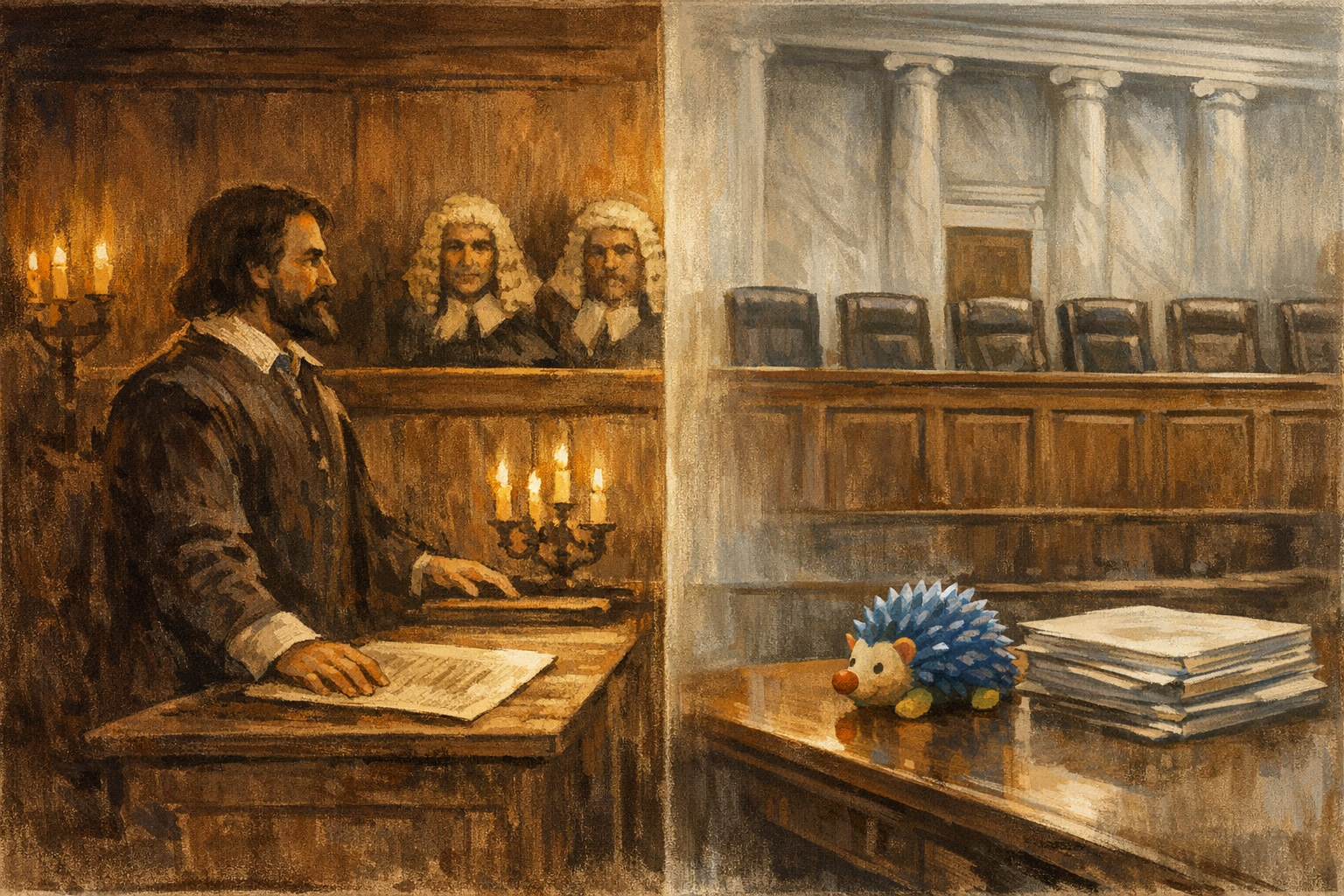
In the autumn of 1637, a prosperous Buckinghamshire landowner named John Hampden was assessed twenty shillings in ship money and refused to pay.
Twenty shillings was nothing to Hampden. He owned estates across three counties. He could have paid the levy, paid it again, and forgotten both amounts by supper. But ship money was a tax that King Charles I had imposed without Parliament's consent, and Hampden had concluded that the principle was worth more than the convenience.
Ship money was, in origin, a medieval coastal defence levy: maritime counties paid for the upkeep of the Navy in time of war. Charles I, who had dissolved Parliament in 1629 and ruled without it for what would eventually become eleven years, extended the levy to inland counties and imposed it annually, in peacetime, without a vote. What had been an emergency coastal contribution became, by royal decree, a permanent national tax. Charles needed the revenue. Parliament, had it existed, would not have agreed to it. So Charles did without Parliament.
Hampden's refusal went before the twelve judges of the Court of Exchequer in June 1637. The case was argued for months. When the verdict came, in 1638, seven judges ruled for the king and five for Hampden. Charles had won.
It was the most expensive victory an English monarch ever claimed.
The narrow margin electrified the country. If five of twelve royal judges believed the tax was illegal, then refusing to pay was not treason; it was a legitimate constitutional position. Collection collapsed. Less than twenty percent of the next assessment was paid. Ship money was effectively dead before Parliament officially abolished it in 1640. By 1642, England was in civil war. By 1649, Charles was on the scaffold.
Hampden himself fought for Parliament in the war his twenty shillings had helped to start. He was shot at the Battle of Chalgrove Field in June 1643 and died of his wounds six days later. He did not live to see the king's execution. But the question he had brought to court (does the executive have the power to tax without the legislature?) survived him by four centuries and counting.
On February 20, 2026, the Supreme Court of the United States ruled 6-3 that President Trump did not have the power to impose tariffs.
The case was brought by Learning Resources Inc., a family-owned educational toy company from Vernon Hills, Illinois, which makes products like Spike the Fine Motor Hedgehog and Botley the Coding Robot. The company had paid approximately $14 million in tariffs the previous year under Trump's "Liberation Day" trade policy, which imposed sweeping duties on imports from dozens of countries using the International Emergency Economic Powers Act as its legal authority.
Chief Justice Roberts, writing for the majority and joined by Justices Sotomayor, Kagan, Gorsuch, Barrett, and Jackson, held that IEEPA does not grant the president the power to set tariffs. "Had Congress intended to convey the distinct and extraordinary power to impose tariffs," Roberts wrote, "it would have done so expressly, as it consistently has in other tariff statutes." The power to tax, the court held, belongs to Congress. Justices Thomas, Alito, and Kavanaugh dissented.
The ruling struck down roughly $175 billion in tariffs. More than $200 billion had already been collected from importers, with the question of refunds left unresolved.
Within hours of the decision, Trump announced new across-the-board tariffs of ten percent under Section 122 of the Trade Act of 1974, a statute that permits the president to impose temporary tariffs to address balance-of-payments deficits. The next day, he raised them to fifteen percent, the maximum the law allows. These tariffs took effect on February 24 and will expire on July 24, 150 days after they began, unless Congress votes to extend them.
The parallel to Hampden is not the verdict. It is what happened after the verdict. Hampden lost in court. Learning Resources won. In both cases, the ruling clarified the constitutional principle (the power to tax belongs to the legislature) without settling the political fight. Charles found a way around his narrow victory until Parliament forced the issue. Trump found a way around his clear defeat by switching legal authorities. Both executives treated the court's answer as a problem to be managed rather than a boundary to be observed.
What Hampden's case teaches is that the power to tax is not a legal question that courts resolve once. It is a political question that legislatures must defend continuously. The Court of Exchequer told Charles he could levy ship money. Charles levied it, and the country refused to pay. The Supreme Court told Trump he could not levy IEEPA tariffs. Trump switched to Section 122, and the tariffs continued.
In both cases, the real question was never what the court said. It was what the legislature did next. Charles's Parliament abolished ship money, then abolished the king. Trump's Congress has until July 24.
Twenty shillings nearly brought down the English crown. Fourteen million dollars and a toy hedgehog brought down a president's trade policy. In both cases, the principle was the same: the power to tax without the legislature's consent is the one power no executive gets to keep.
Whether Congress enforces that principle or lets it lapse on July 24 is the open question. Hampden knew the answer. He died for it.