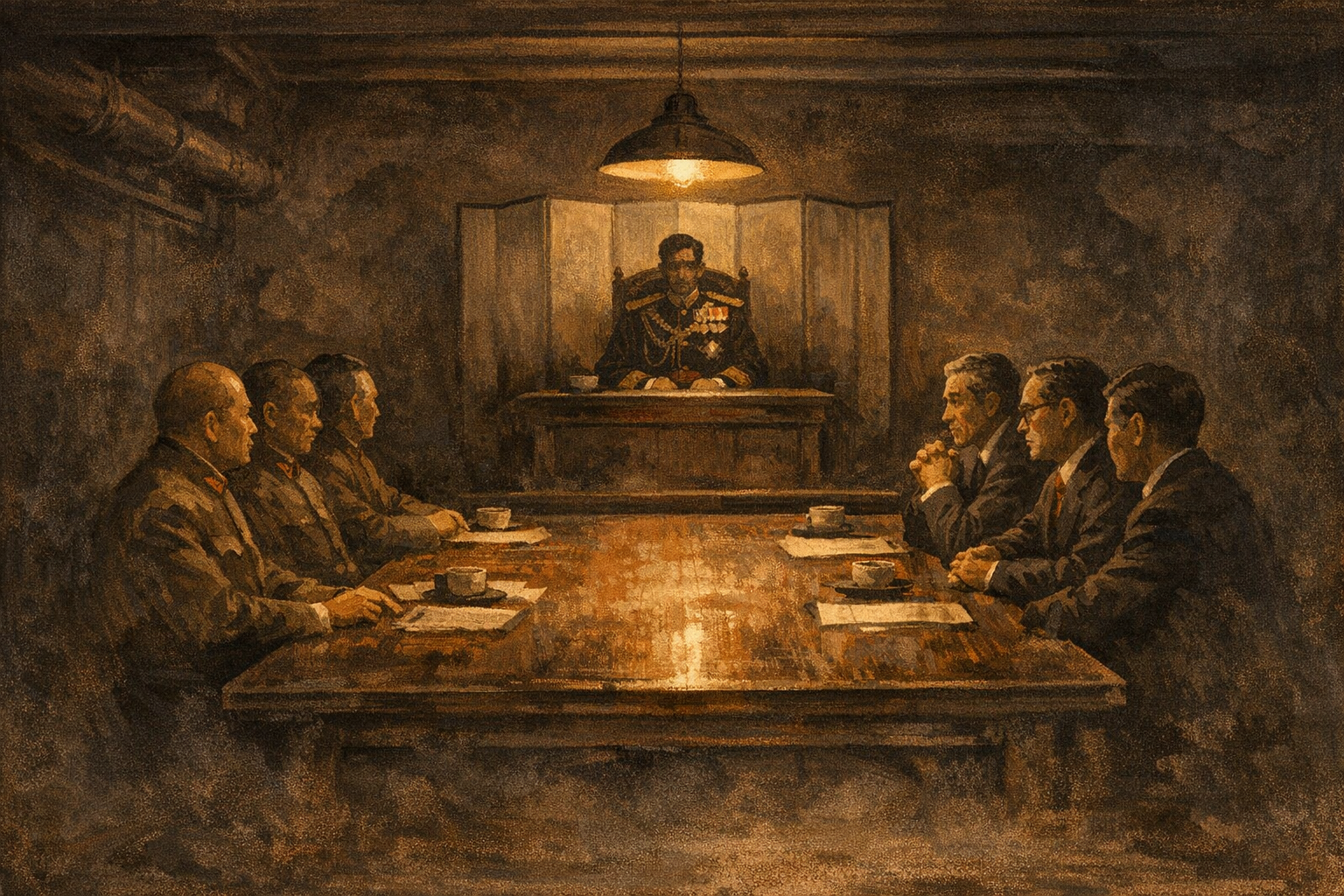
Just before midnight on August 9, 1945, the six most powerful men in Japan filed into an underground conference room beneath the Imperial Palace in Tokyo. They sat at a long table. At the head, elevated on a small dais, the Emperor Hirohito took his seat. He rarely spoke at these meetings. Tonight would be different.
The Supreme War Council, known as the "Big Six," had been deadlocked all day. Three members wanted to accept the Potsdam Declaration and surrender: Foreign Minister Shigenori Togo, Prime Minister Kantaro Suzuki, and Navy Minister Mitsumasa Yonai. Three members refused: War Minister Korechika Anami, Army Chief of Staff Yoshijiro Umezu, and Navy Chief of Staff Soemu Toyoda. The split was absolute. Neither side would yield.
The civilians' position was straightforward. Two atomic bombs had been dropped in three days. The Soviet Union had invaded Manchuria that morning. Japan's cities were ash. Its navy was gone. Its air force was reduced to kamikaze missions. Continuing the war meant annihilation. They wanted to accept the Potsdam terms with one condition: that the Emperor be preserved.
The military's position was also straightforward. Surrender was dishonour. Japan should fight a decisive battle on the home islands and inflict enough casualties on the invaders to negotiate better terms. If the terms were unacceptable, the nation would die fighting. Anami argued that the army still had millions of men under arms. Umezu said the homeland defences were prepared. Toyoda said the navy could still contest an invasion.
Neither side was irrational. The civilians were reading the strategic situation. The military were reading the culture. Both readings were internally consistent. The government could not decide because both positions commanded exactly half the authority in the room.
Prime Minister Suzuki did something that had no precedent in Japanese constitutional history. He turned to the Emperor and asked for his personal opinion. The Emperor, who by custom observed but did not direct, spoke. He said the war situation had "developed not necessarily to Japan's advantage." He said he could no longer bear to see his people suffer. He asked the council to accept the Potsdam terms. The room fell silent. Several men wept.
The Emperor's intervention, later called the "sacred decision," was not a vote. It was something older: the voice of an authority that existed outside the deadlocked system. Anami and the generals submitted. Not because they agreed, but because disobeying the Emperor was treason.
It was still not over. On the night of August 14, junior army officers attempted a coup. They stormed the Imperial Palace, searching for the phonograph recording of the Emperor's surrender broadcast. They did not find it. The coup failed by morning. War Minister Anami, who had argued for fighting to the end but refused to support the coup, committed seppuku at dawn on August 15. Hours later, the Emperor's voice was broadcast to the nation for the first time: Japan would "bear the unbearable."
Time Rhymes. New story every day. If you want tomorrow's, subscribe.
Yesterday, President Trump extended the ceasefire with Iran indefinitely. His reason was specific: Iran's government, he said, is "seriously fractured."
The fracture is between the same two forces that deadlocked the Big Six in 1945: the civilians who want to negotiate and the military commanders who refuse. Foreign Minister Abbas Araghchi and Parliament Speaker Mohammad Bagher Ghalibaf favour attending peace talks in Islamabad. IRGC Commander Ahmad Vahidi and his deputies oppose negotiations as long as the naval blockade continues. When Araghchi announced the reopening of the Strait of Hormuz, the IRGC publicly attacked him and refused to implement the order. A national security adviser to Ghalibaf wrote that the ceasefire extension "has no meaning" and that the blockade "must be responded to militarily."
Trump's ceasefire extension is, in effect, a pause while he waits for one side of Iran's government to prevail over the other. He has asked Tehran to submit a "unified proposal." The word "unified" is doing all the work in that sentence. A unified proposal requires someone inside the Iranian system to break the deadlock.
The parallel to August 1945 is not the war. It is the architecture of the impasse. A government under devastating external pressure, split between a civilian faction that calculates survival requires concession and a military faction that calculates concession is worse than continued conflict. Neither faction has the authority to overrule the other. The system is designed for consensus, and consensus is the one thing the system cannot produce.
In Japan, the deadlock was broken by the Emperor: an authority that sat above the factions, rarely spoke, and whose word, when it came, was final. The question in Tehran is whether Iran's system contains an equivalent figure. The Supreme Leader, Ayatollah Khamenei, has the constitutional authority to overrule both the IRGC and the civilian government. He has not spoken publicly on the ceasefire terms.
The Big Six could not decide whether to end the war. Hirohito decided for them. The decision cost Anami his life and saved millions of others. The question this week is not whether Iran's government is fractured. Trump is right: it is. The question is whether anyone inside the system has the authority, and the will, to do what Hirohito did at midnight on August 9, 1945: override the deadlock and bear the unbearable.