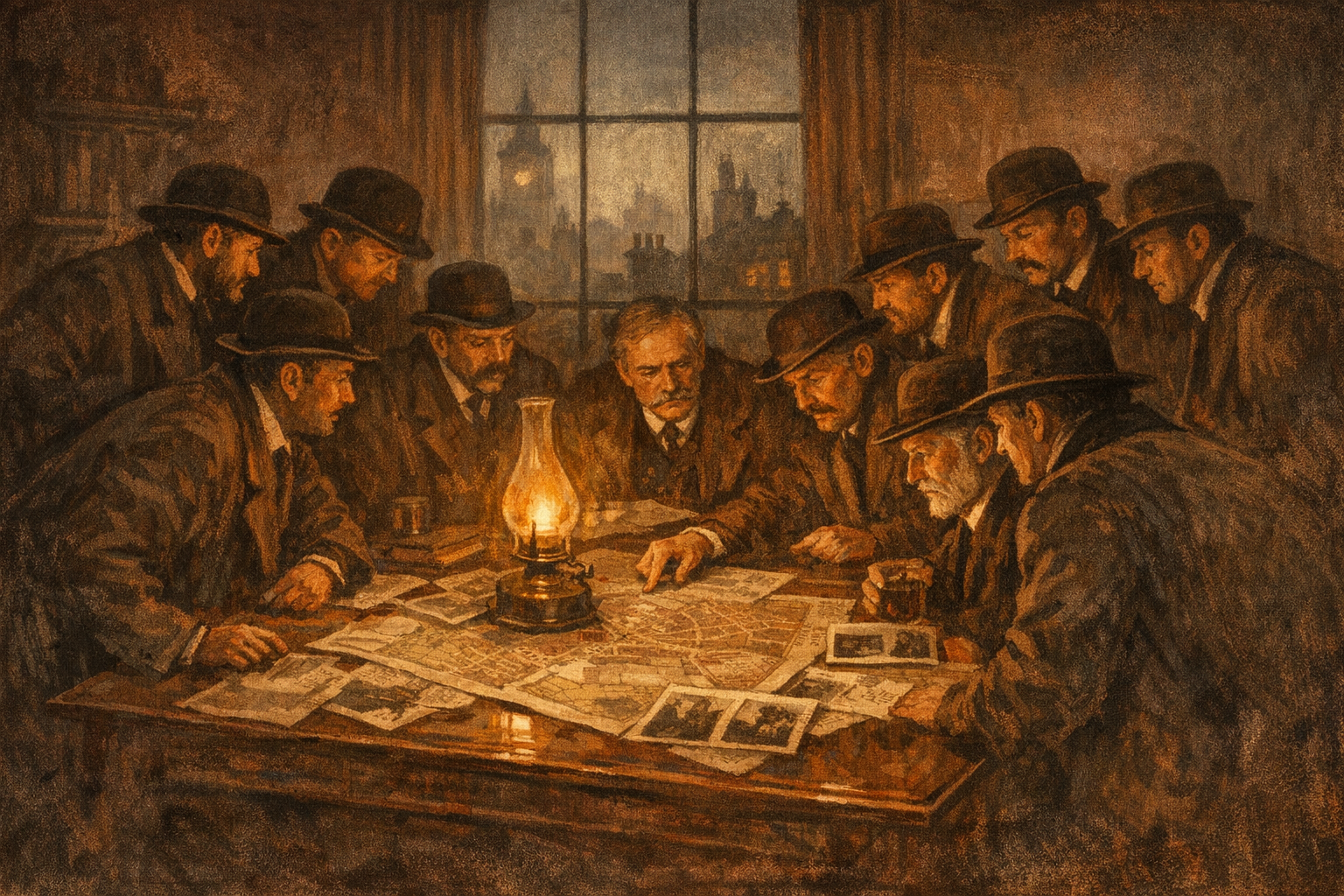
In March 1883, the Home Secretary of the United Kingdom, Sir William Harcourt, walked into Scotland Yard and ordered the creation of a new unit. It would consist of twelve detectives. Their job would be to find the people who kept blowing up London.
The problem was specific. For two years, bombs had been detonating across Britain with a regularity that suggested organisation rather than madness. The targets were not random: government buildings in Whitehall, the offices of The Times, railway stations in Glasgow, and, most alarming of all, the London Underground itself. On October 30, 1883, bombs exploded at Praed Street station near Paddington and at Westminster Bridge station, injuring seventy people in one of the worst terrorist attacks London had experienced.
The bombers were not British. They were Irish-Americans, funded by an organisation called Clan na Gael operating openly in New York, Philadelphia, and Chicago. The campaign's chief fundraiser, Jeremiah O'Donovan Rossa, ran his operation from a desk in Manhattan and made no secret of his intentions. He gave newspaper interviews. He published appeals for donations in Irish-American newspapers. He sent the money to operatives in England who built bombs from commercially available dynamite and placed them in public buildings during business hours.
Britain protested to Washington. Washington was slow to act. O'Donovan Rossa was an American citizen. His activities operated in a legal grey zone that Washington showed little interest in clarifying. And the Irish vote in New York was not something any American politician was eager to antagonise.
The campaign peaked on January 24, 1885, a day the London press called "Dynamite Saturday." Three bombs exploded within minutes of each other: one in the chamber of the House of Commons, one in Westminster Hall, and one in the Banqueting Room of the Tower of London. Four visitors and two police officers were injured. The House of Commons chamber was damaged badly enough to require reconstruction.
The Dynamite Saturday bombers, Henry Burton and James Cunningham, were caught and sentenced to life imprisonment. Over the course of the campaign, Special Branch made roughly fifty intelligence-driven arrests, infiltrating the network deeply enough to trigger internal recriminations within Clan na Gael over suspected informers. By 1885, the organisation was fractured from within, and the campaign collapsed.
By the time it ended, it had killed four people and wounded eighty-six. It had also done something its architects had not intended: it had created an institution. The twelve detectives Harcourt assembled in March 1883 became the Special Irish Branch. Within a decade, "Irish" was dropped from the name. Special Branch became the Metropolitan Police's permanent intelligence and security unit, the prototype for every counter-terrorism police force in the Western world. The bombers built a bomb. The British built an institution that outlasted the cause.
William Mackey Lomasney, one of the campaign's most committed operatives, died on December 13, 1884, when the bomb he was trying to attach to a pier of London Bridge detonated prematurely. His body was never recovered from the Thames. Clan na Gael paid a pension to his widow and four children. Irish independence, when it came thirty-seven years later, came through politics and a different kind of war, not through dynamite in the Underground.
This month, someone has been setting fire to Jewish buildings in northwest London.
On March 23, four ambulances belonging to a Jewish charity were torched in the Golders Green neighbourhood. On April 15, attempted arson attacks hit Finchley Reform Synagogue and the offices of a Persian-language media organisation critical of Iran's government. On April 19, a bottle of accelerant was thrown through the window of Kenton United Synagogue in Harrow. All the attacks occurred within a few miles of each other. None caused injuries. Several suspects, ranging from teenagers to people in their forties, have been arrested.
The attacks have been claimed online by a group calling itself Harakat Ashab al-Yamin al-Islamia. UK police are investigating whether the campaign is the work of Iranian proxies. The British government has previously accused Iran of using criminal networks to conduct attacks on European soil targeting opposition media and Jewish communities.
The structural parallel to the Fenian campaign is not the scale. The Fenians used dynamite; the London arsonists have used accelerant and bottles. The Fenians killed four people; the arsonists have injured none. The parallel is the method: a foreign power using proxies who maintain enough deniability to complicate a diplomatic response. O'Donovan Rossa raised money openly in Manhattan, and Washington could not or would not stop him. If Iran is directing attacks through criminal intermediaries in London, the diplomatic calculus is the same: how does a government respond to violence that comes from a state that claims no involvement?
What the Fenian campaign teaches is that the covert attack rarely achieves what the attacker intends. The dynamite did not advance Irish self-governance. It hardened British public opinion, created a counter-terrorism infrastructure that had not existed before, and gave the British state tools it used for the next century. The bombers intended to terrorise. What they built, inadvertently, was the apparatus that would be used to stop them.
The twelve detectives of 1883 became Special Branch, which became the Counter Terrorism Command, which is now investigating the arson attacks in northwest London. The institution the Fenians created is the institution that is looking for the arsonists. That is the irony of the covert campaign: it does not weaken the target state. It teaches the target state how to watch.
The question this week is whether anyone in Tehran has read the history of O'Donovan Rossa's desk in Manhattan, and noticed how that story ended.