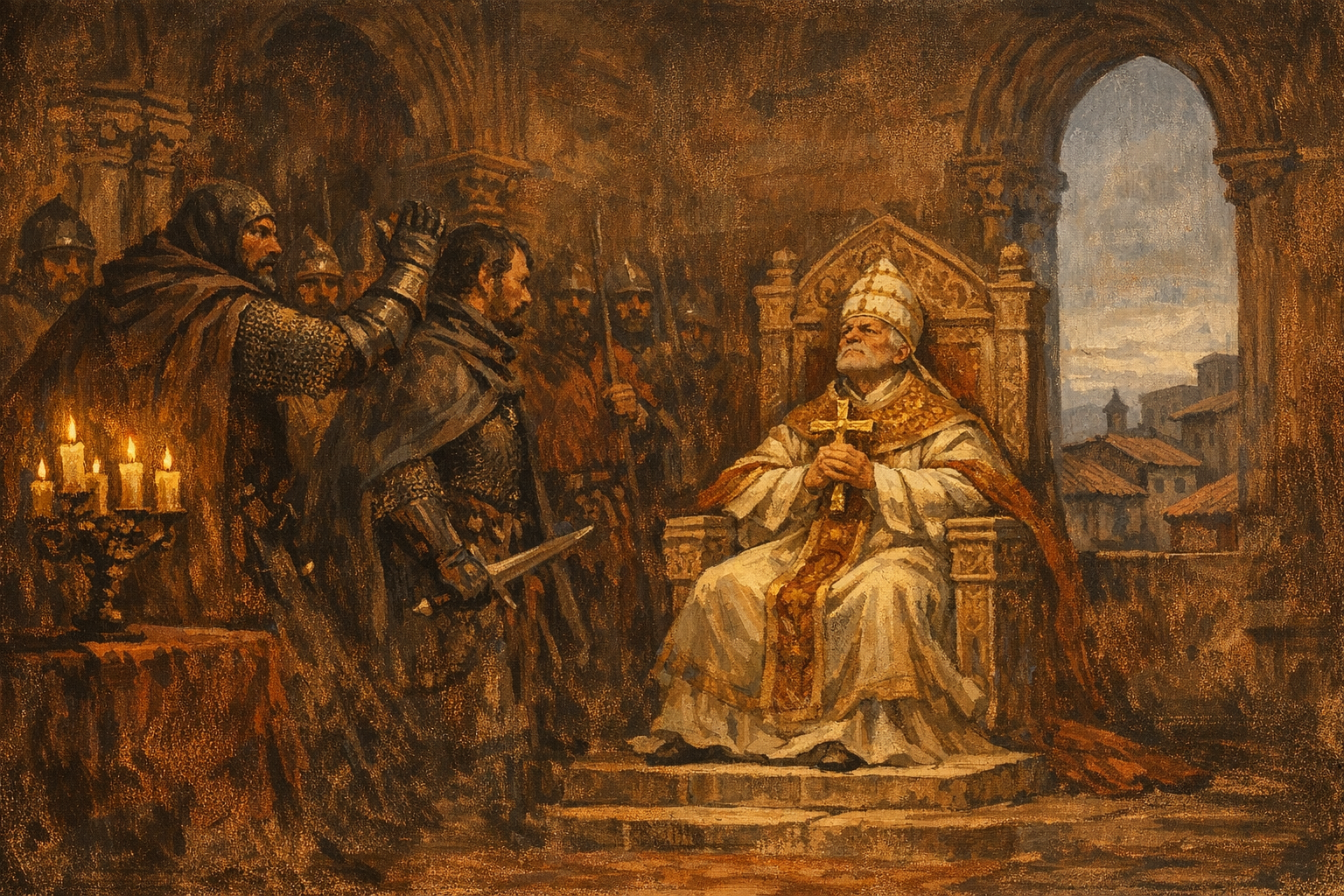
On the morning of September 7, 1303, a French lawyer and a Roman nobleman walked into the papal palace at Anagni with several hundred soldiers and a plan to kidnap the Pope.
Guillaume de Nogaret was King Philip IV's most trusted enforcer, a man who had built his career prosecuting heretics and would later build it further by prosecuting Templars. Sciarra Colonna was the head of a Roman family the Pope had personally ruined, whose lands had been confiscated and whose relatives had been excommunicated. Nogaret wanted to arrest Boniface VIII and bring him to France to stand trial. Colonna wanted something simpler. They had entered the city before dawn, through gates opened by traitors inside.
Boniface VIII was, by most accounts, the most combative Pope in a combative century. He had issued the bull Unam Sanctam ten months earlier (a "bull" being a formal papal decree, named for the lead seal that authenticated it), a document that declared every human creature on earth subject to the authority of the Roman pontiff. He had told Philip IV that the French crown was subordinate to the papal throne. He had forbidden the French clergy from paying the taxes Philip needed to fund his wars. And when Philip organized a counter-assembly in Paris to put the Pope on trial in absentia, Boniface had prepared a bull of excommunication that would have released every subject in France from obedience to their king.
The bull was unsigned on his desk when the soldiers arrived.
Nogaret and Colonna found Boniface in his papal robes, seated on his throne, a cross in his hands. They demanded his abdication. He refused. "I will sooner die," Boniface told them, according to the chroniclers. What followed is disputed by seven centuries of historians, but the incident that gives the day its name is not: Colonna struck the Pope across the face. The schiaffo di Anagni, the slap at Anagni, became the defining image of what happens when secular power decides it has had enough of spiritual authority telling it what it cannot do.
Boniface was held for three days. The townspeople of Anagni eventually freed him. He returned to Rome. He died five weeks later, on October 11, 1303, broken in body and, by all accounts, in spirit. Philip had won.
Or so it appeared. Philip pressured the next conclave into electing a French Pope, Clement V, who moved the papacy to Avignon in 1309. The papal court remained there for sixty-seven years, under the shadow of the French crown, in what later historians called the Babylonian Captivity of the Church. The captivity produced the Great Western Schism of 1378, when two and then three men claimed to be Pope simultaneously, a crisis of legitimacy that lasted forty years and contributed directly to the conditions that produced the Protestant Reformation a century later.
Philip got his compliant Pope. It took a hundred and fifty years for the full cost of that victory to come due.
This week, the president of the United States called the Pope "WEAK on Crime" and "terrible for Foreign Policy."
The exchange has been escalating for days. Pope Leo XIV, the first American-born pontiff, elected in May 2025, has been increasingly vocal in opposing the Iran war. He called Trump's rhetoric against Iran "truly unacceptable." He warned of the "delusion of omnipotence." He wrote that "God does not bless any conflict." Trump responded on social media, and then, when Italian Prime Minister Giorgia Meloni (until recently one of his closest European allies) sided with the Pope and called Trump's language "unacceptable," Trump fired back at her too. On Thursday, the White House signaled that the United States might reconsider its defense commitments to Italy.
Pope Leo, speaking to reporters as he departed for a ten-day tour of Africa, said he had "no fear of the Trump administration" and would continue speaking out.
The parallel to Anagni is structural, not moral: nobody is sending soldiers to arrest anyone. But the architecture of the confrontation is the same across seven centuries. A head of state conducting a war. A Pope asserting that the war is unjust. The head of state concluding that the Pope's moral authority is a political problem and responding with the tools available to secular power: public insults in 2026, a slap and a kidnapping in 1303. And the Pope refusing to back down, because backing down would concede the one thing a Pope cannot afford to lose: the claim that there is an authority higher than the state.
What Anagni teaches is not that the secular power always wins. Philip won the battle. Boniface died humiliated. The Avignon papacy was, for sixty-seven years, a French subsidiary. But the institution Philip thought he had subordinated outlasted the Capetian dynasty, the Kingdom of France, and eventually Philip's own reputation. The slap at Anagni is remembered not as a triumph of the crown but as a stain on it.
Boniface VIII was not a sympathetic figure. He was arrogant, combative, and probably corrupt. Philip IV was not a villain. He was a king trying to fund a war and resenting a foreign authority that told him he could not tax his own clergy. Both had claims. Both had grievances. And the collision between them produced consequences that neither could have imagined: an institutional crisis that reshaped Western Christianity for centuries.
The question this week is the one that has followed every collision between temporal and spiritual power since the thirteenth century. It is not who is right. It is what happens to the winner.
The Pope is in Africa. The president is on social media. And the argument about whether spiritual authority has anything to say to temporal power is seven hundred and twenty-three years old, and no closer to settled than it was the morning Colonna raised his hand at Anagni.