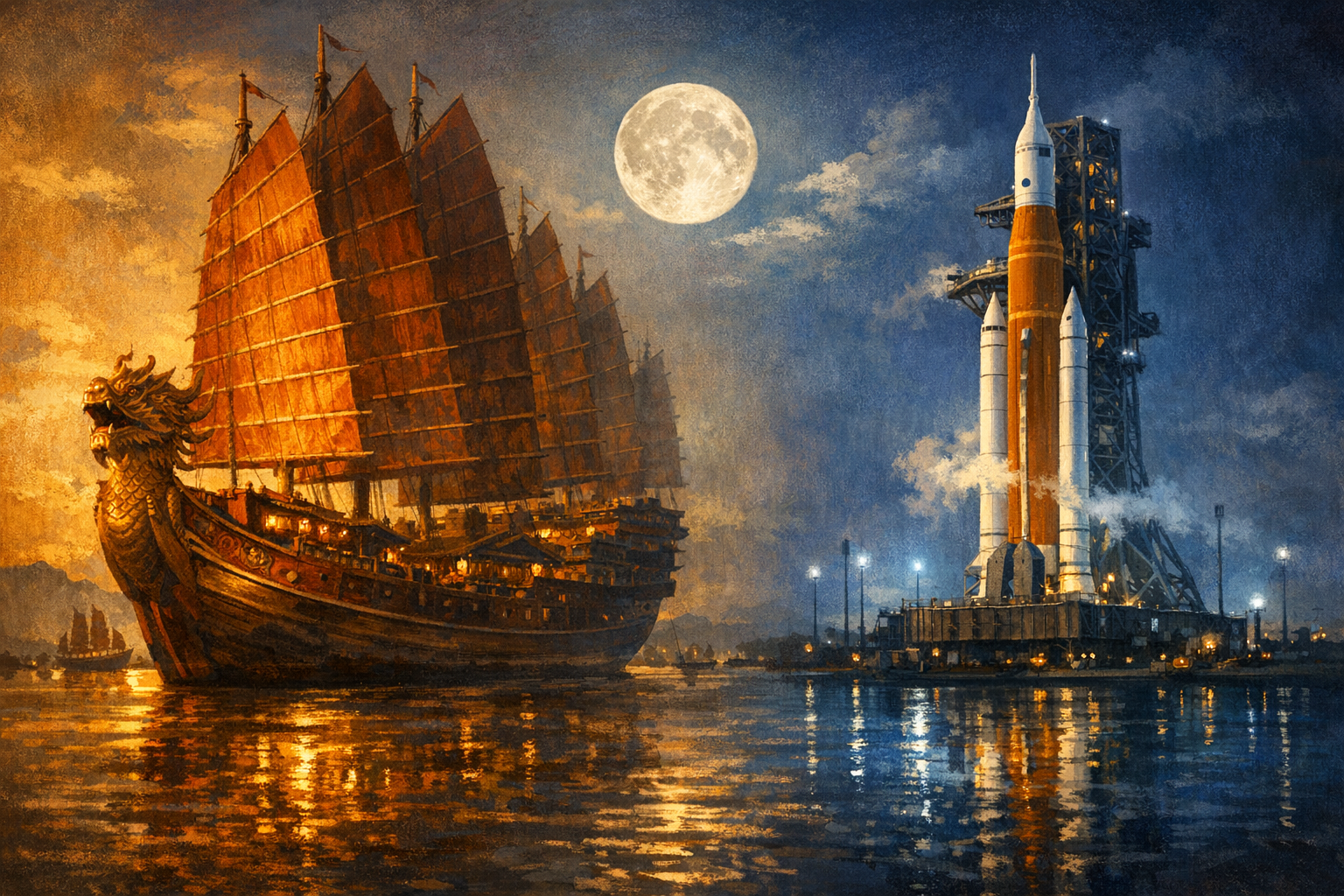
In the summer of 1433, the largest wooden ships the world had ever seen rode at anchor off the coast of Calicut, India. Their commander, a Muslim eunuch named Zheng He, was dying. He had been at sea, on and off, for twenty-eight years. He had commanded fleets of more than three hundred vessels and nearly twenty-eight thousand men. His flagship, by the most conservative modern estimate, was over two hundred feet long. By the most generous, it was longer than a football pitch. Christopher Columbus would not be born for another eighteen years, and his Santa Maria would measure barely sixty-two feet from bow to stern.
Nobody in Europe knew any of this was happening.
Zheng He had been born Ma He in 1371, the son of a Muslim family in Yunnan province. At the age of ten, he was captured by invading Ming armies and castrated. He was placed in the service of the Prince of Yan, who would become the Yongle Emperor, one of the most ambitious rulers in Chinese history. The Yongle Emperor wanted the world to know that China existed, and that it was magnificent. To deliver that message, he chose the boy he had raised from captivity: Zheng He.
Between 1405 and 1433, Zheng He made seven voyages. His fleets sailed to Java, to Sumatra, to Ceylon, to the coast of India, to the Persian Gulf, and to the shores of East Africa. They carried silk, porcelain, and gold. They returned with giraffes, ostriches, and ambassadors. The first expedition alone comprised 317 ships and nearly 28,000 crew. Nothing remotely comparable would sail from any European port for another century.
Then it stopped.
The Yongle Emperor died in 1424. His successor, the Hongxi Emperor, cancelled the voyages immediately. His son, the Xuande Emperor, briefly revived them for one final expedition in 1430, the seventh and last voyage. Zheng He died during or shortly after it, around 1433. Within two years, the Xuande Emperor was dead too, succeeded by the eight-year-old Zhengtong Emperor. The Confucian court officials who had always considered the voyages a ruinous extravagance now had a child on the throne and nobody to stop them.
The oceangoing fleet was left to rot. Only single-masted fishing boats were permitted; anything larger became a criminal offence. According to a widely cited account, a War Ministry official named Liu Daxia later destroyed the navigation charts and expedition logs, though scholars still debate whether this actually happened. What is not debated is the result. China, which had possessed the most advanced naval technology on Earth, chose to forget how to use it.
Fifty-nine years later, in 1492, a Genoese sailor named Christopher Columbus set off across the Atlantic in a vessel one-third the length of Zheng He's flagship. He thought he was sailing to the same places Zheng He had already been. He was wrong about the geography, but it did not matter. Europe filled the vacuum that China had created, and the next five centuries of global power flowed from that single collective decision to stop.
The gap lasted fifty-nine years. Long enough that everyone who made the decision was dead by the time someone else started.
On the evening of April 10th, 2026, four astronauts splashed down in the Pacific Ocean after nine days in space. Their names were Reid Wiseman, Victor Glover, Christina Koch, and Jeremy Hansen. They had just completed Artemis II, a flyby around the Moon and back. It was the first time human beings had travelled beyond low Earth orbit since Gene Cernan and Harrison Schmitt left the lunar surface on December 14th, 1972.
The gap was fifty-three years.
In 1972, Cernan became the last human to stand on the Moon. The Saturn V rockets that carried Apollo there were retired. The production line was shut down, the tooling scrapped. By the mid-1970s, NASA could not have built another Moon rocket if it wanted to. America, which had possessed the most advanced space technology on Earth, chose to stop using it.
The structural rhyme is almost eerie. Zheng He's voyages were funded by the Yongle Emperor, who wanted to project power and awe across the known world. Apollo was funded by Kennedy, who wanted to project power and awe beyond it. Both programmes were phenomenally expensive. Both were attacked by domestic factions arguing the money should be spent at home. Both were dismantled within a few years of their patron's death. And both left a gap measured in decades: fifty-nine years for the treasure fleets, fifty-three for the Moon shots.
The question the parallel raises is not whether Artemis will succeed. Artemis II already has. The question is what happens in year five, or year ten, when the political winds shift and someone argues the money would be better spent elsewhere. The Confucian court faction had perfectly reasonable arguments. So did the senators who defunded Apollo. The case for stopping is always reasonable in the moment. The cost of stopping only becomes visible a generation later, when someone else is doing what you chose not to.
When the Ming court let Zheng He's ships rot, they did not think they were ceding the next five centuries to Europe. They thought they were being responsible. Columbus did not know he was filling a vacuum. He thought he was finding a trade route.
History does not repeat, but the gaps rhyme. Fifty-nine years. Fifty-three years. The question facing the Artemis programme is whether we are at the beginning of a new age of exploration, or at the top of another arc that ends with someone, somewhere, deciding the sea is not worth the money.
Gene Cernan said, before he died in 2017, that he never wanted to be the last man on the Moon. As of April 2026, he no longer is.
Whether that holds depends on whether anyone remembers what happened the last time a civilisation looked at the horizon and decided to turn around.