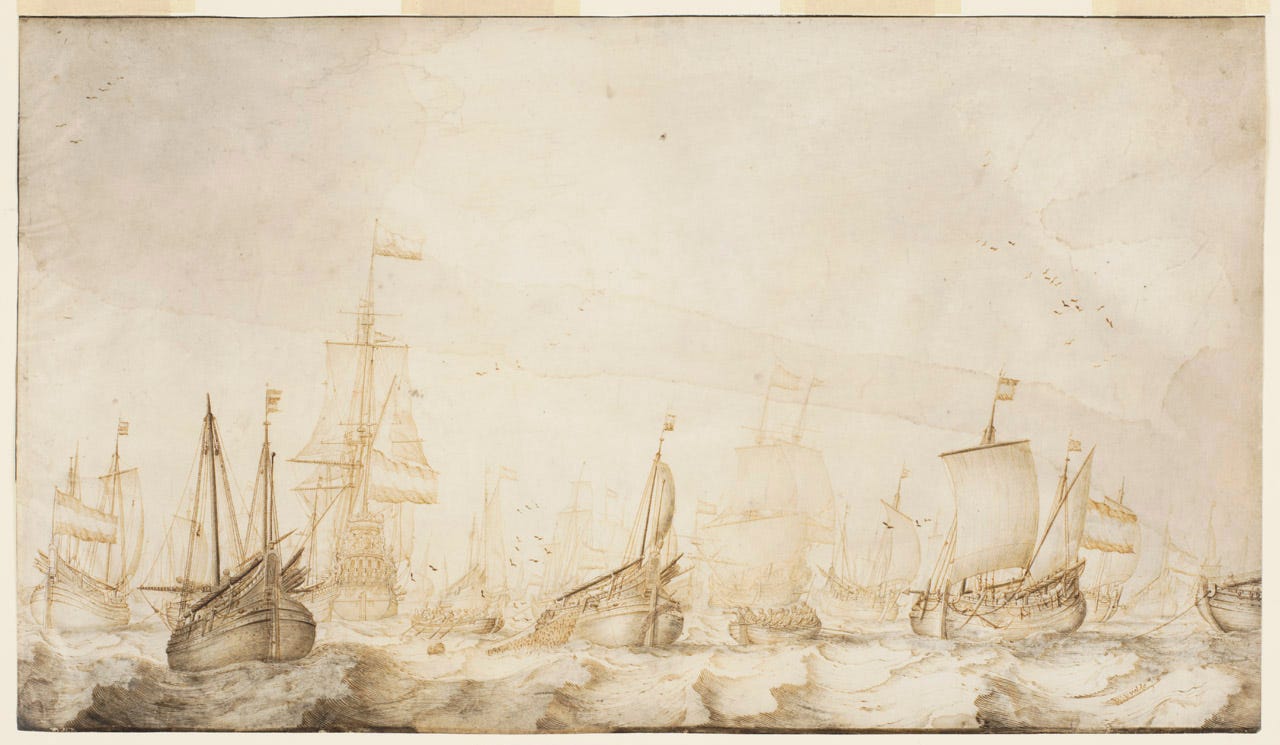
The Cold Open
The stench hit you before the economics did. In the summer of 1598, across the wharves of Amsterdam, Enkhuizen, and Hoorn, tens of thousands of herring rotted in open air. The barrels stood ready. The nets were mended. The buizen -- the fat-bellied fishing boats that were the ATMs of the Dutch economy -- sat idle at their moorings. What was missing was salt. Without it, a herring lasted two days. With it, a herring lasted two years. And Philip II of Spain had just locked the door to every salt port on the Iberian coast.
The Historical Story
Philip II was not a stupid man. He was, by most accounts, the most methodical monarch in Europe, a king who read his own dispatches and annotated them in margins so dense they looked like scripture. When he signed the embargo barring Dutch ships from Iberian salt ports in 1598, he knew exactly what he was doing. He was turning off the refrigerator for an entire nation.
The logic was elegant. The Dutch Republic’s wealth rested on a pyramid whose base was herring. Salted herring fed Northern Europe’s winters. Herring profits funded shipbuilding. Ships carried Baltic grain and French wine. Trade revenue financed the Dutch revolt against Philip’s own empire. Cut the salt, and the pyramid collapses from the bottom.
And for a few months, it worked. Salt prices in Amsterdam tripled. Herring exports cratered. The financial syndicates that ran Dutch commerce watched their working capital evaporate like brine in August sun.
But Philip had failed to model one thing: what desperate money does when its usual channels close.
Three years earlier, a Dutch merchant and secretary named Jan Huyghen van Linschoten had returned from roughly five years of service in Portuguese Goa -- where he had worked as bookkeeper to the Archbishop -- carrying something more valuable than spices. He had stolen -- or, more precisely, meticulously copied -- the Portuguese navigation charts to the East Indies. In 1595 and 1596, he published them in a book called the Itinerario, complete with sea routes, harbor depths, monsoon calendars, and notes on which local rulers could be bribed and which had to be fought.
Dutch merchants had read the Itinerario with interest. But interest is not investment. The routes were long. The mortality rates were horrifying -- Cornelis de Houtman’s first expedition to the East Indies in 1595–97 lost roughly two-thirds of its crew to scurvy, dysentery, and Javanese hostility. Before the embargo, the risk calculus was simple: why fund a speculative death voyage when you can make steady money salting herring?
Philip II answered that question for them. By closing the salt ports, he made the safe bet disappear.
Between 1598 and 1601, Dutch capital poured into Asian trading ventures with the frantic energy of money that has nowhere else to go. Fourteen separate expeditions sailed for the East Indies. The problem was that they were competing against each other -- bidding up pepper prices in Bantam, undercutting each other in Amsterdam, and occasionally shooting at each other’s ships in the Malacca Strait.
Enter Johan van Oldenbarnevelt, the Grand Pensionary of Holland, a lawyer-politician with the diplomatic instincts of a poker player and the patience of a glacier. Oldenbarnevelt saw that the competing syndicates -- the voorcompagnieën -- were bleeding each other dry. He spent months cajoling, threatening, and horse-trading their directors into a single entity.
On March 20, 1602, the States-General of the Dutch Republic chartered the Vereenigde Oost-Indische Compagnie -- the VOC, the Dutch East India Company. Its initial capitalization was 6.44 million guilders, roughly $110 million in today’s money. It was the largest equity offering in human history to that date. Shares were sold to the public -- butchers, widows, servants -- creating the world’s first liquid stock market on the Amsterdam Beurs.
By 1605, VOC fleets had seized the Spice Islands of Maluku from Portugal, cutting off Iberian spice revenue at its source. By 1609, when Spain agreed to the Twelve Years’ Truce, the gesture was almost quaint. The Dutch no longer needed Iberian salt. They no longer needed Iberian anything. They had built a parallel global trading infrastructure -- Asian factory networks, Baltic grain corridors, African way stations -- that bypassed every chokepoint Philip had ever controlled.
Philip’s embargo had been the venture-capital fund for his own replacement.
The Echo
The Strait of Hormuz is roughly twenty-one miles wide at its narrowest point, though the navigable shipping lanes occupy only about six miles of that width. Through it passes roughly 20% of the world’s daily oil supply -- some 21 million barrels. When the US-Iran conflict escalated into direct military strikes, the strait’s vulnerability stopped being a think-tank hypothetical and became a price at the pump.
The cascade has been swift and familiar. As Bloomberg reported, gold initially spiked before falling as Trump threatened escalation of US attacks on Iran -- markets oscillating between fear of disruption and hope of quick resolution. In Asia, CNBC noted that Japanese and South Korean stocks opened higher as investors tried to parse Trump’s Iran war comments against the backdrop of extended deadlines, a mood less of confidence than of desperate pattern-matching.
The structural parallel to Philip II’s salt embargo operates on a level deeper than commodity prices. Both crises involve a single geographic chokepoint weaponized to transmit cascading economic damage through a critical input -- salt then, oil now -- whose interruption radiates immediately into food costs, transport prices, and civilian life thousands of miles from the conflict zone.
But the parallel also carries a warning against easy prediction.
Supporters of maximum pressure on Iran argue that the chokepoint works both ways: Iran’s own economy depends on oil exports transiting the same strait, and sustained military dominance of the waterway could force Tehran to the negotiating table before alternative infrastructure becomes necessary. They point to the speed of US naval deployments and the willingness of Gulf states to increase production as evidence that the disruption, while painful, is manageable and temporary.
Critics counter that every week the strait remains contested, the economic argument for permanent alternatives grows stronger. Emergency LNG rerouting, accelerated pipeline construction from the UAE’s Fujairah terminal (which bypasses Hormuz entirely), strategic petroleum reserve drawdowns across Asia and Europe, and -- most consequentially -- renewed political momentum for renewable energy investment all gain force precisely because the crisis makes the cost of geographic concentration visceral and undeniable. Some energy analysts argue the crisis has already compressed a decade of diversification planning into months.
Both sides may be right simultaneously, which is exactly what makes the historical parallel so instructive. Philip II’s embargo was strategically coherent and self-defeating. The salt ports were a real chokepoint. The pain was real. Dutch herring really did rot on the docks. But the pain was also the catalyst. The money that couldn’t flow to herring flowed to the Itinerario routes instead. The VOC didn’t emerge despite the embargo. It emerged because of it.
The question is whether today’s crisis follows the same arc -- or whether the analogy breaks down because oil markets are more liquid, more globally integrated, and more capable of absorbing shocks than sixteenth-century salt routes. The Dutch pivot took a decade. Modern energy transitions, even emergency ones, operate on timelines that remain genuinely uncertain.
Last time, the chokepoint strategy catalyzed a transformation that took years to fully overwhelm it. The Dutch had already begun probing Asian trade routes before the 1598 embargo, driven by earlier disruptions dating to the 1580 Iberian Union, but the formal embargo accelerated the process dramatically. It took four years from the embargo to the chartering of the VOC in 1602, and longer still before the new trading infrastructure rendered Iberian chokepoints irrelevant. The embargo closed one door, and the Dutch walked through a continental one. By the time Spain offered to reopen the salt ports, nobody was waiting at the gate.
Every chokepoint is a confession: it tells the world exactly where to stop depending on you