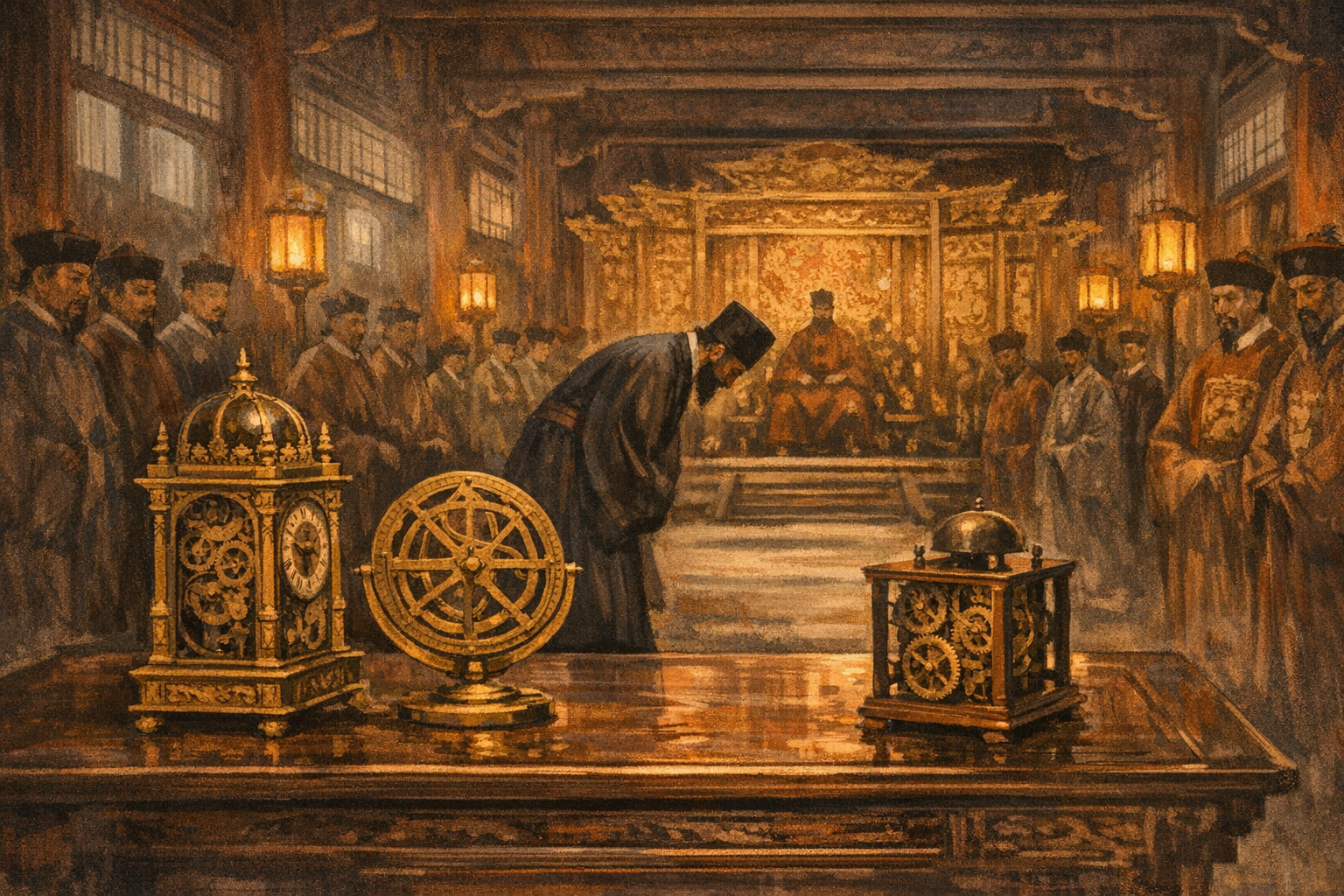
In the summer of 1601, a Jesuit priest from the Italian town of Macerata presented two mechanical clocks to the court of the Wanli Emperor in Beijing.
Matteo Ricci had spent eighteen years preparing for this moment. He had arrived in southern China in 1583 with a strategy that was, by the standards of Christian missionary work, almost heretical in its patience. He did not announce himself as a priest. He did not preach. He dressed as a Confucian scholar, learned Mandarin, and made himself useful. He drew a map of the world that placed China at the centre (the first time most Chinese officials had seen the Americas). He built astrolabes. He corrected local calendars. He demonstrated mechanical clocks that chimed on the hour, a technology the Chinese court had never encountered. And he waited.
The clocks opened the door.
The Wanli Emperor, fascinated by mechanical devices, granted Ricci an imperial stipend and a residence in Beijing, an unprecedented privilege for a European. Ricci stayed for the rest of his life, dying in Beijing in 1610. The emperor granted him a burial plot inside the city walls, an honour no foreigner had received before.
What Ricci had understood, and what his Jesuit successors refined into an institutional strategy over the next century, was that the exchange was the point. Europe had astronomy, optics, and clockwork. China had access, tolerance, and an emperor's ear. If the Jesuits could make themselves indispensable as scientists, they could earn the trust to proselytize as priests. Technology first, theology second.
It worked spectacularly. Adam Schall von Bell, a German Jesuit who arrived in Beijing in 1630, was appointed Director of the Imperial Observatory by the new Qing dynasty in 1644. He reformed the Chinese calendar using Western astronomical methods and predicted solar and lunar eclipses with a precision that humiliated the existing court astronomers. The Shunzhi Emperor made him a mandarin. His successor, Ferdinand Verbiest, became the Kangxi Emperor's tutor in mathematics and astronomy. By 1692, the Kangxi Emperor had issued an edict of toleration for Christianity throughout the empire. The Jesuits had been in China for over a century and had gone from smuggling in clocks to shaping the calendar, advising the emperor, and winning legal protection for their faith.
Then Rome overplayed its hand.
The question was ancestor worship. Chinese Christians, following the Jesuits' policy of "accommodation," continued to honour their ancestors with traditional rites: offerings, incense, bowing before family tablets. The Jesuits argued this was cultural, not religious, and compatible with Christianity. The Dominicans and Franciscans, who had arrived later and resented the Jesuits' influence, argued it was idolatry. The dispute went to Rome.
In 1704, Pope Clement XI ruled against the Jesuits and banned Chinese Christians from practising the rites. In 1705, he sent a papal legate, Charles-Thomas Maillard de Tournon, to enforce the ban at the Kangxi Emperor's court. Tournon arrived in Beijing and informed the emperor that Rome had forbidden Chinese customs in Chinese churches.
The Kangxi Emperor, who had studied Western mathematics with Jesuits and tolerated Christianity for decades, responded by expelling Tournon to Macau, where he died in 1710. In 1721, the emperor banned Christian missions entirely. By 1724, under his successor the Yongzheng Emperor, Christianity was proscribed and most missionaries were expelled. Over a century of patient scientific diplomacy ended because Rome demanded a concession no Chinese emperor could make: the surrender of ancestor worship, the foundation of Confucian social order.
The Jesuits had offered technology and asked for tolerance. They received it. Rome then demanded obedience to a foreign religious authority, and the door that the clocks had opened closed with a speed that stunned everyone who had walked through it.
This week, the United States offered Cuba Starlink.
A delegation of senior State Department officials flew to Havana on a government aircraft, the first US government plane to land in Cuba since Barack Obama's visit in 2016. They met with Raul Castro's grandson, known as "Raulito," who is widely regarded as the retired leader's de facto spokesman and a figure the US sees as a back channel to the real power on the island. The American proposal, reported by Axios: install Elon Musk's satellite internet service across the island in exchange for free elections, the release of political prisoners, and compensation for properties confiscated since 1959.
President Trump called it "a new dawn for Cuba."
The structural parallel to the Jesuits is not the technology. Clocks and Starlink are separated by four centuries of engineering. The parallel is the exchange: an outside power offering something the regime wants (scientific prestige then, internet access now) in return for something the regime may not be able to give (tolerance for a foreign faith then, free elections now).
The Jesuits' strategy worked for as long as the conditions they attached were ones the Chinese court could live with. Reform the calendar? Yes. Predict eclipses? Gladly. Teach the emperor mathematics? An honour. But when Rome escalated from scientific exchange to religious obedience, demanding that Chinese Christians abandon the rites that defined their identity as Chinese, the emperor concluded that the cost of the relationship exceeded the value of the clocks.
Cuba's economy is collapsing. Internet access is scarce and government-controlled. Starlink, which bypasses terrestrial infrastructure entirely, would give Cubans unfiltered access to the global internet for the first time. The regime has every reason to want the technology. The question is whether it can accept the conditions.
Free elections in Cuba would end the system that has governed the island since 1959. Compensation for confiscated properties would bankrupt the state. The release of political prisoners would acknowledge that political prisoners exist. These are not reforms. They are the dissolution of the regime, offered in exchange for internet access.
The Kangxi Emperor accepted the clocks, the calendars, and the eclipse predictions. He drew the line at ancestor worship. The Castro family may accept Starlink. The question is where they draw theirs.
Ricci spent eighteen years earning the trust to walk through the door. The technology opened it. But the door only stayed open as long as the conditions attached to it were ones the emperor could meet without ceasing to be emperor.
A clock is not a Trojan horse if the gift-giver knows when to stop asking for more. Ricci knew. Rome did not. Whether Washington does is the open question in Havana this week.