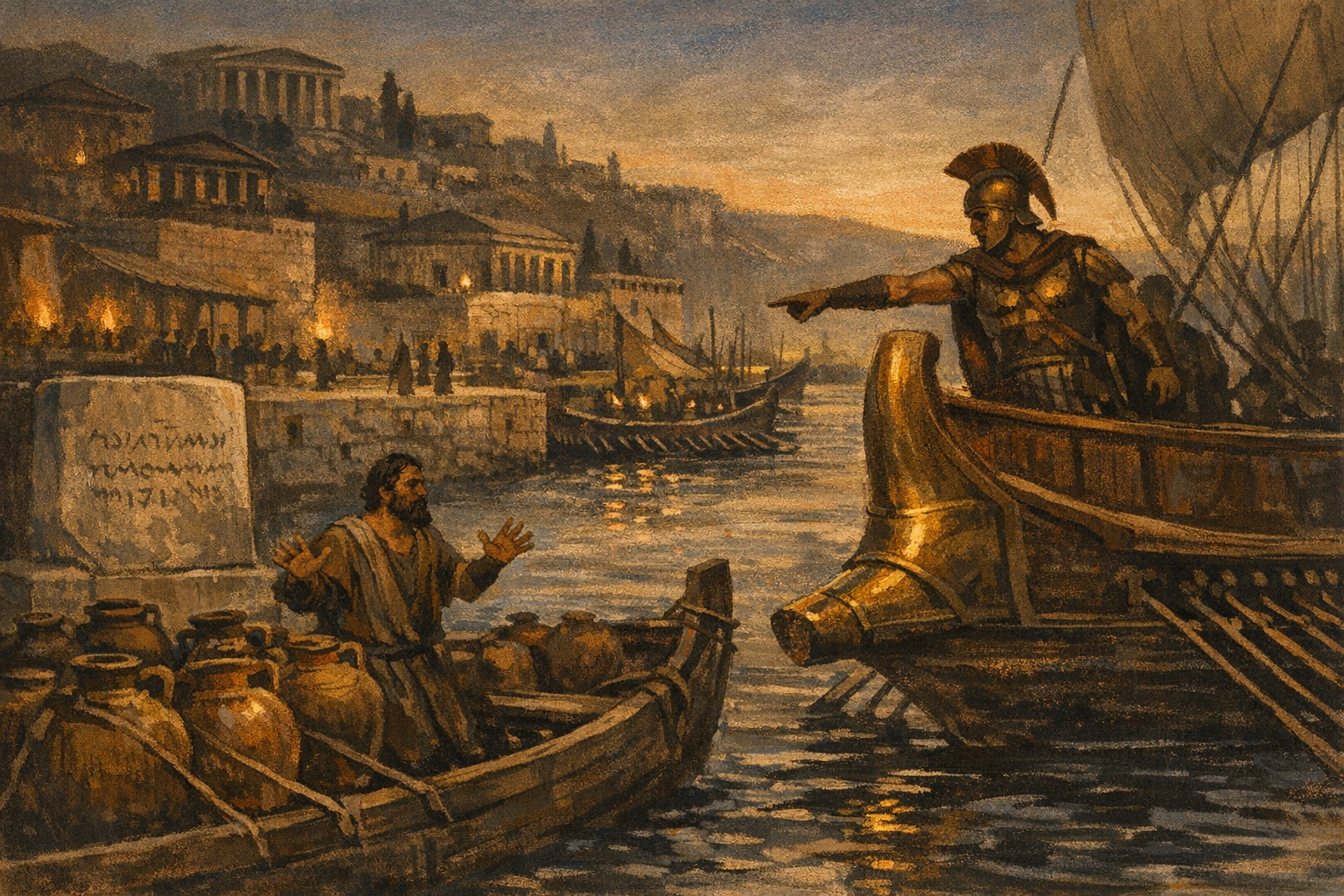
In the spring of 432 BC, a Megarian merchant arrived at Piraeus with a hold full of olive oil and was turned away. Then turned away again at Aegina. Then at Byzantium. Then at every harbor between Italy and the Hellespont where Athenian triremes patrolled. He had broken no law and paid every tax. He had simply been born in the wrong city.
The Megarian Decree, passed by the Athenian assembly at the urging of Pericles, was a single sheet of marble that announced something the ancient world had been building toward for a generation: an empire using its naval supremacy not to conquer a rival but to slowly close the market to one. Megara was a small city-state perched on the isthmus between Athens and Corinth. Its offenses were real, at least in Athenian eyes: the killing of an Athenian herald sent to Megara, the harboring of runaway slaves, and the cultivation of land Athens considered sacred. Megara was Sparta's ally, and Sparta, the dominant land power in Greece, had spent years inching toward a confrontation with Athens over who would order the affairs of the Greek world.
Pericles did not think he was starting a war. He thought he was preventing one. The logic he laid out to the Athenian assembly was lawyerly and, at the time, widely considered sound. Megara was small. Athens had the navy. Economic pressure was reversible in a way that spears were not. If Sparta did nothing, Megara would fold and the precedent would stand: Athens could discipline Sparta's allies without Sparta being able to protect them. If Sparta attacked, Athens had the Long Walls, a fleet, and Delian League gold, and could outlast any land campaign. Either way, Athens won without the mass death of a generation on the battlefield.
The Spartan king Archidamus, a cautious man who had spent decades trying to keep the peace, sent embassy after embassy asking Athens to lift the decree. Some came with veiled threats; some with genuine offers to arbitrate. Pericles refused them all. He refused, in part, because he believed the decree would work. He also refused because backing down under foreign pressure is the one move a democratic assembly almost never makes.
The Peloponnesian War began the next summer. It lasted twenty-seven years.
Thucydides, who watched the whole thing as a general and then as an exile, was careful to distinguish two kinds of cause. The truest cause, he wrote, was the growth of Athenian power and the fear this caused in Sparta. That war, he was suggesting, was coming regardless. But he also recorded the embassies and the ultimatums in flat detail. Some later historians read him as exonerating Pericles: the structural forces were too large to escape. Others read him as damning him: a more flexible leader might have bought years, even decades, and used them. Both readings have survived because the evidence supports both.
What is not in dispute is how it ended. Plague carried into a city Pericles had packed with refugees killed perhaps a third of Athens, including Pericles himself. The city won battles and lost a fleet at Sicily and fought on through regimes it kept replacing until it surrendered in 404 BC. The walls came down. The democracy that had passed the Megarian Decree was briefly replaced by a junta of thirty men who executed roughly 1,500 Athenians without trial in eight months. By some ancient accounts, that was more than the Spartans had killed by political violence during the entire war.
Blockades, it should be said, do not always end like this. The Union blockade of the Confederacy in the 1860s cut Southern cotton exports by roughly 95% and helped strangle the Confederate economy in the years leading to Appomattox. The British blockade of Germany from 1914 to 1918 killed hundreds of thousands of German civilians through malnutrition and contributed materially to the conditions for armistice, even if the collapse of the Western Front was the more immediate cause. The Kennedy administration's "quarantine" of Cuba in 1962, a blockade in all but name, extracted the removal of Soviet missiles without a direct exchange at the blockade line. A blockade is a tool. It has worked. It has also, often enough to deserve its own chapter in the textbooks, been the thing that turned a crisis that could have been managed into a war that could not.
This week, the United States closed every Iranian port.
The blockade is not the first move in the current crisis. That was a year of strikes, counter-strikes, sabotage, and diplomacy that ran out of time. But it is the first move that puts a uniformed American sailor between an Iranian tanker and the global oil market. As of Monday, vessels carrying Iranian crude are being turned back or escorted away. The administration's case is straightforward and has serious backing across both parties: Iran's enrichment program has moved closer to weapons-grade than at any previous point, successive diplomatic tracks have failed to produce a verifiable rollback, and a blockade sits between accepting a nuclear-armed Iran and striking the facilities directly. In that frame, it is the restrained choice.
Iran's military calls the blockade piracy; its foreign ministry has warned of dangerous consequences for regional and global security. The IMF, in its April outlook, cut its global growth forecast to 3.1% and warned that a prolonged conflict with oil near $100 a barrel this year would push global growth to 2.5%, with a worse scenario putting the world economy on the edge of recession. Fertilizer shipments through Hormuz, on which a significant share of next season's global grain output depends, are already disrupted. Talks in Islamabad collapsed last week over the same clause the blockade is meant to enforce: an end to Iranian enrichment.
Whether this works is a bet on three things that nobody can know in advance. Will Iran's leadership conclude, before political conditions inside Iran make concession impossible, that the nuclear program is worth less than the economy? Will the coalition tacitly supporting the blockade (Gulf states, Europe, allies in Asia) hold together as the price of oil and wheat climbs at home? And will the moment of maximum pressure arrive while Tehran is still capable of saying yes, or only after domestic politics have made yes unthinkable?
Athens bet that Megara would fold first. It was a reasonable bet. It was also, in the end, wrong. Other blockading powers have made the same bet and been right, sometimes spectacularly, as at Appomattox or in the Caribbean. What separates the cases is usually visible only in retrospect: whether the blockaded side had a politically viable path to surrender, and whether the blockader had the patience, and the coalition, to wait for that path to open.
Pericles did not have a bad strategy. He had a strategy that required Sparta to behave a particular way, and once Megara's ribs began to show, Sparta could not. The question in the Gulf this week is the one Archidamus was trying to answer from the other side in 432 BC: when an outside power uses trade to demand a concession that a regime cannot publicly make, what does the regime do next?
Closing a port is the easiest decision a great power ever makes. What it buys (victory, war, or a long strange interval between the two) is the part no one has ever been able to decide in advance.