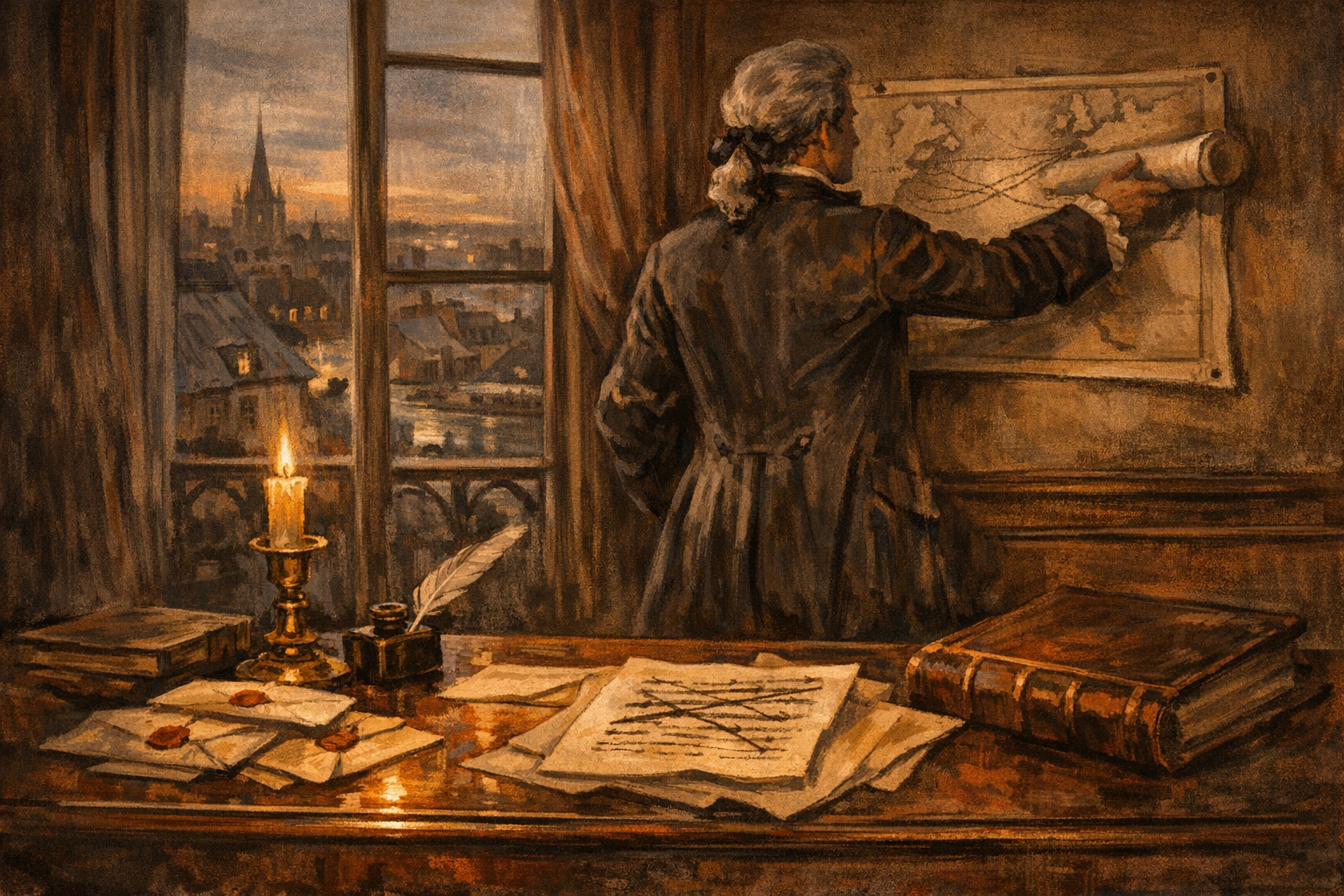
In the spring of 1776, the most famous playwright in France brought a proposal to the foreign minister that had nothing to do with theatre.
Pierre-Augustin Caron de Beaumarchais was, by the standards of any century, a strange man. He had written The Barber of Seville, which was packing the Comédie-Française. He had taught harp to the daughters of Louis XV. He had fought a series of courtroom battles so flamboyant they drew praise from Voltaire. He had also, rather more quietly, been running intelligence operations for the French crown across Europe for the better part of a decade: intercepting blackmail plots in London, tracking Bourbon pretenders in Vienna, and filing reports to the foreign minister that read like the scripts of the plays he hadn't yet written.
The proposal he brought to Charles Gravier, comte de Vergennes, that spring was this: France should arm the American rebels. Not openly, because that would mean war with Britain. Secretly, through a private trading company that did not exist, run by a man whose name would not be attached to it, and financed by a million livres from the French treasury, a million from Spain, and whatever else Beaumarchais could raise from private investors. The company would buy arms from French arsenals, load them onto French ships, route them through the Dutch island of St. Eustatius in the Caribbean, and deliver them to a Connecticut merchant named Silas Deane, who had been quietly dispatched to Paris by the Continental Congress to make exactly this kind of arrangement.
Vergennes liked the plan. Louis XVI approved it. By the end of the year, Beaumarchais was running Rodrigue Hortalez et Compagnie, a corporation that existed on paper and in the holds of seven ships. What it shipped was staggering: over two hundred brass cannon, twenty-five thousand muskets, two hundred thousand pounds of gunpowder, mortars, tents, and uniforms sufficient for thirty thousand men. In total, roughly five million livres' worth of war materiel, assembled from France's own stockpiles, loaded under cover of commercial trade, and delivered to a rebellion that could not have survived the winter of 1777 without it.
The British knew almost immediately. Edward Bancroft, an American-born scientist who served as secretary to Silas Deane in Paris, was also a British spy, reporting the details of every shipment to London in invisible ink. The British ambassador in Paris confronted Vergennes directly. Vergennes lied. France, he said, was a neutral power and had no knowledge of any arms shipments. The ambassador knew this was false. Vergennes knew the ambassador knew. And nothing happened. Britain chose to tolerate the fiction, because calling France's bluff meant opening a second front in a war it was already struggling to win in the colonies.
By late 1777, the fiction was unsustainable. The American victory at Saratoga in October, made possible in no small part by the French weapons that had been arriving for eighteen months, convinced Vergennes that the rebels could actually win. In February 1778, France signed a formal treaty of alliance with the United States. The covert phase was over. The secret that everyone had known was now a fact that everyone acknowledged. And the war, which might have remained a colonial rebellion, became a global conflict.
Beaumarchais, for his part, went back to writing plays. The Marriage of Figaro, the sequel to The Barber of Seville, premiered in 1784 to one of the most riotous opening nights in theatrical history. He never received full payment from the American government for the arms he had supplied. He died in 1799, still arguing about the bill.
This week, U.S. intelligence agencies reported that Chinese Y-20 transport aircraft have been landing in Tehran.
The shipments, first revealed by CNN on April 11 and subsequently confirmed by defense analysts, include HQ-9B air defense batteries, HQ-16 and HQ-7 systems, a thousand shoulder-fired FN-6 missiles, and 150 C-802 anti-ship missiles. The estimated value: $8 billion, reportedly paid in gold bullion. Some shipments have been routed through Pakistan's China-Pakistan Economic Corridor to mask their origin. China's embassy in Washington issued a denial: "China has never provided weapons to any party to the conflict." The denial, like Vergennes's to the British ambassador in 1778, was made to an audience that already possessed the intelligence to contradict it.
The structural parallel is older than either France or China. When a great power supplies arms to a belligerent while claiming neutrality, three things are always true at once. The arms change the balance of the war. The secrecy is, at best, temporary. And the discovery forces the opposing side into a calculation it would rather not make: does it confront the supplier and risk widening the war, or tolerate the fiction and accept that the battlefield is tilting?
Britain tolerated Vergennes's lie for eighteen months. It did so not out of naivety but out of arithmetic: confronting France meant a two-front war that Britain could not afford. The American rebels, supplied with French cannon and gunpowder they could not have manufactured themselves, won at Saratoga. Once Saratoga happened, the covert phase ended and France stepped into the war openly. The fiction had served its purpose. It had bought France the time to arm a rebellion without paying the diplomatic price of a declaration of war.
The question for Washington is the same one London faced in 1777. The intelligence is on the table. China's denials are pro forma. The arms are landing. Confronting Beijing openly risks a rupture in the one bilateral relationship that the global economy cannot survive losing. Tolerating the fiction means accepting that Iran's air defenses are being rebuilt, in real time, by America's most sophisticated competitor.
Vergennes bet that Britain would tolerate the lie long enough for the lie to become irrelevant. He was right. Whether Beijing has made the same calculation, and whether Washington will respond the way London did, is the open question this week.
A playwright armed a revolution because a foreign minister calculated that the opposing power would rather be deceived than confronted. Two hundred and fifty years later, the playwright is a Y-20 cargo plane, the foreign minister is Beijing, and the calculation is the same.