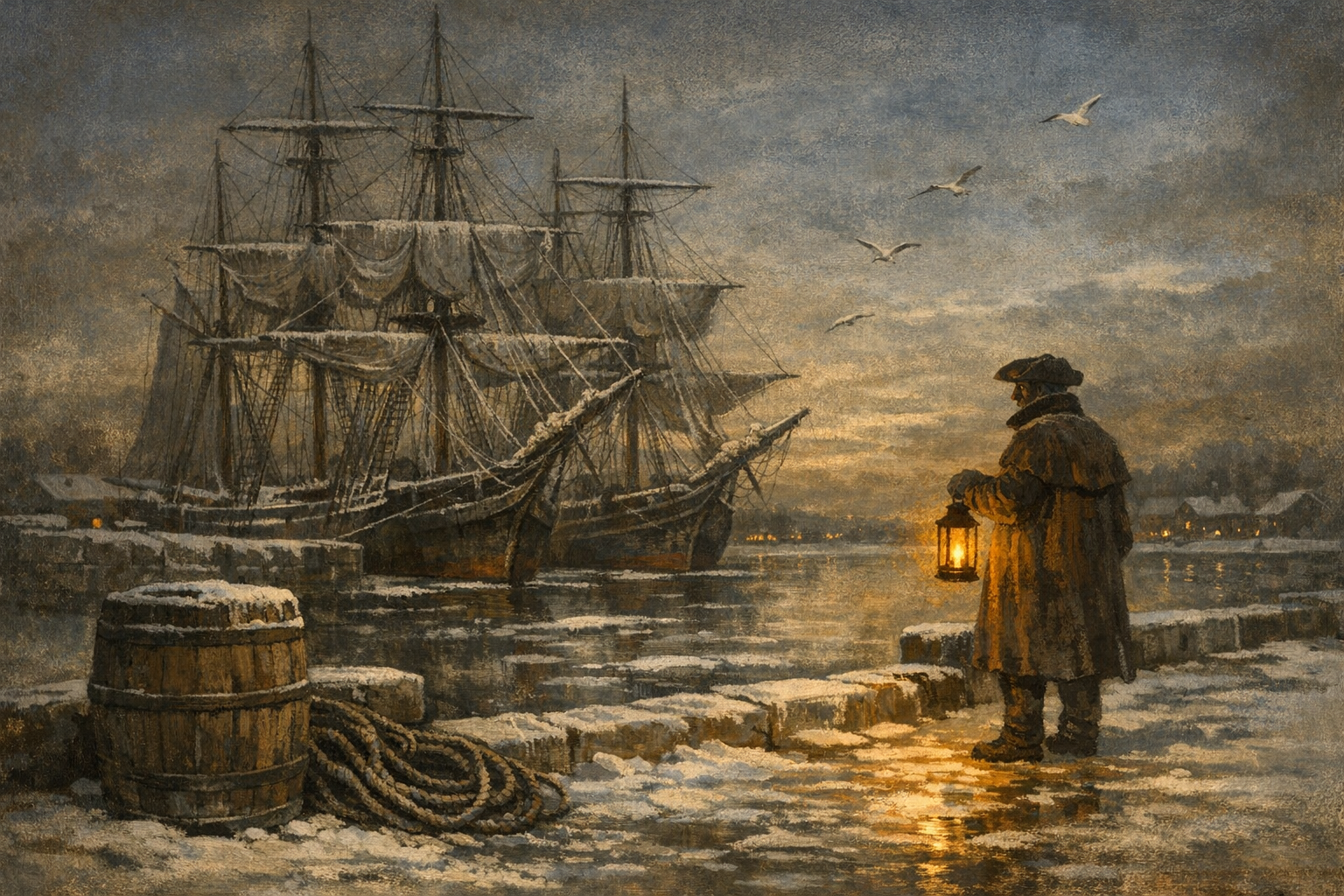
Off the Virginia coast, on the morning of June 22, 1807, an American warship was making for the open ocean when a British frigate cut across her bow.
The Chesapeake had only just left Norfolk. Her decks were still littered with stowed cable; her new crew had not cleared for action; her commander, Commodore James Barron, was carrying baggage, passengers and a Mediterranean posting. The British frigate Leopard pulled alongside and demanded the right to search the American ship for deserters from the Royal Navy. Barron refused. Leopard fired three broadsides into the undefended American hull. Three sailors were killed. Eighteen were wounded, Barron among them. Four men were dragged off in irons. Three of them were, as it turned out, American citizens. Only one, a deserter named Jenkin Ratford, was British-born, and within ten weeks he was hanged from the yardarm at Halifax.
The United States, by any reading of the law of nations, had been attacked. Washington expected war. Thomas Jefferson offered something he thought finer.
He called it peaceable coercion.
The idea was almost beautifully simple. The great powers fought their struggles with cannon. The young republic, with a sizeable merchant marine and no navy worth the name, would fight with commerce. Starve Britain of American cotton and Britain's mills would stop. Starve France of American grain and Napoleon would moderate. The belligerents, squeezed between two absences, would have no choice but to respect neutral shipping. Jefferson wrote to friends, at length, that the experiment might demonstrate to every people everywhere that the gun was obsolete.
On December 22, 1807, a pliant Congress passed the Embargo Act. Every American ship was forbidden to clear for a foreign port. Every harbour in the United States was, for practical purposes, closed.
The theory was elegant. The theory was wrong.
British mills substituted cotton from Brazil and India. Napoleon, who fed his armies out of the countries he invaded, troubled himself little over American wheat and cheerfully ordered the seizure of any American ship that slipped through to a European port, on the theory that if she had evaded Jefferson's embargo she must be a British agent. Both belligerents treated the American gesture with the tolerant contempt that large nations reserve for small ones that mean well.
At home the results were devastating. American exports fell from one hundred and eight million dollars in 1807 to twenty-two million in 1808, a drop of nearly eighty percent. Overall business activity contracted by three quarters. Shipping trade in New York collapsed in a single season. In Boston and Salem, seamen walked the wharves looking for work that was not there. Along the Maine coast, vessels put to sea distressed by weather and drifted, by curious accident, into Halifax. Wags everywhere called the law Ograbme, the word spelled backwards, and cartoonists drew it as a snapping turtle biting the trouser leg of a Yankee merchant.
The worst defiance, predictably, was where the customs officers were farthest away. Along Lake Champlain, Vermont farmers drove wagons of lumber, potash and beef north into Canada as fast as the snow would carry them. When federal collectors tried to stop them, they were shouted down. When the collectors called on the militia, the smugglers organised their own. On April 19, 1808, Jefferson invoked the Insurrection Act, declaring that residents of the Champlain valley were opposing the authority of the United States by combinations too powerful to be suppressed by the ordinary course of judicial proceedings, and ordered out the Vermont and New York militias against their own neighbours. Later that year, a broadside circulated in New England accusing smugglers on the lake of killing two militiamen and a veteran of the Revolution who had been trying to enforce the law.
The president, who had taken office pledging to retire the army, found himself building gunboats to blockade his own harbours and invoking emergency powers against his own farmers. The commercial classes, in his letters of that winter, are obstinate; the states are faithless; the great powers are obtuse. Only the embargo, held firmly enough, could save the republic from the war it was also failing to prevent.
It could not. On March 1, 1809, three days before he left office, Jefferson signed a bill repealing his own law. It was replaced with the Non-Intercourse Act, a narrower measure that forbade trade only with Britain and France. That failed too. Three years later the United States, having tried commerce and found it wanting, went to war with Britain anyway. The British burned the Capitol. The grievances that had produced the war were resolved less by American arms than by the fact that, in 1815, Napoleon lost his own.
The Echo
This week, the United States Navy turned away its thirty-first ship in its blockade of Iranian ports. Iran, for its part, boarded and seized two commercial vessels attempting to leave the Strait of Hormuz and fired at a third. President Trump, extending the ceasefire with Iran indefinitely while keeping the blockade in place, ordered the Navy to destroy any Iranian boats found laying mines in the strait. American and Iranian negotiators were supposed to have met in Pakistan. They did not. Tehran has said it will not return to the table while the blockade holds.
The logic, on both sides, is familiar. Coercion without war. Commercial pressure, correctly applied, will bring the other side to reason. Iran, starved of oil revenue by the blockade of its ports, will yield. The global economy, starved of the crude and gas that pass through Hormuz, will pressure Washington to relent. Each capital is betting on the other's flinch.
Neither has come. Iran closed the strait at the start of March, in the opening week of the war, and Brent crude surged past one hundred and twenty dollars a barrel before a ceasefire was even on the table. European gas prices rose by roughly sixty percent in the same stretch. Japan, which imports ninety-five percent of its crude oil from the Middle East and moves most of it through Hormuz, has begun to look, with its European counterparts, for arrangements that do not depend on either capital's goodwill. Inside Tehran, every faction that has ever argued the republic bargains only under duress has been handed a fresh page of evidence. Inside Washington, every faction that has ever argued the Islamic Republic understands nothing but pressure has been handed the same page.
Jefferson believed that the right kind of economic pressure, correctly applied, could substitute for a fleet: that it could compel an adversary without bloodshed and spare the coercer's own citizens the cost. Two hundred and nineteen years later, the same proposition is being tested in the same narrow water from both directions at once, and both sides are discovering, by degrees, what the merchants of Salem discovered first.
Coercion is rarely peaceable. Most of the time, it is only deferred. The question, on Lake Champlain in 1808 and in the Strait of Hormuz this week, is the one the Vermonters asked their collectors before the shots were fired: who, exactly, pays first?