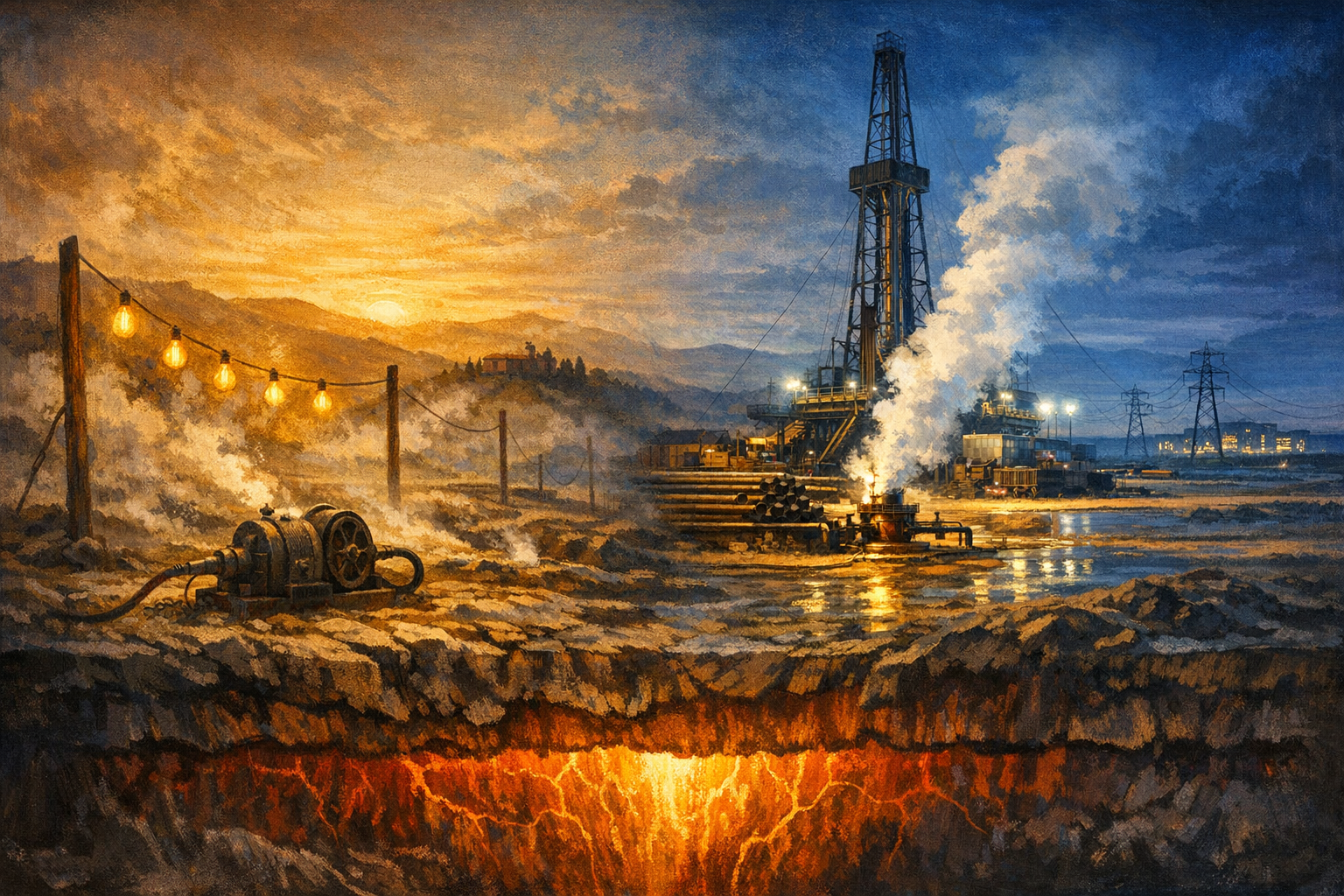
On a July morning in 1904, in a valley in Tuscany where the ground hissed and the air smelled of sulphur, an Italian prince connected a steam pipe to a small dynamo and lit five electric light bulbs.
Nobody came to watch. The prince, Piero Ginori Conti, was the director of a boric acid works at Larderello, a desolate patch of geothermal terrain south of Florence that had been belching steam from the earth for as long as anyone could remember. The locals called the vents soffioni. They had been used to extract boric acid from the mineral-rich steam since the early 1800s, a modest chemical business that kept the estate running and not much more. Ginori Conti looked at the same steam everyone else had been looking at for a century and asked a different question: could it generate electricity?
Five light bulbs said yes.
By 1913, he had built the world's first commercial geothermal power plant at Larderello: a 250-kilowatt station that ran on nothing but the heat of the earth. It worked. It kept working. Larderello is still generating power today, more than a century later, from the same geothermal field.
But Larderello had a problem that would haunt geothermal energy for the next hundred years. It worked because the geology was extraordinary: natural reservoirs of superheated water sitting close to the surface, venting steam through cracks in the rock. You could tap it with a pipe. Most of the planet is not like that. The heat is there, everywhere, miles down, trapped in dry rock with no water and no cracks. For a century, geothermal power remained pinned to a handful of sweet spots: Iceland, New Zealand, Kenya, the Geysers field in northern California. Reliable, clean, and completely unable to scale.
The rest of the world's heat stayed locked in the rock, useless.
In late 2026, a company called Fervo Energy will switch on Cape Station, in the desert of southwestern Utah. It is the world's first large-scale enhanced geothermal system. There is no volcanic sweet spot beneath it. There is no natural steam vent. There is just hot, dry granite, three miles down, at temperatures above 200 degrees Celsius.
What Fervo did was drill horizontally into that granite using techniques borrowed directly from the shale oil and gas industry: the same horizontal drilling, the same hydraulic stimulation, the same directional control that unlocked the American fracking boom. They drilled paired wells, injected cold water down one, let it flow through fractures in the superheated rock, and brought it back up the other as steam. An artificial geothermal loop, manufactured in rock that has no natural permeability, anywhere the earth is hot enough.
The irony is almost too neat. The drilling technology that enabled the fossil fuel revolution may now enable its replacement.
Cape Station will begin at 100 megawatts, enough to power roughly 100,000 homes, with an additional 400 megawatts planned by 2028. Google has both invested in Fervo and signed a power purchase agreement. The US Department of Energy estimates that enhanced geothermal could provide over 120 gigawatts of baseload power in the United States alone, roughly a quarter of current electricity generation, from a resource that produces no carbon, requires no fuel, runs day and night regardless of weather, and exists virtually everywhere on Earth.
The structural parallel to Larderello is almost exact. In 1904, Ginori Conti looked at steam that had been venting uselessly for centuries and saw electricity. In 2026, Fervo looked at hot rock that had been dismissed as inaccessible and saw baseload power for data centres, cities, and grids. Both times, the energy was already there. It had always been there. The question was never whether the heat existed. The question was whether anyone would figure out how to reach it.
Ginori Conti's five light bulbs did not change the world overnight. It took nine years to build a commercial plant, and a century before geothermal contributed meaningfully to any national grid. The lesson of Larderello is not that breakthroughs scale instantly. It is that some breakthroughs sit in plain sight for generations, waiting for someone to take them seriously.
The heat beneath your feet right now is enough to power civilisation for millions of years. The only question is whether Cape Station is the beginning of the drill, or another set of five light bulbs that the world admires and then ignores.
Piero Ginori Conti died in 1939. His valley is still running. The rest of the earth is still waiting.