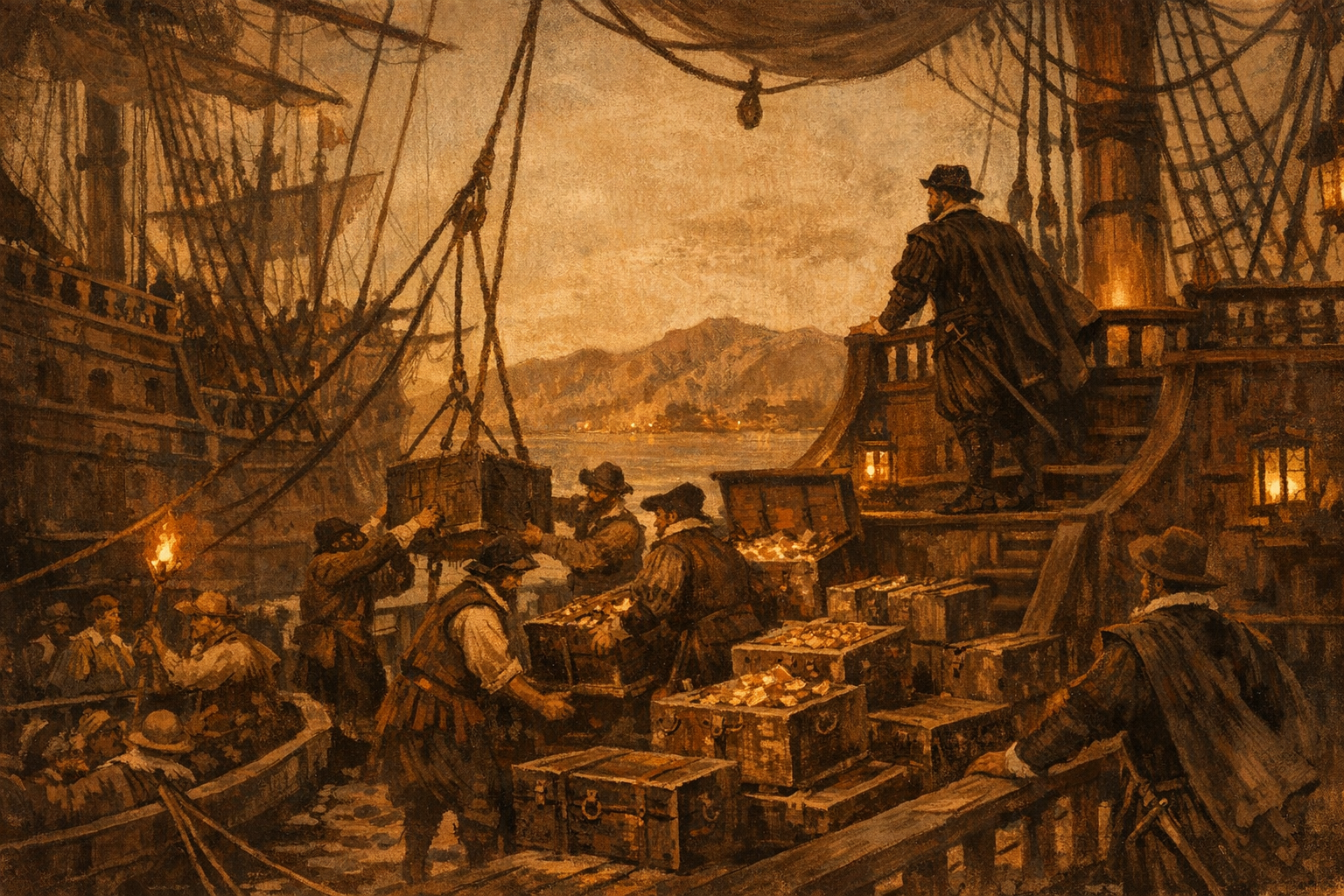
On March 1, 1579, a small English galleon named the Golden Hind intercepted a Spanish treasure ship called the Nuestra Señora de la Concepción off the coast of Ecuador. The Spanish crew did not resist. They had not expected an English warship in the Pacific, because no English warship had ever been in the Pacific.
It took six days to transfer the cargo. Twenty-six tons of silver. Half a ton of gold. Chests of coins, porcelain, and jewellery. The total value exceeded 360,000 pesos, the largest single prize any English vessel had ever captured. The captain of the Golden Hind was Francis Drake. His voyage had been authorised, and secretly financed, by Queen Elizabeth I.
Drake had left England in December 1577 with five ships and 164 men. By the time he reached the Pacific, only the Golden Hind remained. He raided Spanish ports along the coast of South America, looted Catholic churches, and hijacked silver bullion being shipped from the mines of the Andes to the Spanish treasury. The Spanish called him a pirate. Elizabeth called him nothing at all, publicly, because England and Spain were officially at peace.
When Drake returned to England on September 26, 1580, the Golden Hind was so heavy with treasure that it sat low in the water. Elizabeth came aboard to inspect the cargo. The return on investment for the voyage's backers was 4,600 percent: forty-seven pounds for every pound invested. Elizabeth, who was among the investors, took her share.
On April 4, 1581, she knighted Drake aboard the Golden Hind. Philip II of Spain was furious. He demanded the return of the stolen treasure. Elizabeth declined.
The treasure was not simply pocketed. A substantial portion of the profits from Drake's raids, and from the privateering campaigns that followed throughout the 1580s, was reinvested in the English navy: new ships, new dockyards, new armaments. When Philip II sent the Spanish Armada to invade England in 1588, Drake was second-in-command of the fleet that defeated it. The ships that turned back the Armada had been funded, in no small part, by gold that Spain had mined from the Americas and that Drake had taken from Spain.
Philip spent a decade building the Armada to punish England for stealing his gold. The gold England had stolen helped build the fleet that defeated the Armada. The enemy's wealth paid for the enemy's defeat.
Time Rhymes. New story every day. If you want tomorrow's, subscribe.
Yesterday, the European Union unblocked a €90 billion loan to Ukraine.
The loan had been held up for months by Hungary's veto, which was lifted after Viktor Orbán lost the parliamentary election on April 12 and his successor, Péter Magyar, announced that Hungary would no longer block EU funds for Kyiv. The loan provides Ukraine with €45 billion per year in 2026 and 2027, with €28 billion earmarked for military spending and €17 billion for general budget needs.
The mechanism of repayment is where the parallel to Drake becomes precise. Ukraine is not expected to repay the loan from its own resources. The capital comes due only when Russia begins paying war reparations, and the source of those reparations is already identified: approximately €210 billion in Russian central bank assets that have been frozen in European financial institutions since the start of the war.
Russia's own money, parked in European banks before the invasion, is now the collateral for the loans that are funding Ukraine's defence. The EU has not formally confiscated the assets. It has "frozen" them and structured the loan so that the frozen assets are the implied source of repayment. The distinction between freezing and confiscation is, in practice, the same distinction Elizabeth drew between privateering and piracy: a legal framework designed to make the seizure look orderly.
Russia has called the arrangement theft. The EU has called it security for a loan. Drake called himself a privateer. Philip called him a pirate. The vocabulary changes; the economics do not. One side has the other's wealth and is using it to fund the war.
The parallel is not the scale. Drake's 26 tons of silver is a footnote beside €210 billion. The parallel is the mechanism: taking the enemy's resources and converting them into the military capacity to defeat the enemy. Spain's gold built the English navy. Russia's frozen reserves are building Ukraine's defence. In both cases, the enemy paid for the war against itself, and in both cases, the enemy could do nothing about it except protest and prepare a larger fleet.
Philip built the Armada to take his gold back. It did not work. Whether Russia's response to the frozen assets follows the same pattern is the open question. But the precedent is clear: when a great power discovers that its own wealth is funding its opponent's war, the instinct is not to negotiate. It is to escalate. Philip escalated to the Armada. The Armada failed. The gold stayed in England.
The €210 billion is still in Euroclear. The question is what Russia builds to try to get it back.